More Time

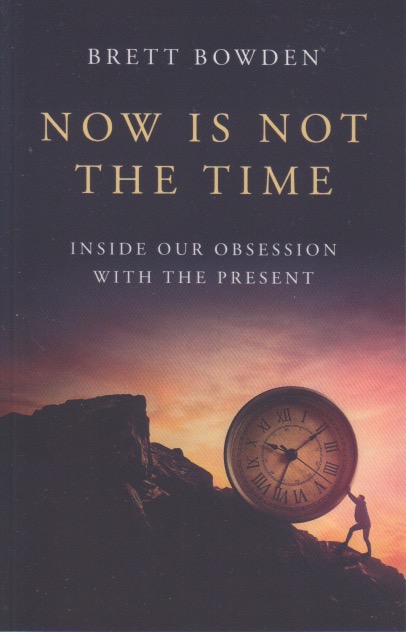
Speaking of time… Time is one of those things that flummoxes me.  A time change, crossing time zones, trying to figure things out on a base-6 system (metric time anyone?).  Confusing.  One thing about time is that we live in it, and so reflecting on it seems a reasonable thing to do.  Brett Bowden does just that in Now Is Not the Time: Inside Our Obsession with the Present.  As an historian, Bowden is experienced at looking back and this brief book is a reflection on why we’re so fixated on now being the most important time ever.  Given recent events, his seems to be a comforting message when looking at the long term of human history, and even longer term of our humble planet’s history.  The present is a blip and the future, at least as far as we know, hasn’t been decided yet.

One of the topics Bowden addresses here is the human propensity to claim and name.  We like to name things and when we do, it implies ownership.  Who but an owner gets to decide on a name?  This leads him to reflect on Eurocentrism, as in the naming of objects, such as Mount Everest, that are very far away and in somebody else’s territory.  We name craters on the moon (which we can’t really just pop over to) and even stars and galaxies.  We’re terribly acquisitive rascals, aren’t we?  We do the same with time—dividing it into eras.  Bowden’s discussion of the Anthropocene debate is quite interesting.  It seems we need a name for the time when people really began changing the planet on a global scale, but geological time ought to hush us up, if we stop and think about it.

As Bowden notes, psychologists and life coaches often encourage us to be in the present.  I think what they mean is that we shouldn’t worry unduly about the future.  That’s good advice.   Something Brett reminded me of is that some cultures, such as those of the Bible writers, view people as moving into the future backward.  It’s like riding on a train facing away from the direction of motion.  We can see the past and we can interpret it.  The future, however, we can’t perceive quite so clearly.  As someone who has studied the history of religions, I tend to agree that looking back is often a source of comfort.  It’s also a source of horror—many bad things have happened, many of them intentionally orchestrated by our species.  But it does serve to ground us in the now.  Even if it’s no more important than what went before or than whatever it may be that will come.

Anthropocene

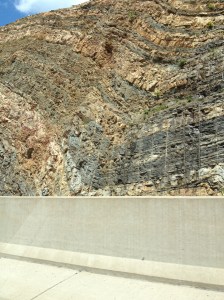
The word “Anthropocene” has been showing up quite a bit lately.  For a period of many years I was an avid, self-taught amateur geologist.  In my dreams I still am, I guess.  My interest in the ages of rocks began when I, like Charles Lyell, began to consider the implications of their extreme longevity.  The Bible, of course, famously intimates we live in a comparatively new neighborhood.  Having grown up believing that literally and firmly, and also having started a modest fossil collection, I failed to see the conflict.  I mean, there were fossils right down there by the river.  Tons of them.  Some Young Earth Creationists had already begun, by that point, to suggest they’d arisen because of Noah’s flood, but dinosaurs still seemed to be a problem.  In many ways rocks broke me out of my fundamentalist stupor.

While at Nashotah House I taught electives on Genesis 1-11.  I read about the geologic ages of the planet and would fall into Devonian dreams of a world entirely different from ours—a world in which there was no Bible for there were no humans to make God in their image.  I knew that we lived in the Quaternary Period of the Holocene Era.  I don’t think the term Anthropocene was in wide use then.  Parsing it is simple enough—it is the “human age.”  The age in which the planet was, has been, and is being altered by human behavior.   There’s no agreed-up start date for the Anthropocene, but it will likely be set in the twentieth century; the twentieth century in our way of counting.  There have been millions of centuries before that.

A couple of weekends back I attended a church program on plastics.  These useful polymers are deeply, deeply integrated into our lives and are promoted by the far too powerful petroleum industry.  The problem with plastics is that they break down and invade the bodies of animals and humans.  And although they do decompose it takes many centuries for them to do so.  Naming the Anthropocene is an effort to get us to see that a human perspective is far too brief to deal with the many issues we raise.  Our practices on this planet will likely not destroy the earth, but they may very well make it uninhabitable by us, or by creatures we like to see.  Life is persistent, and rock lasts for eons.  Even stone’s not eternal, however, and the idea of the Anthropocene is to get us to look at ourselves and realize that our use of this planet, as toxic as it is, is shortsighted.  We will someday be the fossils under a bridge long crumbled to dust for those in the future who know of no such thing as Genesis.  Perhaps we should act like it.