Documenting Horror

Watching documentaries always seems to raise questions.  I recently found A History of Horror with Mark Gatiss on YouTube.  Produced by the BBC in 2010, the set of three episodes is a selective walk through the horror genre through the eyes of an insider in the film industry.  Divided over three segments, he covers early horror (primarily Frankenstein-related movies), British horror, and the American horror revival beginning in the late 1960s.  It occurred to me while watching this that horror is often—but not always—an intellectual genre.  Many of the plots and ideas are sophisticated and puzzling.  At one point Gatiss says it is nearly the perfect genre for movies.  I would tend to agree.  Many of the payoffs of horror are the reasons I go to see a movie.

Of course, documentaries involve interviews.  While discussing religion and horror—the two are closely related—in the third segment, he considers the impact of what I termed the “unholy trinity” in Holy Horror: Rosemary’s Baby, The Exorcist, and The Omen.  His primary interview for this set was with David Seltzer, the screenwriter for the last of these.  At this point my memory took me back to an interview on one of the extras for my DVD edition of The Omen.  In that interview Seltzer mentions that the antichrist is at that moment (clearly this was shot shortly after the movie came out) walking the earth.  In my mind I compartmentalized this to interpret his stance as that of a religious conservative.  The idea of the Antichrist, after all, is post-biblical, at least in the sense that end-time scenarios are developed.

The Gatiss interview was filmed many years later and he asked Seltzer if he believed in the Devil.  “No,” Seltzer laughed, stating that if he did he wouldn’t work on movies like The Omen.  People’s opinions change over time, of course.  And the Devil and the Antichrist are two separate characters as they develop after the Bible was completed.  Still, I had to wonder if his earlier interview included that comment about the Antichrist being alive now wasn’t intended as a bit of spooky propaganda for the movie.  It’s difficult to know what someone really believes.  Most people mouth what their ministers say, not really considering where said clergy get their information.  For these many years I’ve been thinking that The Omen was considered as some kind of documentary by the screenwriter.  Documentaries always seem to raise questions.

Devil of a Time

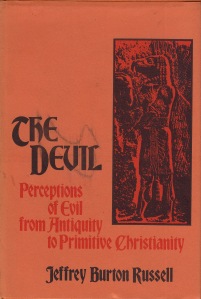
thedevilOne might be excused for thinking so much about the Devil these days. Displays of lies and evil intentions are on pretty obvious display at the highest levels. Indeed, the current political situation has me reassessing my skepticism about the Antichrist. One of the truly well thought out books on the subject is Jeffrey Burton Russell’s classic, The Devil: Perceptions of Evil from Antiquity to Primitive Christianity. The first in a series of books Russell wrote on the topic, The Devil opens with evil. Noting that the Devil defies easy definition, Russell begins rather disturbingly with literary descriptions of acts that can only be described as evil. This allows him to point out that real life events often surpass those that authors can get us to read, intimating that something is seriously wrong with the world.

Having noted that, the emergence of the Devil is not an easy one to trace. Evil has been recognized in many cultures and it has been explained in many ways. Some have personified it, but even that took a long and circuitous route to the dark lord we know today. Bits of Greek philosophy and Zoroastrian cosmology combine with an emerging monotheism among the Israelites and their kin until eventually we have an embodiment of evil appearing. Even so, the Bible has no clear image of who “the Devil” is. This took further developments beyond the New Testament and the image that eventually won out, so to speak, borrowed heavily from classical mythology. Eventually Old Scratch emerges in a recognizable form.

Belief in the Devil still runs high in American culture. I suspect it will run even more so in months to come. At the end of Russell’s well researched study, the Devil comes down to the blatant disregard for the suffering of others. One might think of the mocking of the disabled or the favoring of the wealthy over the poor. Evil may be known by many names but it is easily recognized by those not caught up in its worship. This became clear in the biblical quotations sprinkled throughout the book. “Woe unto them that call evil good, and good evil,” for example. Or “when an ungodly man curses Satan, he curses his own soul.” Mirrors may serve multiple purposes. The vain look into them and see only beauty. Those who believe in the Devil can’t help but know who it is that stares back.


Mark of the Beast

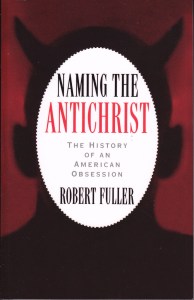
namingantichristI grew up believing in “the Antichrist.” As I came to realize that much of the New Testament pointed to contemporary problems (for them) with the Roman Empire and that what appeared to be predictions were actually safe ways to discuss forbidden topics, I began to worry less. It was about the past, not the future. Recent political events have ratcheted up my anxiety level again—maybe there is such an evil after all. Robert Fuller’s Naming the Antichrist: The History of an American Obsession is an important book in this regard. Although end-time worries have diminished among some now that we’re safely into a new millennium, for the true believer none of that matters. The Antichrist is a great motivator. I hadn’t realized until reading this book just how much of contemporary culture has grown from this fabricated fear.

Let’s get this straight from the beginning. In the Bible there is no figure known as “the Antichrist.” The generalized word antichrist is used only twice and in neither instance is the book in question Revelation. Early Christians speculated that the beast of Revelation might be “the Antichrist” but that identification wasn’t solidified until the beginnings of the Fundamentalist movement in the late 1800s. By the time Fundamentalism was a fully developed system, by about the 1920s, believing in the Antichrist and trying to identify him had become a cottage industry. I grew up in the shadow of Hal Lindsey and the pressing concern that “the Antichrist” was alive in the world today. Face it, The Omen loses something if he isn’t. This strange, non-biblical belief has come to define a large number of true believers.

Fuller’s book is important for the insight he brings into why some “Christians” are avowed enemies of peace, toleration, and the improvement of human conditions. Those who believe their tribe is the only correct one hold the double standard of ethical treatment of those inside and scorn and hatred of those without. This view believes that the world is to be condemned, natural resources used up, wars started, and civil rights suppressed, in the name of Christ. Perhaps you may begin to see why a chill ran down my spine as I was reading this book. We need to try to understand this perverted way of looking at the world in order to understand the forces that would rather see a dictatorial billionaire run the country than an eminently qualified woman. Reason’s got nothing to do with it. It’s all about conviction. Failure to understand that is perhaps the surest way to bring about the end of the world. We ignore religious thought to our own peril.


Omen, O Man!

Omen_ver4

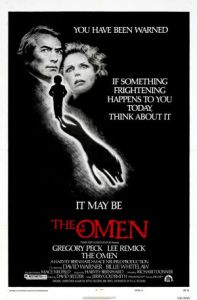
Of the unholy trinity of late-60s to mid-70s horror movies Rosemary’s Baby (1968), The Exorcist (1973) and The Omen (1976), the last always seemed the least effective to me. Having recently read about the Devil in American popular culture, and having a rainy Friday evening alone, I decided to give it a try again. Based as heavily on Hal Lindsey as it is, once one outgrows dispensationalism it is hard to be frightened by the idea of biblical end times. Everything from making up verses in “Revelations” to utterly bogus Holy Land geography (Megiddo is north of Jerusalem, not south—did the writers not even own a map?) contributes to a set of untenable tenets, even among the bibliterati. The film relies mostly on shocks and startles to earn its horror stripes, and after you’ve seen the movie once, these lose their power in subsequent viewings. Nevertheless, on this rainy May night, so close to June 6, I noticed new ways in which the movie undermines its own message.

The premise, of course, is that Damien, the son of the Devil (who apparently has a thing for bestiality), is plotting to take over the world through the means of politics. Having been watching the events of the past few months I have to wonder how the Devil could improve on progress through such channels. But I digress. His step-father Robert Thorn, US ambassador to London, discovers his “son”‘s identity and tries to kill him. With a strong anti-Catholic bias (the Antichrist is born in Rome, the seat of the church, and is protected by Roman clergy) the film nevertheless spawns sympathy for the Devil. As a child, Harvey Stephens hardly appears diabolical. Maybe it’s just because my brothers and I also spilled goldfish from their bowl once, but it seems to me he acts just like most little boys do. Who really wants to go to church at that age? As the movie approaches its climax, he’s represented as the biblical good-guy.

Thorn has to confirm Damien’s satanic identity. Like Delilah, he creeps up on the sleeping boy and cuts his hair. Convinced by a man who introduces himself “I am Bugenhagen” that he has to stab the boy, Thorn in a white car outraces police (so there might be a bit of prophecy here after all) to sacrifice the child on the altar. The movie casts Damien as both Samson and Isaac within a few short minutes. Apart from the film’s use of violence against women’s bodies (Thorn won’t allow an abortion, Kathy seems to have a penchant from falling from high places in slow motion, Baylock gets a fork in the neck) it actually seems ambivalent about the evil of the boy. An unfortunate birthmark does not a devil make. We’ve made it through the change of the millennium and many other hazards, yet dispensationalism is still with us, as is its anticlimactic Antichrist, Damien. He’s less scary than the real politics of an entirely secular age.


Good, Evil, and Normal

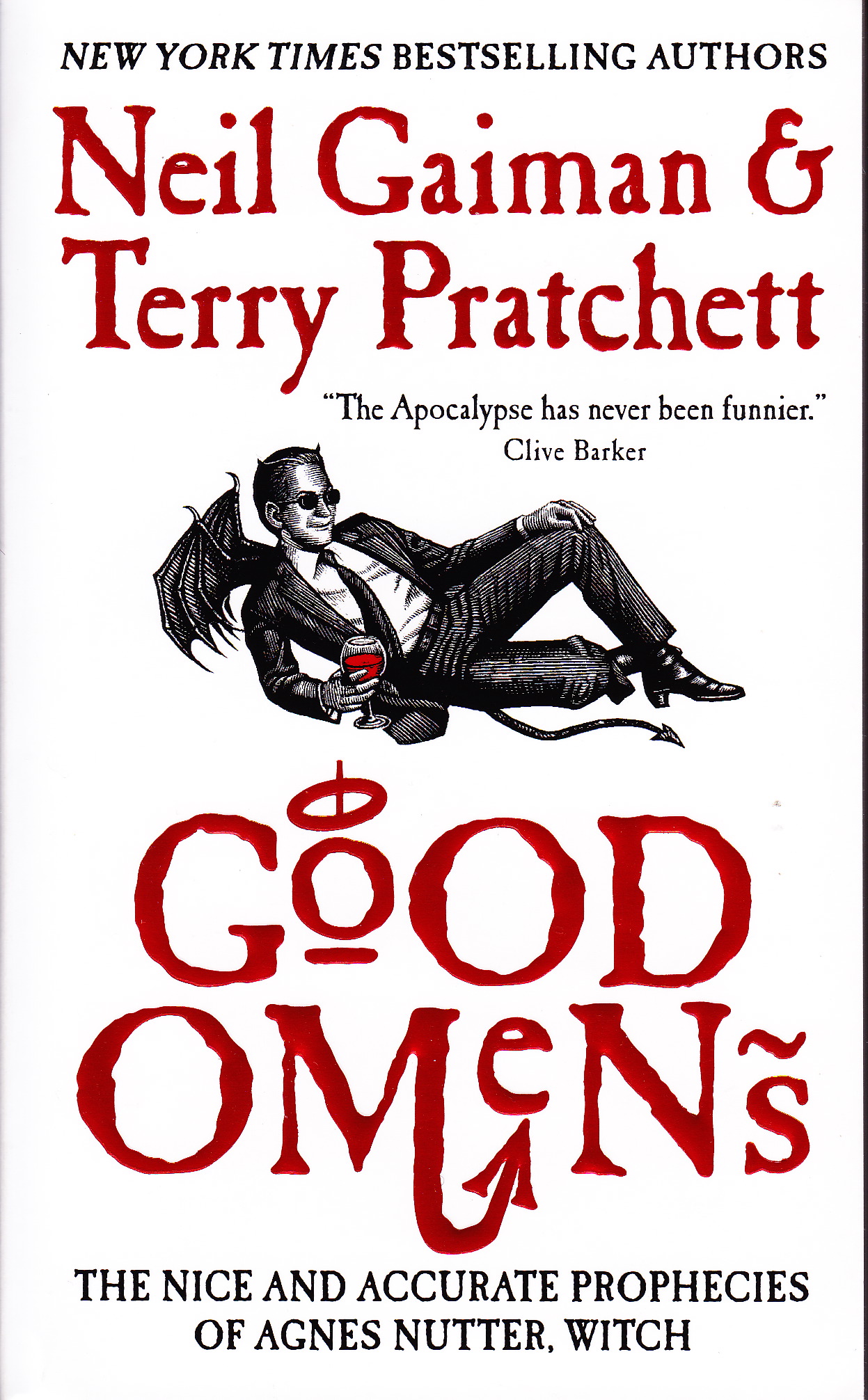
GoodOmensTo date I’ve read a fair number of Neil Gaiman novels. One of my students started me out on American Gods and I pursued his others on my own after that. I was a little unsure about Good Omens, however. I guess I’ve always been dubious about the quality of co-written books. Terry Pratchett, an accomplished novelist in his own right, paired up with Gaiman on this one, and it took the wisdom of another student, albeit recently graduated, to assure me that it was worth the effort. Given that it’s about the apocalypse, or perhaps an apocalypse that doesn’t quite take off, there seemed to be no reason not to give it a try. It is, at the end of the day, a charming book with colorful characters and an Antichrist who gets switched at birth and grows up in a normal household and herein lies the tale.

One of the most common religious themes in novels is the end of the world. The four horsemen of the apocalypse are one of the most striking literary tropes of the first century, if not of all time. The real question about the end of the world, it turns out, is—why can’t it be funny? For those who’ve pondered that, Good Omens is the book for you. It actually does help, however, if you’ve read the Bible. It adds to the cumulative effect. Subtitled The Nice and Accurate Prophecies of Agnes Nutter Witch, the book revolves around the certainty of the written word. Prophecy, however, just as in the book, only achieves verisimilitude in retrospect. The prophets didn’t always get it right, even in the Bible. Human choice often causes a breakdown in divine plans. In Good Omens, you’re pretty sure from the beginning that the world won’t end, but you’re not quite sure how it won’t end. The unfolding of the story eventually addresses how a prophecy can fail.

Free will, those who specialize in theology and philosophy will say, is among the more difficult of phenomena to pin down. Some predestinarians would say it’s all an illusion. We are programmed to do what we do. Ironically, some reductionistic materialists would say the same thing. Each of us, however, trudging through out days of toil and play, feels like we’re making our own decisions. True enough, sometimes circumstances decide for us, but if we were given the choice of good or evil, wouldn’t we approach it the way we approach just about everything else? Along the way, the demon Crowley asks a pointed, poignant question: why would God make people inquisitive and then forbid them some obvious, desirable fruit? Isn’t the conclusion foregone? Any writer today would know the outcome before the first sentence was finished. And so, free will is off and running. I hope that the fact that the world doesn’t end won’t be a spoiler for anyone, because I also hope that others will read Good Omens and learn a great deal about how demons can be good, angels can be naughty, and people will always just be people.


Real World Ethics

Do yourself a favor. Spend five minutes watching this video:

(note: the video has been removed and a “family friendly” version is here: Kai)

Although it has a whiff of the apocryphal about it, I choose to believe that Kai is really who he claims to be. I don’t know what actually happened here, but this is ethics divorced from armchair pundits and congressional committees. Sometimes you see something and know it’s just wrong. Most of us wring our hands and await some authority figure to sort it out. When Kai met someone claiming to be Jesus, he was willing to be “the Antichrist” to save innocent people with no regard for himself. I am very impressed.

No, vigilantism is wrong. In fact, I wouldn’t trust a who coven of Republicans to ever arrive at so parsimonious a solution as Kai. He saw evil, he confronted it. I don’t know the backstory here, but I know that I feel a lot less threatened by the street people I see nearly every day than I do by those hiding away in limousines. Ethics is all about figuring out what is right. Kai has his head on straight here. If he could go back in time to stop “Jesus” reincarnated from harming an innocent bystander, he would. No regrets, no questions.

I have watched, and personally experienced, religious leaders intricately plotting how to ruin the life of their neighbors to maximum effect. I have read about politicians who shamelessly increase their earnings while knowing that some of their constituency live in poverty and persistent hunger. I have seen a president declare a war to fulfill a personal vendetta. And I have seen Kai lifting a hatchet to save a person he didn’t know.

There will certainly be those who would condemn such quick thinking and right action as immoral. For those who object from a Christian outlook I would remind them of Dietrich Bonhoeffer, one of the darlings of the Evangelical world. Bonhoeffer was hanged by the Nazis because he did what he knew to be right. Even though his bomb plot failed to kill Hitler, Bonhoeffer knew what Kai knows—those who sit around and watch evil happen as just as guilty as those who perpetrate it. And that’s like trying to surf when the ocean’s at a dead calm.


Special Babies

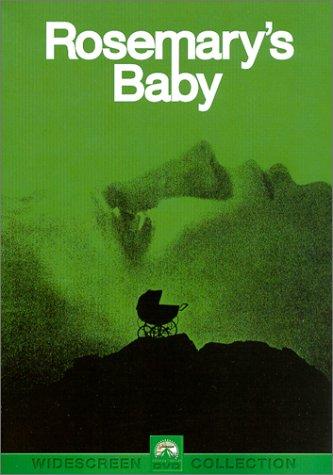
Roman Polanski has been in the news quite a lot lately. While I haven’t been following the story, his name is perennially associated with Rosemary’s Baby in my mind. In my youth I feared this movie and made no attempt to watch it until I reached my 40s. Like other works conceived by Ira Levin it features a threat to what we value most; the original Stepford Wives is still almost too scary to watch. While Rosemary’s Baby remains a good psychological thriller, the counter-Christmas theme became quite evident the last time I viewed it. I won’t worry about spoilers since the movie was released in the 1960s, but if you’re still waiting to watch it and want a surprise ending, you might want to turn to another post at this point!

The 1960s were times not only of a strong counter-culture but also a period of fear. Many popular evangelists were warning of the coming of the Antichrist and the Time article entitled “Is God Dead?” is featured in the movie itself. Although it is unclear until the end, upon first watching, who fathers Rosemary’s baby, the child-spawn of Satan is presented with many of the trappings of the first Christmas as Rosemary herself makes the discovery. In fact, Christmas comes as Rosemary is pregnant, and the film carefully accentuates the contrast between Mary and Rosemary. The suffering of the expectant mother still makes the film difficult to bear at points.

As Christmas nears in this very commercial and recession-ridden season, many lawns are sporting “Keep the Christ is Christmas” type displays. Isaiah is being taken out of context and the Religious Right continues its attempt to make Christmas a political petard. Babies represent new beginnings. And while Rosemary’s baby was born six months after (diametrically opposed to) the celebration of the birth of Jesus, in both cases the infant represents a radical change. Any human parent knows that babies are special and that knowledge demonstrates that a young Roman Polanski recognized a theme that would scare audiences for at least forty years.