Where Would Jesus Park?

The walls of the Old City of Jerusalem may not go back to the time of King David, or even Jesus, but they have become one of the iconic symbols of a legitimate site of world culture. As a young man my first sight of those walls was almost enough to bring me to tears. I had read about Jerusalem since my earliest days after graduating from Dick and Jane, and to see the Holy City firsthand was the experience of a lifetime. Too bad it is some of the most hotly disputed real estate in the known universe. Sacred to the three major monotheistic faiths that seem dead set on destroying this or that portion of it, Jerusalem is unlike any other city on earth.

The problem, as any urbanite knows, is where to park. According to Matt Beynon Rees of the Global Post, Jerusalem’s city planning committee is considering literally undermining the sixteenth-century walls of the Old City to construct a parking lot. Just a few short years after U.S. troops drove heavy military machinery atop Nebuchadrezzar’s Babylon in order to satisfy Bush-family oil lust and personal revenge, once again one of the irreplaceable monuments of the past may come under the contractor’s gaze. I teach at Montclair State part-time, so, believe me, I know about parking headaches! There have been times when I thought I’d have to drive the fifty miles back home without stopping for class since every space on campus was full. Yet I wouldn’t suggest tugging down historic University Hall to make room for more cars.

The problem seems to be that in our disposable culture we’ve lost sight of what can never be replaced. Immediate urge takes precedence over what our ancestors left for us to ponder and marvel over. A great hue and cry went up when Yellowstone burned in 1988, a lament that the former beauty would never be restored in a lifetime. Damage to structures from centuries past may be repaired, but the wonder of their staying power will forever be lost. It cannot grow back like Yellowstone, no matter how long we wait. Yet, parking meters under the Wailing Wall might save locals from having to take a bus. Regardless of theological conviction or absence thereof, some sites are simply sacred to the human story. The human story, however, has become one of convenience. Where else might Jesus park his Holy Esprit without having to walk (not on water) to get to the temple?

Sure, it's a nice view, but where do we leave the car?

Illusions of Permanence

Blogging about the ancient world presents idiosyncratic problems. Quite apart from the fact that few readers show much interest in the shadowy ages of antiquity when new tunes and flicks are available to download just mouse-clicks away, the worldview of ancient people is difficult to comprehend. Most people before the common era probably focused their energies on their crops and beasts, hoping to survive for as long as possible in a subsistence world. I’m sure they would have appreciated an i-pod as they were out plowing or were at home weaving and cooking, but theirs was a solid, practical world where reality could be brutally felt.

Fast-forward to our day. I can’t teach a class of undergraduates without noticing their constant attention to their electronic arsenals forever at hand. Cell-phones, i-pods, laptops, and god-knows what-else making as much buzzing and chirping noise as a meadow in springtime. This constant interruption is what Linda Stone has coined “continuous partial attention.” Kids are raised to juggle many sources of input or stimulation at one time, an activity that befuddles those of us raised when television was black-and-white and telephones were heavy devices solidly settled in one place. The disconnect is palpable.

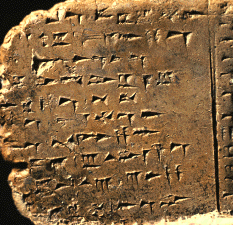
I read in Wired magazine some years back a whimsical analysis of data storage. A chart indicated the most reliable means of keeping data over long periods. Electronic media suffers from rapidly increasing technology (does anyone have a 5-and-a-quarter inch floppy drive I can borrow?) as well as the transience of the media itself (electrons marching in order). On the top of Wired’s chart for durability was the humble clay tablet with a period of about 5000 years. I chuckled at the chart, but deep in my psyche I know that a major power-outage, or a catastrophically failing server could plunge my electronic compositions and data into oblivion. We have so much information out there, but what happens if it flies away in the tale of an errant comet? My suggestion to the younger generation is to learn cuneiform. It may take a few years, but as a storage solution it is rock-solid.

The original hard copy


Rock of Ageism

Hanging on my refrigerator door is a quote attributed to Siddhartha Gautama (the Buddha): “Do not put your faith in traditions only because they have been honored my many generations.” Not being a Buddhist scholar, I am not sure if the words originated with Siddhartha Gautama or not. Whatever their origin, however, these words are worth serious consideration. Do we believe what we do simply because of its age? Are older ideas more difficult to dismiss than more recent ones?

During a recent conversation I was interested to hear a member of the clergy say, “We need to move away from thinking of new religions as cults.” That was like a slap from the Buddha — the proverbial sound of one hand slapping. Do members of an ancient religion feel a kind of entitlement to the status earned with the inexorable passing of time? The idea goes back at least to the Romans. Wanting to stop the endless splintering of religions into new sects and potentially divisive rivals, they tended only to allow outside religions within their empire if they could demonstrate a remote antiquity (Judaism was the textbook example). Age of religion constitutes a kind of seniority; who hasn’t had a run-in with a Roman Catholic who believes their form of Christianity trumps all others on the basis of a supposed apostolic antiquity? If it has survived that long, there must be something to it — right?

I wonder if such a criterion is sound for systems of belief. We readily accept change in perspective in most other aspects of our lives. Religion is where many people draw the line. One of the funny scenes in Religulous is where the imam, in traditional garb, receives a text message on his cell phone in the middle of his interview with Bill Maher. The problem with allowing change in most aspects of life and thinking, but not one fundamental area, should become immediately apparent. Unless religion can be severely circumscribed and kept apart from all other facets of life, it has to fit into an entire system of thought. If one region of thought stops at the Neolithic, Chalcolithic, Bronze, or Iron Age without being reinforced by the other areas of human thought and experience that have transpired since then, can the system survive? I’m not suggesting that religions should be rejected because of age, but that they should be allowed to grow up. If that were to happen I would happily remove the Buddhist quote from my refrigerator door.

Words of wisdom

Words of wisdom