Dreaming Reality

It was like that dream—you know, the one where you find a penny on the sidewalk, stoop down to pick it up, and discover that there are hundreds more of them. Maybe that’s the kind of thing those born in humble circumstances dream of, but we all recognize the draw of a windfall. People are pretty tight with their money in Manhattan, but it was early in the morning, still dark, and rainy when I saw it. A hundred dollar bill on the ground. Then I noticed more—a while bunch of them. When I reached down to pick one up, it came apart in my hand. Of course, it was a novelty replica of an actual piece of currency. When I walk through the garment district I often find great swatches of scrap cloth that have spilled out of designers’ trash bags. I’m tempted, I’ll confess, to pick them up and save them for future use. Nevertheless, this hundred dollar bill wasn’t what it appeared to be. Many things aren’t.
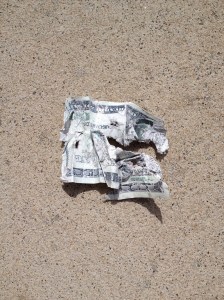
Religions around the world are predicated on the fact that what seems to be real isn’t. Even long before The Matrix came along. The idea that what occurs in our heads—or to use more conventional religious language, our hearts or souls—is truly real automatically takes us a step away from material reality. It’s not to say that this soggy, pulpy piece of paper in my hand has no existence, but it simply isn’t what it pretends to be. On mornings when the fates are all synched just so, I’ll look out the window of the bus from the helix and see Manhattan laid out in front of me like a picture postcard. “It’s not real,” I whisper to myself. Unlike the tourist in awe during a first visit to the city, I actually mean it. This concrete, glass, and steel world is not real. I’d feel a bit exposed suggesting such a thing on this blog had I not the biggest names in world religions behind me. One thing that they all seem to agree upon is that reality isn’t just what we experience in this corporeal vehicle that we currently call home.

Religion has been called the opium of the people. Marx wasn’t the first to suggest that the more needy among us were the driving force behind belief. Nevertheless, belief is present in all forms of thinking from extreme rationalism to naive acceptance of what your parents told you. The thing about religion is that it conscientiously advocates belief. It admits up front that it holds certain things to be true. One of those beliefs happens to be that things are not what they appear to be. Here in Manhattan we’re all so busy rushing around that who has the time to stop and think like that? I frequently walk past Holy Innocents church on my way to work. I may function, in this world, as an editor of biblical studies, but as I pass that edifice to a faith to which I don’t even belong, I feel the draw. Inside those doors—and I know this is true because I can sometimes hear the bells—a different reality awaits. Out here there may be hundreds of dollars scattered on the ground. When you look closer, however, you discover that they’re not what they appear to be.
Cave In

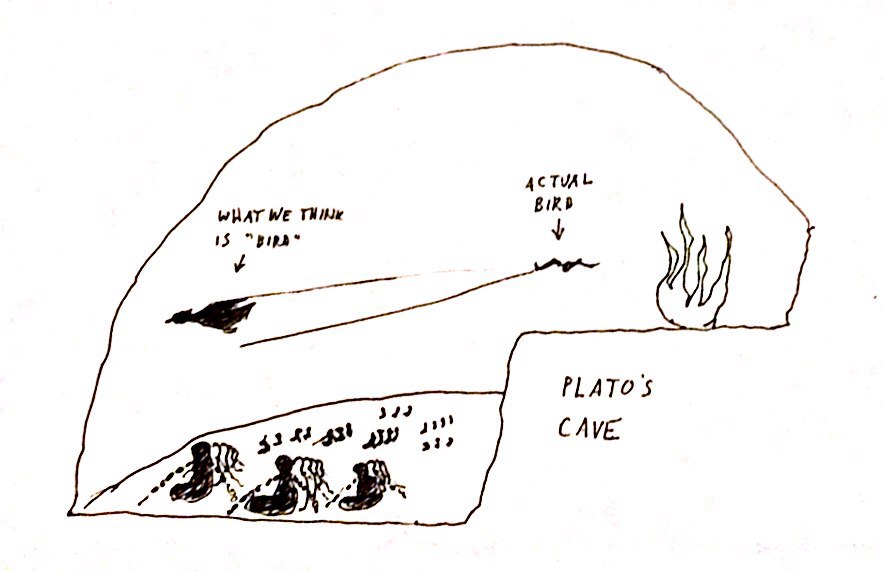
The conversation began, as conversations often do, with Plato’s allegory of the cave. The nature of reality was the topic of a chat I had with a very intelligent undergrad the other day. Plato believed in a realm of ideal forms. What we experience in life is not the actual forms themselves, but a reflection of them sufficient to alert us to what it is we encounter. Humans are sitting, as it were, in a cave. We are chained so that we face the inside wall of the cave and can’t look around. Behind us there is a fire and the ideal forms pass between the fire and people, throwing their shadows on the wall. Not having ever been outside the cave, we suppose the shadows are reality. We are, however, deceived. This led, naturally enough, to a discussion of Aristotle’s counter-argument that the “essence,” or entelechy, of things is something inherently within it. No need for an alternate realm of reality. And so, I asked, what is reality? What is truth?

PlatosCave

My young interlocutor said that reality is what we perceive. It is different for every person, and therefore there are a multitude of realities. Truth is simply the term we apply to our experience of reality. I began to feel as old as Plato. When I was young I believed, not exactly in a realm of ideal forms, but in a universe that contained abstracts. Abstract concepts objectively existed, and in a kind of neo-Platonism, we recognized them when we encountered them. Love, for instance. We may not be able to define it precisely (although materialists claim it is just a pretense to get sex), but we sure know it when we feel it. Or consciousness. What is it? No one reading this doubts, however, that it exists. And truth. I had always assumed that there was Truth with a capital T, objectively floating around out there. Perhaps, if the undergrad is right, there are multiple truths around. We chose the one that fits our experience of reality. Q.E.D.

C.Q.D.! C.Q.D.! Worldviews are in the process of changing. I tend to think the internet has democratized truth. Religions have tended to play their trump card—revelation—at this point. The unambiguous input from the divine should end all questions. But it only requires a moment’s reflection to realize that there are multiple religions and multiple revelations. Which one are we to believe? Some scientists claim there is no need for philosophy, religion, or the humanities. Objective facts, however, are interpreted subjectively. To privilege one reality above others is a kind of intellectual fascism. Perhaps my reality is different. We all sit in the same cave watching the same shadows play in front of us. We then decide what is real. Perhaps we need to get outside for a breath of fresh air. Even Plato knew, however, that that is against the rules.


How Flat is Your World?

I talk so much about lenses in class that some of my students must think I’m a closet optometrist. The lenses I refer to, however, are those that we all wear as part of our culture. We can’t help it – being born into a worldview is part of the human experience. From my youngest days I recall learning that the earth is twirling around at a dizzying rate and we are hurtling through space around the sun so fast that my thoughts can’t even keep up. These are lenses. Then we turn to the Bible (or other ancient texts for that matter) and read about the creation of their world. To understand their worldview we need to take our lenses off.

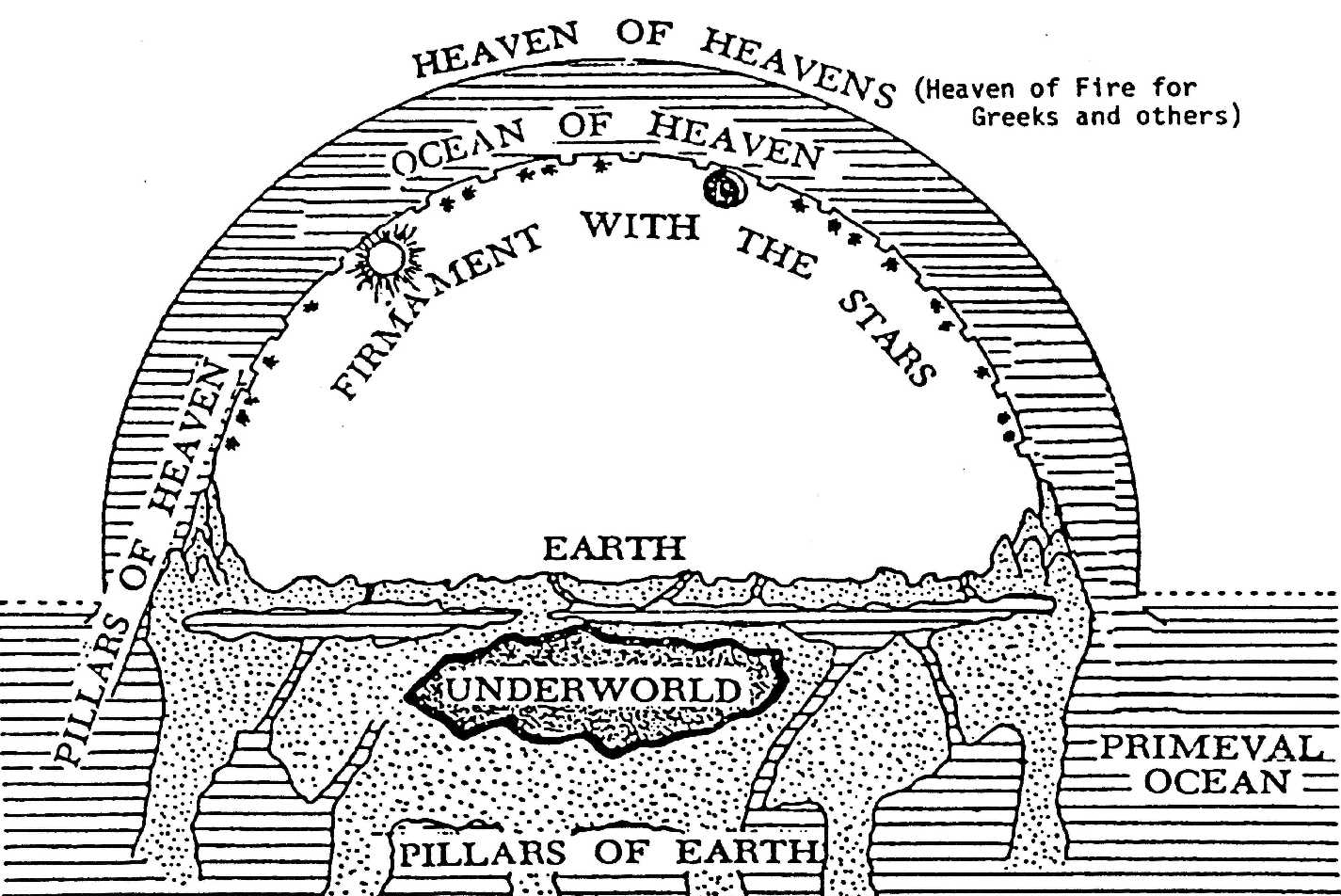
Last night I could see the understanding dawning on some faces in the classroom as I described ancient Israel’s worldview. They were flat-earthers, each and every one. The world that is described in Genesis 1 is flat with an invisible dome over it, a dome that holds back the cosmic waters and provides a living space for the sun, moon, and stars. The flat earth is upheld by pillars that erupt through the surface in the form of mountains, and there is water around all. Genesis 1 does not describe the creation of water; it is already there. You can tell there is water above the dome because it falls on us whenever it rains. Oh yes, and dead people are in Sheol, somewhere under our feet. This is the world that God creates in six days. It is not our world. It was their world.

One possible rendition of an extinct worldview

It is not that the physical world has changed, but perceptions of it have. When I stand outside (this was especially noticeable when I lived in central Illinois), I see the world is flat. I feel no motion – I get sick as a dog swinging my head around too fast, so I would know! The difference is that I understand apparent reality is not the same as physical reality. The writers of Genesis 1 did not anticipate our world, nor did they describe how it came to be. They described the world they knew, a world that does not actually exist. Fundamentalists today claim that the Bible is factual in its description of the creation, and that may be the case. But only if you take your lenses off and admit that the world God created is flat and is covered by a dome. And by the way, it looks like the windows of the sky were left open because it is beginning to snow again.