Standard Maintenance

Something disturbing happened the other day.  My laptop started requiring constant plugging in.  I figured the battery was starting to go—it is several years old now.  Since time is the ultimate commodity in short supply, I made a weekend appointment with a genius at the local Apple store, which really isn’t that local.  I drove out on a rainy Saturday afternoon to get the battery replaced.  That’s not the disturbing part.  Neither is the fact that so many people were flocking around in an Apple store without wearing masks (although that does count as disturbing in it’s own right).  As I sat there watching the giant projection of devices I should consider buying, my daughter mentioned to me how like a dystopia it was: being subjected to advertising aimed at purchasing something you’re in to have repaired.  That wasn’t really the disturbing part, either.

No, what was disturbing occurred when our genius told me I would need to leave my laptop there for three-to-five days for it to be repaired.  I use my laptop daily and extensively each day.  I have no spare and I post daily on this blog.  (Those times when a post doesn’t appear it’s because I think I’ve hit the “publish” button but I haven’t.  That happened to me again recently and I only discovered days later that WordPress was listing it as a draft.  Sure enough, I’d gotten so busy I’d not click “publish”—which happens, ironically, mostly on weekends.)  I was hit with panic.  Could I live for three days, up to a week, without my laptop?  No email.  No blog.  No ubiquitous Zoom meetings outside of work?
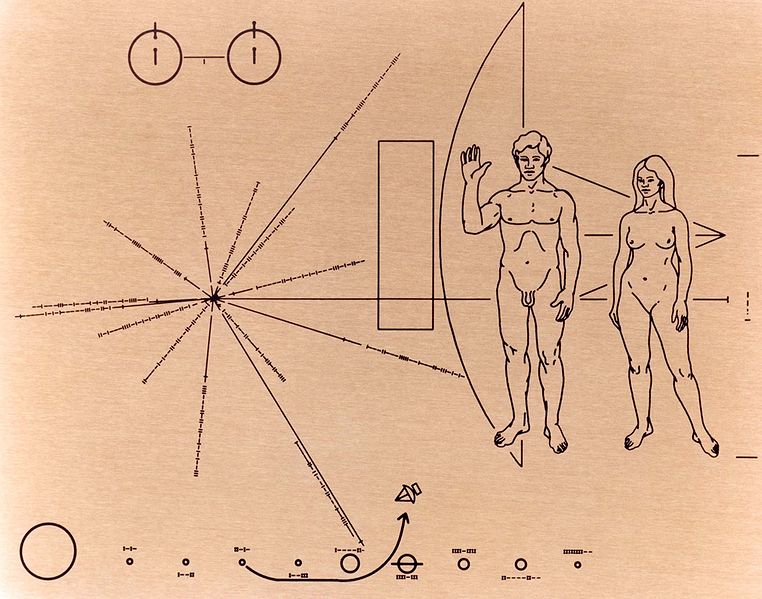
Even before the pandemic the internet had become my lifeline to the larger world.  And the thing is I’m sending my thoughts out like a Pioneer probe to that outer space of the web, not sure if anyone will intersect with it and understand the gold-plated plaque within.  At least I hope it’s gold-plated.  I’ve been blogging here since 2009, at least one laptop ago (or perhaps two).  I’ve posted over 4,500 times.  What would happen if the earth went through the tail of a comet and wiped out all this electronic data?  Would there be anything left at all?  That’s the part I found disturbing.  My ambivalence about technology doesn’t mean I’m not addicted to it.  I was spared an immediate crisis since the genius at the bar told me the battery (being such an old model) was out of stock and would take a few days to arrive.  Meanwhile I could continue to live in my virtual world as normal.


Eureka?

It’s weird to feel yourself becoming a curmudgeon.  Especially when it’s about technology.  Someone asked me the other day if I could send an audio file of something I’d recorded.  I stopped doing podcasts because I lost track of the server that had been hosting the files.  My “inbox was full” or some such nonsense—they’re just electrons, folks.  I’m already paying for the space to host this blog and one thing I know about audio files is they take up lots of space.  My laptop reminds me of that every time it wants to update.  Well, I recorded the requested audio file and wanted to send it along.  I couldn’t find it.  Now, I’m one of those people who started using Apple computers because they were intuitive.  You could easily guess, or reason out, where things were.  It’s not that way anymore.

I had to do a web search (use Ecosia!  They plant trees for your searches!) for where Macs store your audio recordings so that I could send it.  Buried deeply in a directory that has a nondescript name that you’d never possibly guess (it’s as if someone were to assign you Concluding Unscientific Postscript during a game of book-title charades), the helpful site said, you’ll find it.  It’s in your “Library.”  Well sir, Mac had decided that you no longer needed to navigate your way to your Library and that directory was hidden.  Another Ecosia search—more trees—and I learned that you could do a special preference tweaking (it only took four or five steps) so that your computer would display your own Library and you could find your renamed file that you’d created.

Back in the day (here’s the curmudgeon part) when you had to swap discs—floppies—and the computer had the memory capacity of a Republican senator, you knew which disc had your files.  To access them, you simply inserted the disc.  Later they were stored on the hard drive itself and the directory told you right where you’d find them.  Now who knows where your created content is stored—out there on a cloud somewhere, I hear.  That doesn’t help when a friend asks you to send a file.  I had no idea where it even was.  It’s job security for the tech sector, to be sure.  At least it helped me to plant some trees along the way.  Back in the day we used to say you can lose sight of the forest for the trees.  It works, it seems, the other way around as well.


Time Slip

Perhaps you’ve noticed it too, or perhaps it’s just something those of us in the strange world between Mac and PC see.  A couple of months ago I noticed something strange: the time clock on my work computer (PC) differed from that on the various Mac devices scattered about the house.  The difference was about a minute, possibly a bit less than that.  PC, symbolically, was running behind Mac time.  Now, I have no idea where either platform gets its data regarding what time it is.  I do know that I never have to set clocks anymore, and that the traditional clocks in the house all have trouble keeping up with electronic time.  Still, it is odd that time signatures that had, for many years been the same are now off by a number of seconds.

Time is a mystery.  We know it’s passing and many of us looked up suddenly a few days ago and said “How did it get to be August?”  A summer without vacations, without the usual markers, has silently and sickly slipped by.  We’re all waiting for something undefined, and time has begun to slip.  The phrase always makes me think of “The Time Warp,” and that may be more appropriate than I realize.  We live by the clock.  My jeremiad—surely not mine alone—is that I never have enough time.  The pandemic and its endless Zoom meetings have taken much of what had been a quiet, if time-stressed, life and made it a very busy time-starved life.  Meanwhile HR measures your loyalty by the hour and minute and many of us therefore overcompensate.  “Time,” Morpheus says, “is always against us.”

So you can see why I’m concerned about that missing minute.  There’s a question as to who owns it, but still, it’s another busy moment to slip into a life with barely enough time as it is.  If I perchance glance at my phone during work hours I notice the discrepancy.  Can we not agree about what time it is?  Businesses, of course, like the more conservative PC image.  Many creative types prefer the freedom and ease of use of Macs, particularly those of us who learned the computer world on one.  And since conservatives drive with a foot on the brakes it does make me wonder if they’re slowing down time or Apple is speeding it up.  The end result is the same—we don’t know what time it is anymore.  A deeply divided society can’t even agree on that, it seems.


Up the Downgrade

My computer’s been telling me that it wants to upgrade.  In fact, when I first bought this laptop several years ago, and started it up the first time right out of the box, a message popped up that a system update was available.  The tech business, you see, never really sells you a computer.  They’re working on it constantly, often at the same time I’m trying to use it.  In any case, the reason I haven’t upgraded has been that I need to clear off space on my hard drive.  Each upgrade requires more and more of the limited space I have, so my work has to be shoved off onto external drives that I stack like bricks in my attic.  And that takes time.

This wasn’t a problem with my pre-internet computers.  You bought them to do PowerPoint for work and word processing for publications.  Said publications were printed out and sent via mail to publishers.  Just typing that makes me feel old.  The fact was, however, you could get by on those computers without any upgrades at all.  The system that came with it was sufficient for the life of the machine.  Once you get connected to the internet, though, you have to keep up.  I often run into websites on my work laptop, which doesn’t have the latest system, that simply don’t work.  If they’re going to upgrade, I have to upgrade, and to upgrade I have to discard stuff I want to keep.  Every day I get the red warning signal—computer is hungry but can’t be fed until I start throwing my hard work away.  Or at least putting it where it will take extra effort to get it back.

Also, how are you supposed to find the time for upgrades when you use your computer constantly?  A typical download and install takes over an hour.  If we’re so wired, when are we possibly going to find the time for that?  And I still haven’t cleared enough space on my hard drive.  My external drive’s getting too full.  I guess it’s impossible to keep everyone happy.  In the midst of all this I squeeze in some time to use my laptop for that which I actually bought it—to do my research and writing and, during the pandemic, to buy the necessities of life.  And if I don’t upgrade Zoom’s going to stop working because it’s upgrading too.  I need to buy a computer that does nothing but upgrade itself.  That might be the solution.  That, or going back to good old-fashioned pen and paper.