
You can never find a Canaanite when you need one. This has been the bane of scholars of the Ancient Near East for many years. While teaching my class on Ancient Near Eastern Religions the question frequently arises: who are the Canaanites? Problem is, nobody really knows.
The Canaanites have prominence in the ancient world due to the Bible. The people already occupying the land that would one day become Israel are called Canaanites. They appear to have been culturally contiguous with Aramaeans in what is now Syria, the Phoenicians in what is now Lebanon, and even with the Israelites. While there are references to the Canaanites in antiquity, we have yet to discover a people who call themselves Canaanites (unless the Phoenician inscription from Brazil is legitimate!). Canaanite, at this point in time, is only attested as a name used for somebody else. “They are Canaanites,” not “we are Canaanites.”
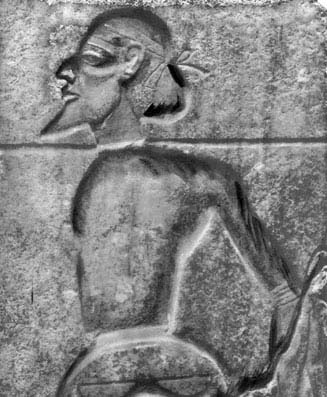
An Egyptian version of a Canaanite
In this we have a useful paradigm. Today religions continue the “us versus them” mentality. In the Hebrew Bible it is often open season on Canaanites since they worship other gods. Today this fear and distrust continues with members of some religions declaring war on those in other traditions. Sometimes it is even within a single religion: Catholic versus Protestant, Baptist versus Catholic, or everyone versus Unitarians.
Religion is, however, always taken on faith. No technique exists to determine, empirically, which is the “true religion” or whether they are all paths up the same mountain. Religions are not fact, they are belief. And religions evolve. It would be the greatest evolutionary leap forward for religions to accept each other, to do away with the ersatz Canaanites. Not that Canaanites should be decimated or eradicated, but they should be accepted for who they are. Who are the Canaanites? They are anyone who practices a religion different from your own.
 Steve A. Wiggins