No Noah

Noah2014Poster

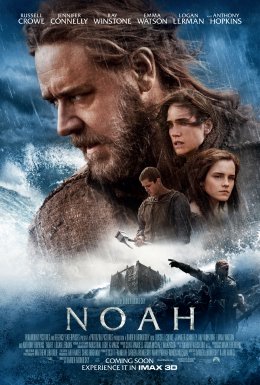
I haven’t seen Noah yet; the timing didn’t work out this past weekend. Besides, you don’t always get to see what you want. Nevertheless, the critics are already having a go at it, and the movie is gathering such attention because it is of biblical proportions. Or more properly, of biblical origins. One commentary in The Guardian suggests that, since knowledge hasn’t moved since Aristotle, that gods really have no place in movies. I have to wonder about that. Sure, the wealthy and powerful seldom have a need for gods, being the captains of their own destinies. Until it comes time to face the flood that all mortals face, and even the rich have to acknowledge that no ark is big enough to take it with them. Who wouldn’t want to have a little divine intervention then? Indeed, God strikes me as the almost perfect antagonist. Before you begin to hurl your stones this direction, think of the book of Job, underrepresented at the box office, but about as honest as they come. We, like Noah, are not in control of this vessel.

To quote Tom Shone, in his review, “[God] has no desire, no needs, no social life, no private life, no self-exploratory intellectual life to speak of.” Of course, the biblical view is quite different. God in the Hebrew Bible is not omnipotent. In fact, he (and he is generally male) comes across as quite lonely. He has anger issues, to be sure, but he is a troubled character rather like a Disney Hercules who doesn’t know how to control his power. Add him to the mix with willful, self-satisfied human beings and it sounds like an afternoon at the movies to me. Perhaps film makers don’t present God with weaknesses—that would be the worst of heresies—but it is also perhaps the most biblical of heresies.

Going back to Aristotle, perhaps it is not that gods should be left out of drama, but that human ideas of God are what writers call a Mary Sue. A Mary Sue is a perfect character with no flaws, the kind of person we first learn to write, since we believe people—and gods—are only good or evil. Then we begin to discover shades of gray. More than just fifty. Characters are complex and experience conflicting wants and wishes. Thus, as Shone notes, God wants people to procreate, but then wants to destroy them. Afterwards he is upset at what he has done. What could be more human than that? The perfect god who knows no struggles, and who never has to fight for what he wants, would be a boring deity indeed. That’s not the divinity skulking around Genesis, however. I’ll have to reserve judgment on Noah’s god until I get to the theater. It seems to me, at this point, that a wee touch of evil makes for deities that are closer to those we experience in our own workaday lives.
Cave In

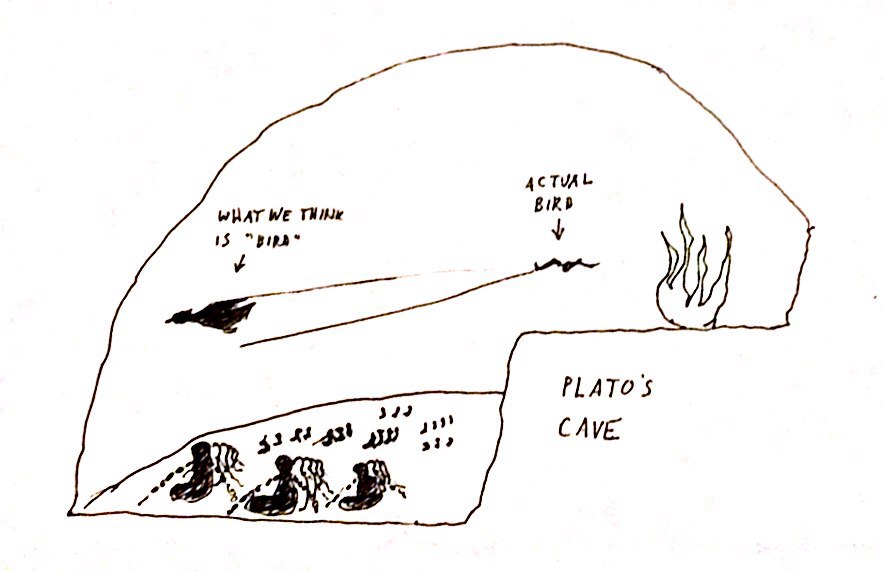
The conversation began, as conversations often do, with Plato’s allegory of the cave. The nature of reality was the topic of a chat I had with a very intelligent undergrad the other day. Plato believed in a realm of ideal forms. What we experience in life is not the actual forms themselves, but a reflection of them sufficient to alert us to what it is we encounter. Humans are sitting, as it were, in a cave. We are chained so that we face the inside wall of the cave and can’t look around. Behind us there is a fire and the ideal forms pass between the fire and people, throwing their shadows on the wall. Not having ever been outside the cave, we suppose the shadows are reality. We are, however, deceived. This led, naturally enough, to a discussion of Aristotle’s counter-argument that the “essence,” or entelechy, of things is something inherently within it. No need for an alternate realm of reality. And so, I asked, what is reality? What is truth?

PlatosCave

My young interlocutor said that reality is what we perceive. It is different for every person, and therefore there are a multitude of realities. Truth is simply the term we apply to our experience of reality. I began to feel as old as Plato. When I was young I believed, not exactly in a realm of ideal forms, but in a universe that contained abstracts. Abstract concepts objectively existed, and in a kind of neo-Platonism, we recognized them when we encountered them. Love, for instance. We may not be able to define it precisely (although materialists claim it is just a pretense to get sex), but we sure know it when we feel it. Or consciousness. What is it? No one reading this doubts, however, that it exists. And truth. I had always assumed that there was Truth with a capital T, objectively floating around out there. Perhaps, if the undergrad is right, there are multiple truths around. We chose the one that fits our experience of reality. Q.E.D.

C.Q.D.! C.Q.D.! Worldviews are in the process of changing. I tend to think the internet has democratized truth. Religions have tended to play their trump card—revelation—at this point. The unambiguous input from the divine should end all questions. But it only requires a moment’s reflection to realize that there are multiple religions and multiple revelations. Which one are we to believe? Some scientists claim there is no need for philosophy, religion, or the humanities. Objective facts, however, are interpreted subjectively. To privilege one reality above others is a kind of intellectual fascism. Perhaps my reality is different. We all sit in the same cave watching the same shadows play in front of us. We then decide what is real. Perhaps we need to get outside for a breath of fresh air. Even Plato knew, however, that that is against the rules.


Capricorn Too

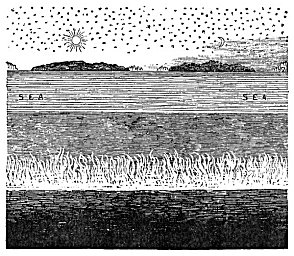
While seeking the official Flat Earth Society website (don’t ask) I became aware of the fact that several such societies exist. Frequently used as a slur against Luddites and troglodytes alike, the Flat Earth Society would best be classified as a modern religion based on ancient paradigms. This is clear when considering the motivation of Samuel Birley Rowbotham, the erstwhile founder of the movement and author of Zetetic Astronomy. Rowbotham also published a broadside entitled “The Inconsistency of Modern Astronomy and its Opposition to the Scriptures!!” (c. 1850, exclamation points in the original). Those who still doubt the religious nature of the movement should consider that the full-text of Zetetic Astronomy is available on Sacred-Texts.com. The objection to non-geocentric astronomy, although now based on several factors, is religious in origin.

The clashing of worldviews is inevitable when empirical evidence comes into play. As early as the days of Pythagoras and Aristotle thinkers were questioning how physical reality fared against apparent reality. As animals who evolved to cope with apparent reality, the fact that the earth bolts around the sun at a dizzying speed is of little practical value to humans. Making that successful hunt, however, depends on the beneficence of the gods—incredibly important. In such scenarios religion wins out against science every time. The truth of actual existence is more fascinating but indescribably less rich than a mythological worldview. Instead of Dagan, Baal, Zeus, or Thor, we have static electricity. Sure, lightning still behaves in unpredictable ways, but there’s not a god out their hurling it towards sinners. Abstruse laws of fluid dynamics and the flow of electrons determine what is actually happening. Yet we flock to theaters to watch Thor.

While most educated religious believers seldom put too much credibility toward the biblical worldview, they often sense relief at having “flat earthers” to ridicule. Ironically, the stated goal of websites such as Sacred-Texts.com is to promote religious tolerance. For most modern believers, already under the gun of science, tolerance is understood to extend to religions like ours. Those that are outside: modern paganism, flat earth beliefs, ufo religions—such belief-structures deserve ridicule. Is such a mentality not indicative of a certain level of discomfort with “mainstream religions” as well? No matter how far Hubble peers, even to the ends of the universe, it spies no God. No matter how deeply geologists sound, no Hell is beneath our feet. We cannot easily let go of such concepts, no matter how pre-Enlightenment they may be. It may be a good exercise for modern-day people to occasionally read Zetetic Astronomy to remind ourselves that religion comes in all shapes and sizes.