Red Dress

Horror sometimes takes a creative turn.  In Fabric is an art film as well as a horror offering.  The basic premise is that a certain red dress, sold at a bizarre fashion store, causes the death of those who wear it.  Sheila, recently divorced and having trouble with her adult, at home son, buys the dress for a date.  After leaving her with a rash, the dress leads to an arm laceration, a German Shepherd attack, an attack on her son’s girlfriend, and finally, Sheila’s death in an auto accident.  The dress is then picked up by a guy as a stag party prank where the groom has to wear it.  His soon-to-be wife finds it and wears it also.  The man, Reg, loses his job as a washing machine repairman and has no luck finding another.  While Babs, his wife, is shopping at that same strange shop, Reg’s furnace malfunctions, killing him with carbon monoxide.  Babs is trapped in the shop as it catches fire and burns down.  All those killed by the dress are shown working on new ones at the end of the film.
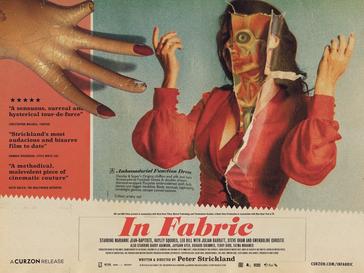
The movie is also called a dark comedy and there are some funny bits.  The sales clerk, Miss Luckmoore, speaks in cryptic, quasi-poetic style, never giving a straight answer to anyone.  The shop’s owner does the same.  And some of the scenarios are amusing.  Although horror, the movie isn’t really scary, but it is stylish.  Unlike some horror comedies, the tone isn’t really funny, but more wry.  And it’s a bit confusing.  The overall story arc is easy enough to follow, but some scenes just confound.  I kept waiting for an a-ha moment when everything would fall into place.  Of course, ambiguity is a hallmark of many intellectual films.

Something that I’ve been noticing, no matter the era that it’s from, is that films really need to justify that last half-hour, if they’re going for 120 minutes.  Maybe it’s just that we’ve become accustomed to the 90-minute feature, but I’ve notice that most two-hour movies (not all) seem to suffer from some pacing issues.  Of course, an art-house movie will defy conventions.  For example, the point of view is Shelia’s for about the first half of the film, then she’s killed and new characters are introduced.  Yes, this shows that the dress goes on killing, but another approach might’ve been to have the protagonist learn about past killings and realize the dress is coming for her.  But then, that might’ve been less creative.

Carnival Days

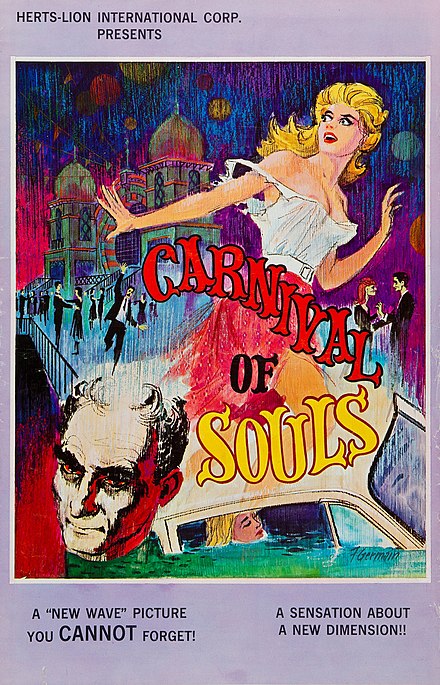
Carnival of Souls has been receiving renewed attention of late, so I decided to watch it again to see if I’d missed something the first time.  Indeed, I had. Carnival of Souls is one of those low-budget movies that was really never considered worth much until reevaluation started to take place several years after it was released (1962).  As a snapshot of an era, it offers a view of how horror and religion interact.  The story, in case you’re unfamiliar, follows Mary Henry, a young woman who’s a professional organist.  Even here a few things stand out.  She went to college, she relies on no man to support her.  And she views church work, as an organist, to be “just a job.”  This is pretty incredible on its own, but I’m getting ahead of myself.  Her car is nudged off a narrow bridge by a couple of guys out hot-rodding.

From the beginning the viewer is clued in that she drowned, although this isn’t made explicit until the end.  She makes her way to Salt Lake City where she’s been offered a job as an organist in an Episcopal church.  She “sees dead people” and becomes fascinated by an abandoned carnival on the shore of the Great Salt Lake.  The priest at first notes that she plays music to elevate the soul.  Later, however, after the dead man she keeps seeing unnerves her, she plays eerie music on the church organ (during practice) and the priest realizes that she’s not a believer.  He fires her on the spot.  Apart from getting the ethos of the Episcopal Church about right, this in itself is interesting.  The playing of creepy music is enough to lead to the loss of a church job.

John, the guy who won’t stop trying to score with her, wonders at one point if viewing church work as “just a job” doesn’t give her nightmares.  These attitudes, from only about six decades ago, seem terribly remote by today’s standards.  Many clergy have doubts about their faith.  Many don’t really believe what their church actually proclaims.  The movie shows a society that has an almost magical view of the church.  You can probably even take the “almost” out of that last sentence.  While the Bible’s not mentioned or quoted, the idea of a lost soul finding no home in the church is a telling bit of commentary.  Intentional or not.  Carnival of Souls will never be my favorite horror movie, but it has pre-echoes of Night of the Living Dead and a sincerity that invites consideration.  I can see why it’s gained renewed interest.


Wolfing Hour

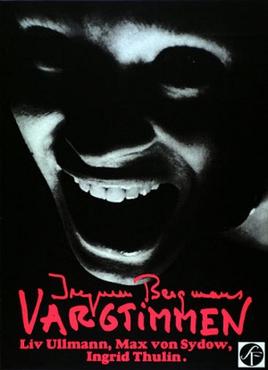
It’s not that I didn’t grow up watching horror; it’s that I didn’t grow up watching horror in theaters.  I’m sure Mom wouldn’t have had it, and besides, we could only afford movies spread apart by wide intervals.  You’d think that now I’m an earning adult (or so I’m told) that I’d have more control but watching is a kind of addiction and money’s still not abundant.  Every once in a while, however, I’ll splurge and pay for a film.  Mostly when they’re not available via any streaming service.  Like many Christians who’ve never read the whole Bible, I know the canon only piecemeal.  So I came to watch Hour of the Wolf, the Ingmar Bergman classic.  Now (at least then) streaming nowhere.  Intellectuals have always flocked to Bergman films since they’re full of symbols and not easy to understand.  (If you want to “get” Robert Eggers, though, you’ve got to do your homework.)

Hour of the Wolf is generally considered psychological horror.  It’s black and white—how scary can it be?  Pretty, depending.  The story of an artist’s wife (Alma) who lives with him in a small shack on an island in Sweden, it’s a tale of unraveling.  Nightmares become difficult to distinguish from waking realities.  The wife reads the artist’s diary, foreshadowing Wendy in The Shining, to discover that he seems to be going insane.  The island’s not abandoned, as they thought.  Soon Alma begins seeing other people too.  And attending their awkward dinner parties.  They speak freely of her husband’s previous affair.  There also seems to be an instance of a real person on the island that the artist keeps secret.

If this doesn’t give you enough to piece it together, well, it’s a Bergman film.  In college we watched The Seventh Seal.  And at least part of Wild Strawberries.  But in 1968 I wasn’t an intellectual and we were poor.  If I’d even heard of Ingmar Bergman it was via reference in some TV sitcom.   I knew to expect strangeness.  These days the box elder bugs are mostly gone from the house.  The weirdness started when, having never seen the film before, I began to pour a glass of water at the very second the artist picks up and begins to pour a glass of wine.  Strange coincidence, I thought.  Several minutes later I saw something edging around my glasses.  A box elder bug crawled right over my right glasses lens.  Like a scene in a Bergman movie.  I knew I’d have to ponder this for some time.