
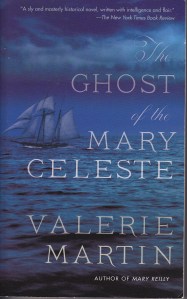
 Ghosts have a way of persisting. I’ve had Valerie Martin’s The Ghost of the Mary Celeste on my reading list since I first saw it in hardcover on a bookstore shelf. The Mary Celeste was an actual ship, found with not a soul aboard, lifeboat intact, and no sign of violence, back in the 1870s. To this day no one knows what happened to the crew. Valerie Martin takes this frame and fills it in with a family drawn into Spiritualism, a religion that was just beginning at the time. Spiritualism, which developed in the aftermath of the Fox sisters and the eerie rapping at their upstate New York home, is one of the few religions to be completely at home with ghosts. The faith still exists today, and although Margaret Fox “confessed” to having hoaxed the effects she also retracted her confession, leaving ghost hunters perplexed to this day. These two mysteries, brought together in the moody month of November, make for a compelling novel that urges the reader forward.
Martin also adds the presence of Sir Arthur Conan Doyle to the story. Doyle, an avowed believer in the spiritual realm, also created Sherlock Holmes. As the various characters try to piece together what happened to the Mary Celeste, the ghosts of those lost at sea ambiguously communicate with the living. The world between realms, in this story, is permeable but indistinct. Those lost at sea are, in the narrative, restless. The mood of the novel is unrelentingly moving and thoughtful. Ghosts haunt, but don’t appear. Readers are left to draw their own conclusions.
As today is the fortieth anniversary of the sinking of the Edmund Fitzgerald, it seems appropriate to think about the Mary Celeste. Since Percy Shelley drowned in his own personal boating accident, loss at sea has become one of the hallmarks of Romanticism. Conceived as an answer to the cold, callus industrialism that trailed the scientific revolution, Romanticism suggested that there was an enchantment to nature and that things were not always as they seemed. Prosaically, there’s nothing poetic about dying in a violent shipwreck. That’s what makes the Mary Celeste so compelling. There is no violence here. The sea calls and claims captain and crew as her own. The lack of resolution has led to a very open-ended mystery—the perfect foil to a harsh materialism. Today the Mary Celeste and Edmund Fitzgerald will be sailing my internal seas as the season of spirits and shipwrecks come together in the lengthening nights of November.
 Steve A. Wiggins