Not Camelot

In the English imagination the Arthurian legend is deeply connected with the Christian myth of Britain’s founding. This may not be on the surface, of course, but the places associated with King Arthur (as well as the tales themselves, such as the Holy Grail) overlap with sacred locations. I was reminded of this by a recent Guardian article about Tintagel Castle. Back in the day when my wife and I visited Tintagel with friends, I was still shooting film. Slides, no less. Some wonderful images came out, the way that only Ektachrome delivers, but I haven’t been able to convert them to digital. I guess you’ll have to take my word for it. Tintagel is in the news because English Heritage, the owner of the property, is developing it to make it a larger tourist draw. According to Geoffrey of Monmouth King Arthur was conceived at Tintagel. Not in the castle—now in ruins—that was built centuries later, but on the island that is accessed by footbridge over a dramatic cove on the Atlantic Ocean. It’s enough to make you drop your pastie.
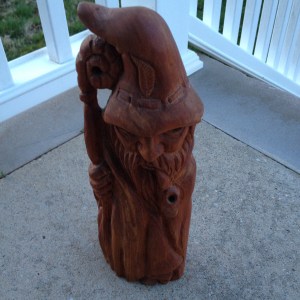
Our own little Merlin

Our own little Merlin

Locals, according to The Guardian, protest the dressing up of the historic site. A bas relief of Merlin has been carved into the living rock, and this is hoped to draw the Glastonbury crowd to the southeast. Glastonbury, upon our visit, was already the home of New Age vendors. It too has connections with Arthur. The staff of Joseph of Arimathea can be seen, still growing after all these centuries. The Holy Grail—likely from Celtic mythology of the cauldron—is also associated with Glastonbury. Oh yes, and also King Arthur’s grave. Even apart from Monty Python, the legendary king has captured the imagination of thousands across the centuries. There’s something about Arthur.

The historicity of the king, however, is vigorously debated. The same is true of many religious founders. Those around whom legends grow become more and more inaccessible with the passing of the years. England was Christianized in the seventh century as part of a political expansion. If Arthur ever lived, it was after that period, perhaps in the days before Beowulf. We just don’t know. It is clear, however, that his legend is intertwined with that of those early Christian days. There never was a Holy Grail—of that we can be fairly certain. In the service of myth-making, it is nevertheless indispensable. Staring out over the Ektachrome sea at the ruins of the island castle of Tintagel, it is only too easy to believe. If only I had the pictures to prove it.
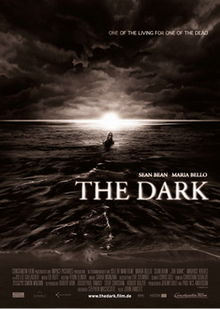

Seeing the Dark

The Dark may be a movie that tries to do too much, but it does illustrate an idea that has been lurking around my head for a few years. That which we fear and that which we worship are never far apart. Since The Dark was pretty much panned, in brief it goes like this—a separated couple gets back together in Wales to draw their troubled teen daughter back. While there she drowns and the ghost of a girl from the past shows her mother how to get her daughter back. The film is notable as being the first I’ve seen that could make sheep scary. Skulking in the back story is a minister, “the shepherd,” the father of the ghostly girl, who started a new religion over the ocean cliffs of Wales half a century ago. When his daughter died, he convinced his flock to leap off the cliff to reach a place that is a combination of Heaven and a Welsh mythical afterlife called Annwyn. The shepherd, however, is really using their sacrificial deaths to bring his daughter back from the dead. The story is complex and the darkness of the narrative is at times overwhelming, nevertheless, it is a showcase of how religious conviction can be more frightening than consoling at times.

Some years back I researched the Welsh mythology of the Mabinogion. Having been a student of ancient religions, however, I knew there was only so far I could go without the lexical support of learning Celtic languages. (This is a fact of mythological study often overlooked by popular treatments; if you really want to get what is going on there is no substitute for reading texts in their original language. I was too busy learning Ugaritic and the time, and struggling with Akkadian, to pick up Gaelic as well.) Nevertheless, the mythology struck me as particularly compelling. Some of the roots of the Arthurian legend lie deep within this lore, and although often uncredited, it still influences our society today. Mythology is simply religion dressed to go out for the evening. The concepts form the basis of much that we still believe and that which still has the power to terrify.

Although the critics didn’t care for the film, the dense interweaving of misplaced religious devotion, Welsh mythology, and basic human longing make The Dark in many ways a classic horror movie. It may be hard to find the characters sympathetic, but they are in some ways archetypal. With a sinister minister driven by personal loss turning to pagan folklore to bring his daughter back, we have a secondary character who curses the fate of an all-too-human condition. The concept of sacrifice becomes a tool for selfish gain rather than a means of helping others. Possibly those who panned the movie did so without an appreciation of the mythology that pulses just beneath the surface here. And while sometimes horror films are simply puerile escapism, at other times they should give us pause to think, and maybe even learn.