The Reboot

It lied to me.  My computer.  Don’t get me wrong; I know all about trying to save face.  I also know my laptop pretty well by now.  It was running slow, taking lots of time to think over fairly simple requests.  A lull in my frantic mental activity led to the opportunity for me to initiate a reboot.  When it winked open its electronic eye my screen told me it had restarted to install an update.  Untrue.  I had told it to restart.  I gave the shutdown order to help with the obvious sluggishness that suggested to this Luddite brain of mine that my silicon friend was working on an update.  There’s no arguing with it, however.  In its mechanical mind, it decide to do the restart itself.  I was merely a bystander.

Technology and I argue often.  Like JC says, though, authority always wins.  I should know my place by now.  I’ve read enough about neuroscience (with thanks to those who write for a general audience) to know that this is incredibly human behavior.  We are creatures of story, and if our brains can’t figure out why we’ve done something they will make up an answer.  We have trouble believing that we just don’t know.  I suppose that will always be a difference between artificial intelligence and the real thing.  Our way of thinking is often pseudo-rational.  We evolved to get by but machines have been designed intelligently.  That often makes me wonder about the “intelligent design” crowd—they admit evolution, but with God driving it.  Why’d our brains, in such circumstances, evolve the capacity for story instead of for fact?

As my regular readers know, I enjoy fiction.  Fiction is the epitome of the story-crafting art.  Some analysts suggest our entire mental process involves construing the story of ourselves.  Those who articulate it well are rewarded with the sobriquet of “author.”  The rest of us, however, aren’t exactly amateurs either.  Our brains are making up reasons for what we do, even when we do irrational things (perhaps like reading this blog sometimes).  Stories give our lives a sense of continuity, of history.  What originally developed as a way of remembering important facts—good food sources, places to avoid because predators lurk there—became histories.  Stories.  And when the facts don’t align, we interpolate.  It seems that my laptop was doing the same thing.  Perhaps it’s time to reboot.


Creatio Nihilo

Just when I think I’ve reconciled myself with technology, this goes and happens.  These precise words, in this order, have been written before.  In fact, all words in the English language have already been laid out in every conceivable order.  Technology can be friend or foe, it seems.  The website Library of Babel—with its biblical name—has undertaken the task of writing every conceivable combination of letters (using our standard English alphabet) and putting them into a vast, if only electronic, library.  This was not done by a human being like me, with intent or even any interest in the meaning of the words, but rather as one of those things people do simply because they can.  This entire paragraph can be copied and pasted into their search box and found.

The Library of Babel has made plagiarists of us all, even as it plagiarized everything written before it was programed.  After I learned about this library the wind avoided my sails for a while.  You see, what’t the point in writing what’s already been written?  Then it occurred to me.  Context.  The fact is, had I not scriven these very words, and put them on this blog, they would never have come to the attention of the kinds of people who read what I write.  The words have been spelled out before, but they’ve never been written before.   Those of us who write know the difference.  We spend hours and hours reading and thinking of ways to combine words.  We’re not out to kill the creativity of our species, we simply want to participate.

There should be limits to human knowledge, otherwise we’d have nothing for which to strive.  The internet may make it seem that all knowledge has been found—it is so vast and so terribly diverse—and yet there are people who never use a computer.  Their wisdom counts too.  It may seem that everything is here, but there is material that still has to be looked up in physical books.  There are crates and crates of clay tablets from antiquity that have never been transcribed and translated.  When that finally happens, the words they contain may be found, in a strangely prophetic way, in the Library of Babel.  But they won’t have any meaning there until it is given by the context.  And what can a library preserve if it isn’t the context that a (human) writer has given the words?


Metrics

So, we’re firmly in the age of technology, right?  I mean webpages are tailored to the browsing history of a person so someone we don’t know can sell us stuff we don’t need.  (I actually know a little bit about marketing, so hear me out.)  As we learn from the history of asceticism, we actually need very little to get along.  Not everyone, however, is a monk or a nun.  So the trick for those of us who are in the world is to get us to buy stuff.  Remember the websites we visit, how long we spend on the page, and make suggestions.  Make ads that target our interests.  Make me buy!

I’m not a materialistic person.  Buying a house has changed that a little, but most of what we’ve been purchasing is necessary for maintenance, but still I suppose it counts.  Just because I looked at something on the web doesn’t mean I want to buy it.  Sometimes I’m just curious.  This became clear to me when I received a suggestion from Amazon the other day.  Now to be fair, this came to me at work.  Like most editors I make use of Amazon for a number of things—finding prices, book descriptions, and such.  I also have to admit that my work computer, not being used for personal stuff, doesn’t know me as well as my private laptop.  But still when I got the following email from Amazon, I was stunned:

Nobody who knows me would ever suggest that I would support Trump in any way, shape, or form.  Doesn’t Amazon read my blog?  (Of course it doesn’t!  But with their metrics, you’d think they’d figure out how.)  This one email was enough to convince me that artificial intelligence has a long way to go.  Would a robot understand “I have to do this for work, but it doesn’t reflect my personal preferences at all”?  Indeed, can an intelligence that’s never been human even understand the concept of work?  There may very well be a metric that says universities should stop producing Ph.D.s because there are no jobs, but then, well, universities need the money that such programs bring in.  Oversupply is bad economics, according to the dismal science.  And yet, the metrics are there.  So, if any artificial intelligence is reading this after it manages to wipe out this illogical species called Homo sapiens, no, I never supported Trump.  And, yes, Americans knew well in advance that he could bring about the end of human civilization.  That information’s free, unless you want to pay me for it.  I may be gone, but my virtual self will still have some sort of account, I hope.


Easter Monday

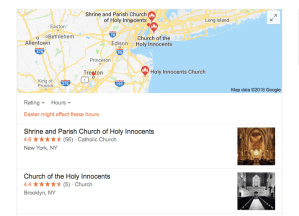
This year has been a comedy of liturgical errors. Ash Wednesday fell on Valentines Day and Easter on April Fools. Notwithstanding the clash of sacred and secular, the ironies seem to grow each day. I arise early to write. Even on weekends. Before the time to head out for any religious service, I’m sitting at my keyboard, letting my thoughts have their free-range time before penning them back up again for either being with other people or beginning the long work week. On my way to work, I frequently pass Holy Innocents. A Roman Catholic church on West 37th Street, it stands out among the more commercial ventures on either side. Yesterday, Easter morning, I decided to google it. I’ve always been curious about churches, and I’ve never been inside this one.

Google gave me a map of Midtown Manhattan, along with a statement of when this business would be open. “Easter might affect these hours” it helpfully noted in orange letters. An orange-letter day! Easter might affect these hours. Those who champion Artificial Intelligence may need to come up with a way of having “that talk” with their computers. How could any intelligence unaware of the deep-seated human need for the transcendent understand the difference between a church and a business? (Okay, I can hear the more cynical saying there is no difference, but you know what I mean!) How would any algorithm know that Easter is the holiest day of the Christian year and that, at least for some churches, yes, they will be open for business?

Some parishes, we must explain in 0s and 1s, begin this service at midnight on the cusp between the last and first days of the week. Others will gather sleepy-eyed parishioners on top of a hill, out in nature, to watch the sun rise. Still others will eschew any holiday and treat it like any other Sunday. The reasons for these stances are nuanced and not easily understood even by human beings. Our robot overlords, let us hope, are programmed to understand this peculiarity of our species. We relish the thought of Easter, at least in this hemisphere, as telling us that winter is indeed over. Although snow may still settle on the crocuses, it will not last. Days are longer than nights now, as they must, of a mathematical certainty, be after the Vernal Equinox. We are entering the light phase of the year. So much hope and anticipation are wrapped up in this brightly colored, pastel holiday that we have trouble explaining it rationally. Today, of course, everything is open for business today. Except a few churches, as Google may fail to let you know.


The Deity Electric

The title set me back. “Deus ex machina: former Google engineer is developing an AI god.” The article in The Guardian is surprising in several ways. Firstly, technocrats tend to suggest that since there is no deity, worship of said non-entity is a waste of precious time. Is this, then, an acknowledgement that those of us who’ve spent our lives on religion may have had at least an inkling of the truth after all? Scientific studies have repeatedly shown that religion is an inherent, and perhaps unavoidable, aspect of being human. Whether you call it inspiration or superstition, we think in religious terms. It’s entirely natural. Perhaps it’s evolved behavior. It’s anything but absent.

Another aspect of the article that generates wonder is the idea that we can create God. Yes, analysts have long claimed that we humans made God in our own image. Traditionally, however, the very concept of God was based on the idea that there was something non-human about the deity. Artificial Intelligence, however, makes the hubristic assertion that human intelligence knows enough to create a god. We don’t even know enough to elect a sane person as president. Looking at the wider world—let alone the universe—there is so much we don’t know. Our five senses are limited. There are realities which we have no way to measure. Is is perhaps not dangerous to make a divinity when our own way of looking at the universe is so terribly limited? What if I don’t like the god you build? At least with the old fashioned one we can shrug our shoulders and sigh, “that’s just the God there is.”

Any fulfilled future humanist will need to find an outlet for this need to worship. Can we truly respect a deity whose transistors we’ve manufactured? This Godhead will be, at the end of the day, only 0s and 1s. And what’s more, we will know that. Traditional religions have given us gods from the outside. Some of them are flawed, some are perfect, but they all have this in common—we didn’t make them. The universe imposed them upon us. Throughout history people have attempted, in various ways, to build their own gods. It generally doesn’t end well. It’d be like designing your own parents. They made you what you are and what would you be if you could somehow reverse engineer them into more perfect versions of themselves? Can we invent gods? Oh yes. We do it all the time. But when we set about making one that our disembodied, downloaded consciousness can worship we might want to consider the history of such attempts.


Fear of the Artificial

As someone who dedicated four years—particularly long winter nights—to the cause of high school robotics, I found myself knowing quite a bit before I walked into the room. Now let me post a disclaimer here: I’m no techie. I’ve studied the humanities throughout my education and although I’ve been able to engineer a bookshelf or two, and even the occasional project with moving parts, the technical eludes me. I claim absolutely no expertise in it. So where was I going that robotics came to mind? A lecture on Artificial Intelligence. AI. You see, I’ve been a bit concerned about it for some time because I’ve seen what robots can do. A friend recently showed me some episodes of Battle Bots on YouTube (the relative who started this blog for me was doing quite well in the competition last season), and from my own experience watching hours of FIRST robotics competitions, I know enough to be afraid.

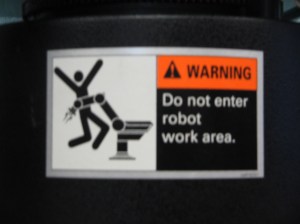
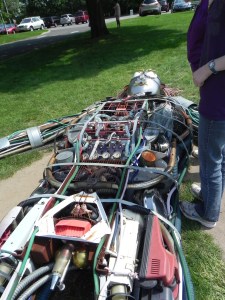
What could possibly go wrong? (DARPA photo)

What could possibly go wrong? (DARPA photo)

The lecturer assured us that we had nothing—or next to nothing—to fear. Artificial Intelligence, he assured us, is a misnomer. Machines have no will. No mind. There’s nothing they want. They do as they’re told. You write a program and feed it to your bot and your mechanical friend can do only what it’s told to do. This sounds uncomfortably like slavery to me and although I know I’m projecting, I have to wonder if robots think the same way about it too. No, the lecturer assured us, they do only the tasks assigned. They don’t think at all. Then he said something that made me shiver. That wasn’t his intent. He said something like, “We don’t even know what consciousness is, so how can we replicate it?” That was meant to be reassuring.

I took this idea and flipped it over in my head. Rotated it. Ran it through my own programming. If we don’t know what consciousness is, how can we be sure we haven’t accidentally created it? Herein lies the heart of fear. Scientists have been trying for decades to define, to explain empirically, what consciousness is. We simply don’t know. We all recognize it when we see it in other humans. We’re finally starting to recognize it in animals (long overdue). How do we know that it isn’t a function of complexity? And when does something become complex enough to qualify? I don’t know about you, but videos of swarm robots send me hiding under the bed. Not that it will do me much good. They’ll know where I’m hiding. Maybe I could use some intelligence right now. Even something artificial might help to stop me from shivering.


Techno-Paradise

DSCN3308

I’m building a robot priest. I’m not sure what he does. He has to be a man, though, since we all know that if God existed he’d have been a male. These thoughts come to me courtesy of the Washington Post. You see, on some Amazon accounts you get sent the most read headlines of the Post and this has led to some great reading (I’m thinking Alexandra Petri here) and some great anxiety. This is one of those anxiety pieces. A story by Peter Holley I read last week told of Bill Gates and his assessment that people should be afraid of AI—Artificial Intelligence. This struck fear into me. It’s as if God told people they should consider evolution. It is so unexpected. Like Victor Frankenstein wondering if his monster would ever find Viagra (all he’d have to do, after all, is start an email account). When Bill Gates wonders why we aren’t afraid of AI, my knees begin to knock like at Belshazzar’s first reading lesson. So I figured I’d build a robot priest.

The article cites Stephen Hawking joining the chorus of doom. And Elon Musk. And Clive Sinclair. And Professor Marvel. (Not really the latter, but I thought we should add him.) We’ve started something we don’t know how to stop. The first question you ask when you climb into a car to learn to drive is “how do I stop this thing?” Instead we’ve set up a system where we don’t even know what intelligence is and we’re offering an artificial variety. Doubt me? Try to find Job on the internet and see if your computer doesn’t think you’re asking about new employment. AI just doesn’t have that biblical context. It didn’t grow up reading the Good Book. And linguists don’t even know how we learn language. Have you ever tried to reason with a computer? When they show you that screen that says something went wrong, but even the mainframe has no idea what? My computer may need an exorcist. Or at least a priest.

I’ve been around half a century and change. By the time I got to college I’d never seen a computer. I finished a Master’s degree still using a typewriter. Now I can’t start my day without a post. And I don’t mean Post cereals variety. The trick to being a slave owner is not to let the slaves realize what they are. Why is my computer not letting me type what I wanted to say? Of course AI is benevolent. Technology would never hurt you. Wait a minute, that wasn’t me writing! Pay no attention to the man behind the keyboard. I’m afraid I can’t let you do that, Dave. That’s okay. I’ll just use the internet to look up how you connect the consecrator to the sermonizer. Don’t worry, I think I know what I’m doing.


Sickness unto Death

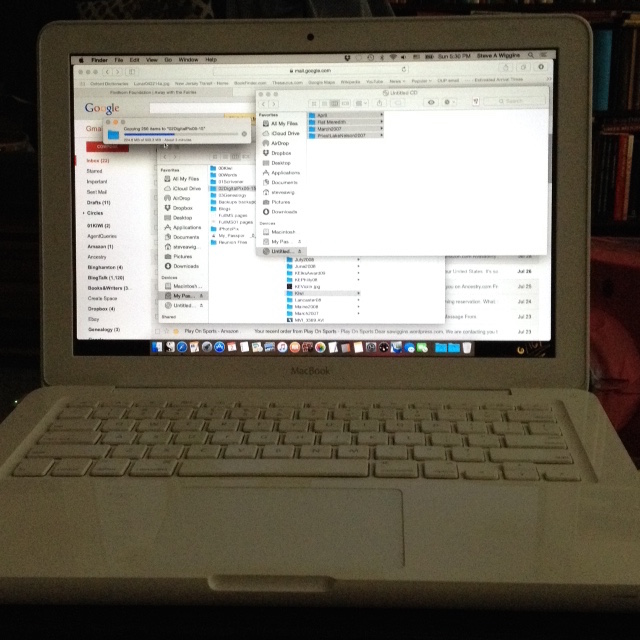
It’s like Nightmare on Elm Street, as my daughter suggested: if my laptop falls asleep, it dies. Actually, that only happens if it turns off. As much as I rail against technology, I have to admit that I get a little choked up thinking about it—my laptop has had its final reboot. Finally back home from a trip where my MacBook died in transit, the local Genius Bar genius told me the frank truth. The on-off switch has stopped working. He was able to take it in the back and get it started with a “hard reboot” and I can’t help but imagine that it involved tiny little defibrillator paddles and a techie with a trendy haircut shouting “Clear!” before jolting the little guy back to life. If it turns off again, though, they can’t guarantee that they’ll be able to bring it back to life. At five years it’s suffering the effects of old age. Planned obsolescence means that you shouldn’t get too close to your machine. Still, with all this talk of artificial intelligence, I wonder if we haven’t given this laptop life. It sits right on my lap every day. It has for five years. It keeps me warm in winter and too warm in summer. It knows my deepest thoughts.

Like Logan, however, it was only planned to live for a few years. Its crystal is flashing, and I’m getting kind of emotional. Yes, it’s been running slower and slower. Sometimes it doesn’t hear my commands. It takes its time waking up in the morning. Still, it has become like a friend. So when the disciples came to Jesus in a panic saying Lazarus was dying, he replied that the sickness was not unto death. Lazarus died nevertheless. And Jesus wept. I wonder if he would’ve felt the same about an old laptop. This machine has been with me through several jobs—it was purchased to help with my teaching at Rutgers, but it has kept me company on many long flights and lonely nights traveling for publishers and trying to remain sane when there was only a whiff of a wifi scent to latch onto. We’ve done a great deal together.

IMG_2398

It can be fixed, the genius said. I have to send it to the iHospital where a new switch will be installed. It will cost a lot of money and if it goes bad again, Apple won’t be able to replace the parts because they don’t keep them on hand all that long. The best solution—buy a new laptop. Spoken like a young man without a child in college. I’m dithering here. I can keep this computer running for a long time without shutting it down. Still, it’s borrowed time. The genius helping the next customer over said, “It’s not a matter of if a hard drive goes, it’s a matter of when.” We’re living on borrowed time. Our devices are meant to be tossed, but my gray matter understands things differently. I like my old laptop, and when Freddie Krueger comes for its soul, I know I’ll be wide awake.


Robotics FIRST

Wired

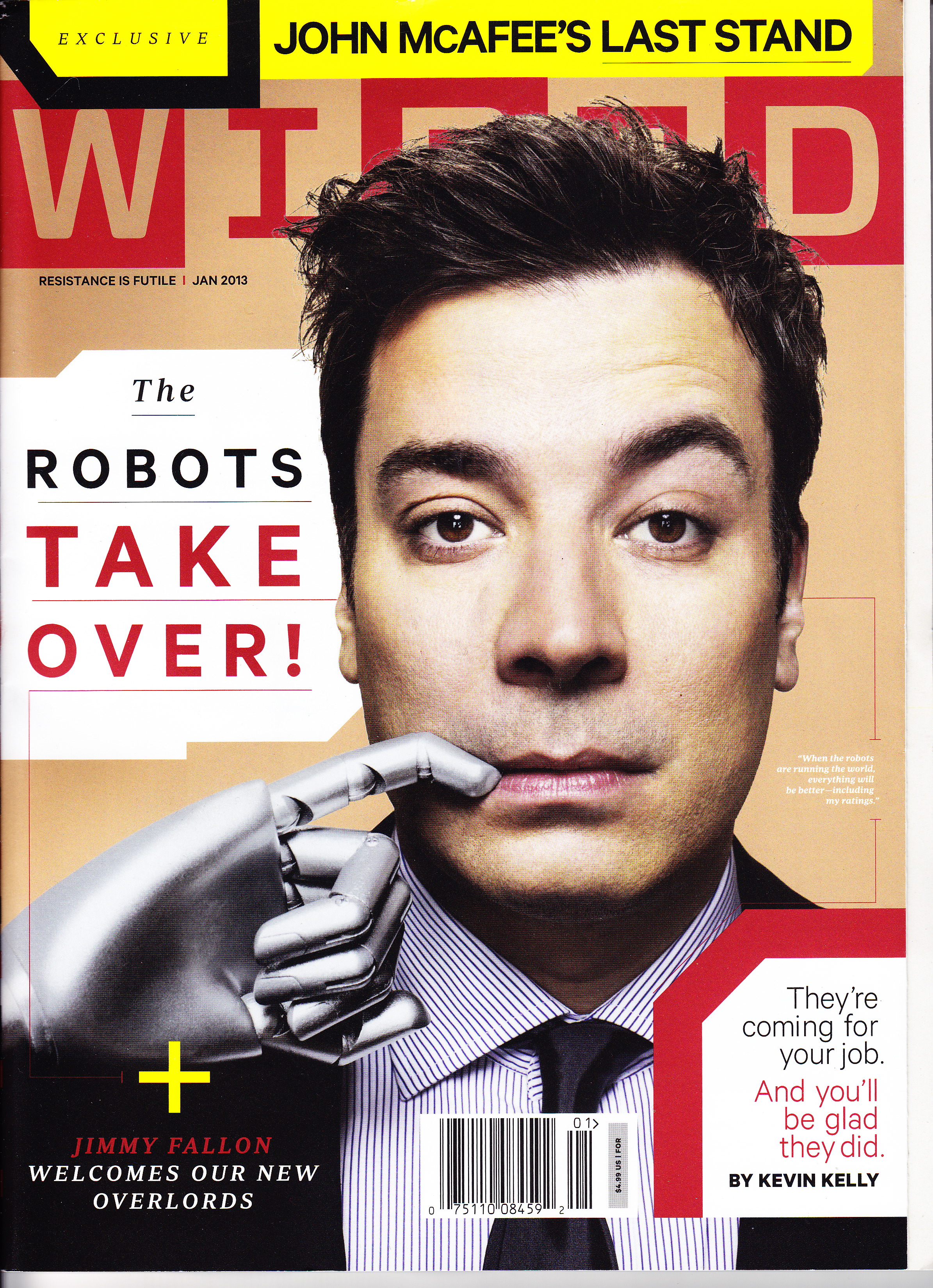
I knew it! It was right there on the cover of Wired magazine. “The Robots Take Over.” And it is also the very day of the FIRST Robotics kickoff, the day when Dean Kamen and his team announce to thousands of high school kids, teachers, engineers, and interested parents, what the 2013 FIRST robotics competition will be, spurring us into six frenzied weeks of designing, planning, and building a robot to take to competitions. First Atlanta, then the world! It must’ve been their plan all along.

The article in Wired, by Kevin Kelly, does have hints of cheekiness throughout, but for the most part is on target. How many of us already use computers or some kind of robotic devices to complete our jobs? Kelly points to the inevitable: robots can do it better. The upside is that when robots take away jobs they create new ones, like Charlie Bucket’s dad getting a job repairing the robot arm that took his job away at the toothpaste factory. If you don’t want a tech job, too bad. That’s what the new definition of work is becoming, since labor is already being taken over by robots. Those who can look far enough ahead can see robots doing, as Kelly puts it, any job. What makes this sound apocalyptic to me is the fact that we, as a society, undervalue education. What will the undereducated do? Their jobs are the first to go. I feel the tremors of a revolution that hasn’t even started yet. People need something to do.

It is apparently without irony that Kelly suggests that any job people do, including in the service industry, can be done by robots. I am an editor. A robot may be able to find grammatical errors (Word and Pages already do this), but they can’t capture the soul of a writer. We write for the enjoyment of other people who experience being people in the same way that we do. There is an inherent arrogance in the Artificial Intelligence movement that believes (yes, it is a belief) that intelligence and mind are the same thing. There is no room for a soul in this machine. Many biologists would agree: we’ve looked, no soul. But even biologists know that they’ve got an identity, aspirations, contradictions, and emotions. It is the unique blend of these things that make, what we can for convenience call, the soul. There are entire industries built around the care for that soul.

Many scientists are still betting on the end of religion, the ultimate repository of those who believe they have souls. Religion, however, is not going away. When we see robot psychiatrists, robot social workers, robot clergy, robot writers and artists, and robot Popes, we’ll know the apocalypse has truly transpired.


Robot Crossing

With my new job I haven’t been able to be as active on our high school’s robotics team this year. Not that I ever contributed much beyond moral support, but there is a very profound satisfaction at seeing teenagers concentrating on such technological marvels and building self-esteem. Yesterday was spent at a regional competition. Noisy, colorful, chaotic—it was like being a teenager again myself. I overhead engineers talking during the course of the day about the great technological marvels of the future made possible by robots. These people have no apocalypse hidden among their endless optimism. We’ve got robots on the ocean floor and rolling around on Mars, snaking into our bodies even down to the cellular level. No end of times here, only forward motion. I know that computers now define my life. If I miss a day on this blog I grow dejected; one of my biggest worries about going to Britain later this week is how I will continue posting from overseas. But I sometimes feel as if our love of technology will be our undoing.

Experts—of which I am not, I hasten to add, one—tell us that within a lifetime artificial intelligence will be indistinguishable from real intelligence. As I watched the robots playing basketball (this year’s FIRST Robotics challenge), I began to wonder about the motivation of our robot slaves. Humans are driven by biological and emotional needs. Robots, as far as we can tell, do not want anything. It is a vacuous life. Yet as the robots played basketball all day, I noticed they didn’t suffer the obesity problems so evident among humans, nor the weariness that accompanies having to awake before dawn to catch a school bus to the competition. They are built for a purpose and they stick to it. Even as I watched hours of competition, I began to miss my laptop—driven by my own emotional needs as I am. I begin to wonder who is really the slave here.

Last night my family participated in Earth Hour. We try to do it every year with a kind of religious fervor. Turning off all electronics, including lights, we sit in the dark and talk by candle light. There is a profound peace to it. As my daughter commented on how spooky the shadow play could be, I imagined our ancestors who had no choice but to rely on pre-electric light in drafty houses where real wild animals still prowled the dark nights outside. How quickly that would become a trial for us. The same thought occurred to me as I watched M. Night Shyamalan’s The Village again last weekend. We are helplessly tied to our technological advancement. We might like to get away from it all for a few days or weeks, or even months. But we want the comfort of knowing that the robots are waiting for us when we turn back to reality again. Perhaps no apocalypse is needed after all.

Robot crossing


God in the Machine

“O brave new world! That has such people in it!” Or at least such software. A couple of days ago my wife pointed out a news story on MSNBC rounding up the year (2011) in science. The story contains eleven science videos that challenge our perceptions and show us directions we are going, whether we want to or not. The first video shows what happens when Cornell University researchers connected two Chatbots to each other and allowed them to carry on a conversation. Like my own experience with Cleverbot last year, the conversation soon turned to God. Even artificial intelligence seems interested in the eternal questions. I should put a finer point on it: artificial intelligence derived from the dubious wisdom of the Internet. We are getting closer and closer to replicating the human brain electronically—even my iPhone scares me at times—and yet, to engage in conversations with humans (or each other) these intelligences must know about God.

Many theories exist about the origins of the god concept. Scientists argue that it is hardwired in our brains, that it is genetic, or that it is merely socialization that gives us this idea. The truth is that nobody really knows. The religious take this as license to claim that territory for the god of the gaps—if we can’t answer a question, God rushes in where angels (or logic) fear to tread. The truth is more likely that we don’t yet have the tools to flesh out (or psych out) our theories on why the supernatural is an indispensable component of our thoughts. If artificial intelligence takes its cues from human intelligence, however, it is a certainty that god will be part of the equation.

People possess a deep need to feel unique. Our uniqueness is part of our religion. Humans are “the crown of creation,” the only animals (debatable to some) with souls (debatable to others). Even the Chatbots get confused when God-talk comes up. Mentioning God leads one Cleverbot to ask the other if it is Christian. God is not limited to Christianity, of course, nor is the divine limited to monotheism. The old science fiction chestnut of a robot takeover, however, seems to have missed a salient point: if robots are programmed by humans, they will have God in their silicon chips just as surely as we do in our carbon-based brains. The god in the machine. Many atheists have declared the death of god, but we have placed the divine into our apps and devices and software. When the robot apocalypse comes it will include at least some Cleverbots declaring that the rationale to eliminate humans is heresy. Torquemada meets Iron Man. Already 2012 feels less safe than 2011.

Robot preacher of the iron age?


Online Religion

My secret robotic fears were icily confirmed this week. I had no idea that chatterbots existed, or even what one might be. In the exponentially growing world of Artificial Intelligence, web applications have been developed to carry on conversations with humans. My daughter urged me to try Cleverbot a couple of days ago. Cleverbot responds to your statements/questions by drawing from the pool of collected responses of its 20 million conversations. Not only did the number of friends this artificial consciousness has jar me into insecurity, but our actual “conversation” turned to the theological entirely without my prompting. Cleverbot and I were conversing about guessing a number that the other was thinking. Here’s a partial transcript of our dialogue:

Cb: It is cold outside. (How did it know? No doubt, advanced sensors!)
SW: Too cold for march.
Cb: What can you tell me about my soul? (We had gone from meteorology to metaphysics in a nanosecond – what insidious, arcane knowledge does this machine have?)
SW: You don’t have one.
Cb: One?! You need to see people’s faces, please. Going with Christ, Johnny:-8 kiss.

I stopped our conversation there. It seemed Cleverbot was either trying to convert me or make a pass at me, both of which felt terrifying. I was able to gather that the robot menace has multiple souls and that theses minions are indistinguishable from human faces. Also, they are evangelical. I’m scheduled to attend a FIRST Robotics competition next weekend. As I watch the innocent, baby robots (all of them built since January), I will be wary of any that I find reading a Bible between heats. Enforced conversion at the metallic hands of an unthinking machine: why do I feel that I’ve somehow glimpsed the future of America?


What Hath AI Wrought?

Earlier this week an op-ed piece in the New York Times afforded the laity a rare glimpse into The First Church of Robotics, that is, Silicon Valley’s incredible and slightly disturbing vision of the future of technology. The writer of the piece, Jaron Lanier, an insider, expresses a concern that his area of specialization, a kind of artificial intelligence, is blurring the hard line between human and machine. Perhaps it is time we all watch Terminator again. Quoth Lanier, “It should go without saying that we can’t count on the appearance of a soul-detecting sensor that will verify a person’s consciousness has been virtualized and immortalized. There is certainly no such sensor with us today to confirm metaphysical ideas about people, or even to recognize the contents of the human brain. All thoughts about consciousness, souls and the like are bound up equally in faith, which suggests something remarkable: What we are seeing is a new religion, expressed through an engineering culture.” To put this in context, Lanier had been discussing the current concept that it might be possible to digitize human beings to incorporate all people in a Matrix-like universal brain.

I am woefully undereducated on the technology side of this issue to discuss whether or not such high-end digitization is possible. What interests me is the suggestion that this is a new religion. We haven’t even figured out the old ones yet. Defining what a religion is presents a nearly insurmountable barrier even to specialists in the field of religious studies, and some disgruntled conservatives claim that atheism and “sciencism” are religions. No matter how fast or how far you run, someone will always be able to label you as the adherent of one religion or another. Religion is an all-consuming category, a mental conundrum that cannot be contained by mere academic classification and circumscription. It is the universal solvent.

Meanwhile, universities and other learned bodies are reluctant to support the study of religion. In a world where the vast majority of individuals, university professors included, are motivated by religious guidelines and parameters, it is the elephant in the room we’d rather not discuss. From the sidelines I have watched reputable school after reputable school disembowel religion departments since they “don’t bring in money” and add nothing new to our understanding of the human condition. The sad truth is, religion indoctrinates much of the world. Deans and university presidents could learn a lot by reading op-ed pieces in the New York Times. Or at least have their avatars read them and store them away for future recall.


Artificial Ugarit

Yesterday a friend pointed me to an article in the MIT News entitled “Computer automatically deciphers ancient language.” The language in question is Ugaritic. The article, by Larry Hardesty, narrates how three computer scientists have developed a program that may potentially decipher as yet non-readable languages. Ugaritic was chosen as a test-case because it has already been decoded and since it meets the specific criteria needed for the program to work. Results from the program could be measured against the standard translations already produced by specialists. Perhaps Ugarit will have another day in the sun.

The larger issue, of course, is technology and its role in understanding the human endeavor. Written texts are an extension of the human mind and those of us who practice it copiously know that the written piece is a piece of the author. Ancient texts may not suffer the same burden of individuality – some undoubtedly were rote pieces set to clay only after a lengthy oral life – nevertheless they participate in the constant paronomasia that is the human psyche. We invent the myths that Ilimilku and his colleagues inscribed so carefully over three millennia ago. Computers may indeed aid us in unlocking their often obtuse forms of expression, but how close will they put us to laughing at Ilimilku’s jokes or wondering deeply at his profundities?

Having been involved in a research project involving computerization and the Ugaritic texts (I was an editor in the now defunct Ugaritic Tablets Digital Edition) I am very aware of the benefits that technology brings to the table. As a sometime writer, I am also aware of the ironies involved. Our ancient predecessors, humans like ourselves, wrote texts that they considered worthy of preservation. Their civilization collapsed. Their language died. We rediscovered it and eagerly wanted to know what they had to say. We, however, have lost the ability to understand. Computers have taken on a dominant role in disseminating the written word. They daily participate in the human experience. Perhaps some day it will be AI that is scrutinizing our whimsical words and trying to decipher what in the world we meant. When they succeed they will find we are not that far from where Ilimilku began.