Yes, Mammon

In the continuing coverage of the most recent New Jersey scandal the Star-Ledger, on Monday’s front page, posted a picture of San Giacomo Apostolo in Hoboken. San Giacomo is traditionally the brother of the equally mythical St. Ann. The statue, which stands outdoors in a public street, has monetary donations tacked to it. The image flashed me back to my Nashotah House days when students became visibly excited nearing the date for the procession of Our Lady of Walsingham at the proto-shrine in Fond du Lac, Wisconsin. Seminarians would beg for an opportunity to hoist the holy statue, or at least be a lowly acolyte. (These were grown men, mind you — many of them seeking the priesthood as a second career.) I never attended Walsingham, but it was my understanding that pilgrims and penitents at the festival also adorned their lady with money in hopes of some gift of grace. I grew up in a blue-collar household where paying ladies for favors was itself considered a sin.
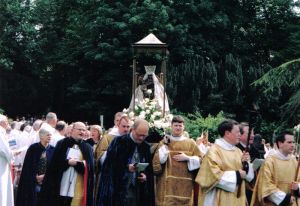
Looks like Our Lady has put on some weight

Looks like Our Lady has put on some weight

While on a recent trip home, I saw a church for sale. As I started to break out my checkbook, I recalled how closely money and religion are tied together. The more I pondered this, the clearer their ancient, entangled roots became. The religiously observant bringing gifts to the temples of their gods was a standard act of piety and civic duty in the ancient world. Temples were expensive and the staff could only be supported by continuous donations. In the Ugaritic tale of Kirta, our protagonist seeks a son and makes a vow to Lady Asherah that if he successfully procures a wife he will make a statue of her in silver and gold. The favors of gods may be purchased. Today credit cards are accepted, but we are still caught in the web of those who claim God has asked them for your money.

For sale, God not included

For sale, God not included

When I was a teenager a friend invited me to attend a public presentation by some visiting Rev. Harrington, a popular evangelist. Several times during his high-energy sermon he sent the collection baskets around. The first time it was for your standard church offering. The second time was for any change you had in your pockets. The third time was for a special blessing. For those who had checkbooks ready, a thousand-dollar donation would get your name on a personalized plaque in his private jet. Years later I saw Harrington on television during an interview on his private estate. He puttered around it in a customized golf cart with wheels designed not to scuff up the gold-plated bricks that constituted the drive before his opulent mansion. “If we’re going to walk on streets of gold in heaven, I want to get used to it here,” he casually explained.

So, as an (unofficial) agent of Asherah, if you are seeking to make a divine investment, get out your checkbooks and I’ll tell you where to send the donations (checks made to “cash” please!).


What’s a Ugarit?

Self-knowledge for any society begins with a knowledge of its past. We identify ourselves with where we have come from and what we have experienced. As denizens of a highly technological world in which change occurs rapidly, it is easy to forget that in ancient times technology progressed at the rate of centuries, or even millennia. The rapidity of cultural change is closely linked with the efficiency of communication with large groups of people over great distances. Working together we build on the many stories already built below us, we begin on a higher level than those in the stories below us did.

When we think of the Middle East, named from the western penchant for placing itself at the geographic center, we think of it as a region of perpetual conflict. Looking beyond our accustomed frame of reference, this region of the world is also where western civilization itself began. It was here that written communication itself was conceived. Ancient Egypt and Mesopotamia have often captured the western imagination. When enumerating the important archaeological discoveries of this region, most informed people would easily tick off the Rosetta Stone, King Tut’s tomb, and the Dead Sea Scrolls. Missing from most rosters would be Ugarit, an ancient city of incomparable importance among the lower stories of the tower of our society.

The great founding nations of civilization grew along the banks of west Asian rivers. Apparently developing independently, Egypt flourished along the Nile and the nations of Mesopotamia along the Tigris and Euphrates. The Euphrates was the quintessential waterway of the ancient world, known by many as simply “the River,” just as the Mediterranean was “the Sea.” Early in human history the city-states of Mesopotamia coalesced into united ventures recognizable as nations. The same unification occurred in Egypt and among the Hittite peoples of what is now Turkey. The basic unit of civilization, however, tended to be the city-state.

(Please see the Full Essays page for the remaining text of this essay.)


Asherah Begins

Back in the Dark Ages when I was working on my dissertation on Asherah, web research had not been born, or even conceived. Its parents might not have even met yet at that stage! When Gorgias Press decided to print a second edition of my book on the goddess a couple of years back, I utilized the opportunity to peruse the web to find out where the old girl is these days.

It seems that Asherah worship is alive and well, according to the internet. I suspect that the ancients would be scratching their heads — and not just because of the omnipresent lice — at the ways she is portrayed these days. The matronly bearer of the gods of Ugarit is a lithe and whimsical girl, walking on the water just like so many other ancient divine figures. She has become a patroness of witches and is identified with any number of pet causes. She is chic, sexy, and alluring.

Unfortunately, what we know of the actual goddess is quite a bit less exciting than all that. Asherah is best attested at Ugarit, a city on the northern coast of Syria that has been extinct for 3000 years. Here she is matronly, passive, and interested in doing the laundry. Her role in the mythology is small, despite being the mother of the gods. She does become notorious in the Hebrew Bible and still has the power to inspire the “bad girl” dreams of many a rebellious youth. She is a fascinating figure — some pundits even think she might have been the main squeeze of someone very high on the spiritual food chain!

Perhaps this is one of those “disconnects” that pop-up like toadstools during a wet and rainy summer. Technology has outstripped reality. A goddess once feared and revered as the ancestor of the gods has become a pin-up girl in a digital era. If a mirror could be held up to time itself, I’m not sure that Asherah would recognize herself even if she long gazed into it.