Land’s End

Although not due for release for another two years, the internet is already buzzing about Pirates of the Caribbean 5. Thing is, once a studio finds a successful formula, they’re reluctant to let it go. Nevertheless, with a couple days off for New Year’s, and all the family here, we decided on a marathon of the four movies available for home viewing. I used to use a clip from the second movie (Dead Man’s Chest) in my classes to demonstrate how the Bible is portrayed in popular culture. In the scene where Pintel and Ragetti are rowing toward the beached Black Pearl, Ragetti is leafing through a Bible, although he can’t read. He says, in his defense, “It’s the Bible. You get credit for trying.” Indeed, the Bible appears disguised as the huge codex of the pirate code (a kind of over-compensatory pentateuch), and, as I noted before, the book that saves the mermaid’s life in On Stranger Tides. In fact, for those willing to look behind the scenes, the Bible shows up repeatedly in the series.

Even as a landlocked child maritime themes and concepts were compelling to me. I yearned for the ocean without ever seeing it. Long I stared at the cover of Rachel Carson’s The Sea Around Us in wonder. When I finally had the opportunity to strike out on my own, it was to Boston I headed, with its rich New England tradition of the sea. I have tried, ever since, to return there. Theologians, although I don’t count myself among their number, have often found a religious resonance with the sea. The Pirates of the Caribbean movies, based as they have been on a Disney ride, nevertheless manage to tap into the romance of the ocean. Not compellingly written, apart from the fun antics of Captain Jack Sparrow, they don’t present an entirely coherent story line, but they do put the viewer, vicariously, at least, on the ocean. And they have been among the most successful film series ever released. Many, I suspect, are drawn by the lure of the open ocean.

Rewatching the films also reminded me of Cthulhu’s influence on the character of Davy Jones. The origins of the euphemism “Davy Jones’ locker” are uncertain, although some trace it back to Jonah. Nevertheless, it stands for the place of death on the sea floor—the very place where Cthulhu lies dead but dreaming according to his creator H. P. Lovecraft. No doubt, Lovecraft’s description of Cthulhu played into the depiction of the character of Davy Jones as presented by Disney. At the end of At World’s End, Jones falls dead, once again, into the maelstrom that will take him back, dreaming, to the ocean floor. In so doing he participates in the endless give and take of the sea. I suspect a couple years hence will find me in a theater to watch what seems a somewhat tired trope, but it will be more the sea than the sparrow that will draw me in.
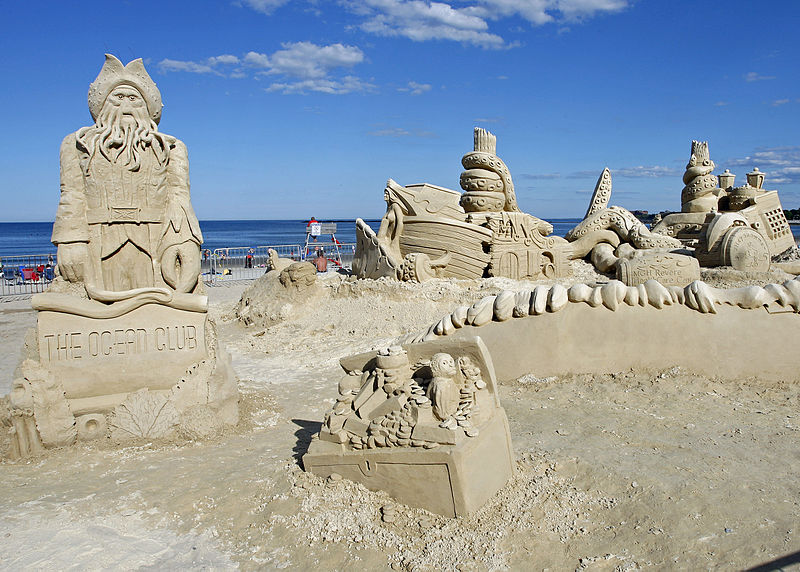
Photo credit: Anthony92931, Wikipedia Commons
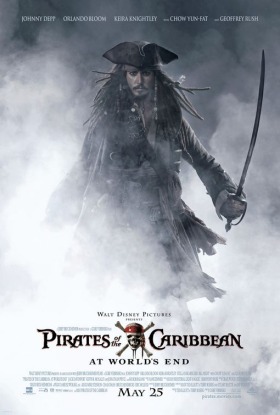
Photo credit: Anthony92931, Wikipedia Commons


At World’s End

“I am not a number, I am a free man” Number 6 plaintively cried on The Prisoner. Capitalism, however, has a way of making each of us quantifiable. A statistic. Not a guy with a kid in college. Not a human being with a sense of self worth and pride of achievement. From far above, in houses and penthouses owned by those who climb ladders made of other human beings’ hopes and dreams, those below are just means to an end. I’m sorry Number 6, you are wrong. Freedom is not free and the capital in capitalism is humanity, commodified.

It used to be that on the way to work I’d walk past the homeless in Midtown and wonder what could have brought them here. What could happen to a person to make them invisible—just a statistic waiting to die? What system could reduce a person to a number? Learning to count is, at times, a betrayal of our very humanity. It used to be that hard work was rewarded. It used to be when someone looked our way s/he saw a human being, and not a number. I’m terribly sorry, Number 6, I truly am. We don’t know your name. You are a number. So are we all.

In the aptly named Pirates of the Caribbean series, the second installment complicated the story by introducing the unmoved Englishman Lord Cutler Beckett. Satisfied with nothing less than the control of the world’s oceans—some two-thirds of the planet, he secures the means to reduce all enemies to fish-food with no show of emotion beyond a shallow smile. In At World’s End, as the Flying Dutchman and the Black Pearl bombard the Endeavour, blowing the ship of unbridled capitalism to bits, Lord Beckett, bewildered, significantly climbs down the steps muttering, “It’s just good business.” Aye, but not Aye, aye. (There is a serious difference.) As the Endeavour sinks I think I hear Number 6 from the depths, and I desperately hope he’s right.

Pirates_3_AWE_Poster_International


Preachers and Pirates

One of the more colorful characters, albeit briefly mentioned, in Jon Butler’s New World Faiths, is Rev. Henry Loveall. While not a major historical figure in any sense of the word, and as a man who is known without the benefit of his own account of himself, the little we know of him intrigues. According to Butler, Loveall was dismissed as pastor from the Baptist church in Piscataway, New Jersey (a town in which I once worked) on charges of bigamy, prompting the Philadelphia Baptist Association to note he’d chosen an appropriate name for himself. Genealogical records online indicate that his given name was Desolate Baker and that he was born in Cambridge, England. As a youth he found himself in trouble for immorality with a woman at his church and he moved to America. Records are sketchy, but he apparently moved from Rhode Island to New Jersey to Maryland to Virginia. He had married but had gone to Virginia with another man’s wife. Even the usually forgiving genealogical records indicate some suspicion of his character.

Loveall lived in the eighteenth century when the world was still large enough to hide in. While I’m not the one to be impressed with Disney’s attempts at profundity in the Pirates of the Caribbean series of movies, there is one parsimonious line from At World’s End where Barbossa and Sparrow are discussing the incursion of business interests (in a delightful irony for a Disney film) into the free-spirited world of piracy. Barbossa avers that the world is smaller, but Jack Sparrow retorts that it’s not a smaller world after all, but “there’s just less in it.” Our world has been rapidly reduced to the pixels we can see on the screen in front of us. Bloggers are acclaimed as experts while those who’ve gazed across the war-torn promised land from atop the Mount of Olives with its frenetic network of churches start to doubt what their own eyes have revealed to them. We are content to let the Lovealls and Sparrows live it for us.

Our names are seldom a matter of choice. Like being born, they are factors in the midst of which we find ourselves—someone else supposed that we might turn out like this. The names we would select for ourselves show the size of our inner worlds. To love all is a noble sentiment. A sparrow is nervous, flighty, and has but a small brain. Our inner worlds are partially constructed by our religions. Declaring on divine authority what we must and mustn’t do, we find ourselves born into religions like we’re born into names. Few question the faith tradition fed to them by parents with such certainty, and that religion, just as surely as our name, becomes an integral part of our identity. History tell us little of Henry Loveall, a man who changed his name, and a clergyman who lived religion on his own terms.

Baptized!