Childhood History

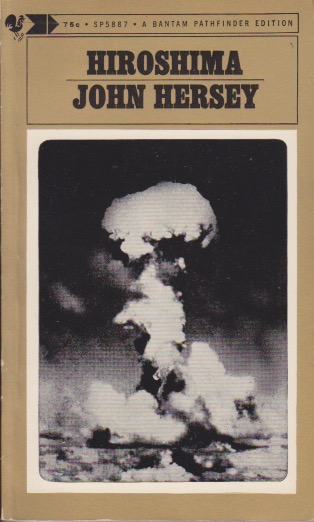
It looked just like I remembered it.  Having recently read the account of a Hiroshima bomb survivor, I had a hankering to read it.  John Hersey’s Hiroshima was my brother’s book, growing up.  He read it and told me about it, but I’m not fond of war stories or accounts of human suffering.  Still, having read a contemporary account at work I realized how little I knew about what had happened to the survivors.  So when I saw this little book at a local AAUW book sale, I picked it up.  Even after all these years it’s still a page-turner.  In my mind, ever hoping for merciful resolutions, the atomic bomb had killed just about everybody instantly.  A lifelong pacifist, I believe war morally unjustifiable (prisons should be for autocrats, not for minor offenses).  Those who start wars, such as Vladimir Putin, should be required to read this book.

I wasn’t really quite sure of what to expect.  I’d heard that the account involved the interwoven stories of six survivors.  It wasn’t quite as complete as I supposed it would be.  Of course, it was published in 1946, after appearing as a New Yorker article.  As I came to the end, I wondered what had happened to these people.  None of the six, a year later, had any semblance of a normal life, and scientists even then didn’t understand the consequences of what might happen to those the bomb didn’t directly kill.  I guess, in my mind, the city had become an irradiated wasteland.  I didn’t realize it had been rebuilt and that over a million people now call it home.  The was a blank in my mind after the dropping of the bomb.  Hersey’s book has started to fill in that blank.

My mind tends to trace things to their origins.  I’ve always thought that way.  Those who enter into politics ought to be required to pass a test on corruption.  They should be required to study diplomacy.  They should have to read books like Hiroshima to see what the consequences of their selfish acts can do.  Considering the real life horror of Hiroshima and Nagasaki, it is important to me to see that the cities are rebuilt.  It’s like looking up the bio of an actor who dies in a movie, just to make sure s/he is really okay.  Why is it so difficult to treat other human beings as human beings?  Why do we still allow war mongers to become national leaders?  Have we learned nothing since 1945?


Digging Deeper

A propos of apes, I’m not sure whence derives the draw of Planet of the Apes on me. I watched the movie with fascination as a child—since the obviously satanic delusion of evolution was impossible this had to be pure fantasy (and perhaps just a little dangerous). The movies just kept on coming, Beneath the Planet of the Apes, Escape from the Planet of the Apes, and Battle for the Planet of the Apes, each with their new twist on the theme that we are the beasts. Recently I watched the second installment, Beneath the Planet of the Apes. It had been years since I’d seen it, although I remembered the terrible mutants and their possession of an atomic bomb. Although the geography is badly distorted, it is made amply clear that the church where the bomb is stored is St. Patrick’s Cathedral on (beneath?) Fifth Avenue. As Brent makes his way into the partially intact cathedral he finds a priest praying to a missile with the letters alpha and omega inscribed on one of its fins.

Since last seeing the movie I spent a lengthy stint among the Episcopalians. Naturally I became thoroughly acquainted with the liturgy and therefore could appreciate subtleties in the movie I had missed before (nothing is ultimately wasted, it seems). As the mutants prepare to set off the doomsday bomb that will obliterate the entire planet—both apes and humans—they recite many prayers from the mass, substituting the word “bomb” for “God” and “Holy Fallout” for “Holy Spirit.” Okay, so maybe “subtleties” was the wrong word. Of course, back in the early 1970’s this was a very real concern, the arms race was well underway. Despite the overacting and forced script, the movie did offer considerable social commentary. Ironic and iconic Charlton Heston condemns the unadulterated praise of such a lethal weapon (or was it just missile envy?), even as he falls, shot, onto the controls, accidentally destroying the earth.

The fascinating aspect of this social critique is that the players may have changed, but the drama remains the same. Those who protest evolution praise the build-up of native strength so that the true Christians might obliterate their enemies first and better than they will obliterate us. One gets the feeling that destruction is not so bad a fate as being proven wrong. Somewhere along the millennia religion slipped its mooring from being an ethical way of life to become an extreme way of believing. And yet people are still the same. And the Planet of the Apes movies continue to appear, ever evolving. When it comes down to the final scene, however, it is not the evolved apes who destroy us. No, it is the utterly self-righteous humans who decide that if they can’t have it all, nobody will have any of it. In the name of the bomb, and the holy fallout, amen.