At Home Abroad

You would’ve thought it was obsolete.  You see, we have the power to make it end, although the price is very high.  As a Cold War kid, I thought that the next war would be nuclear.  I’d been more or less resigned to that fate by the time I entered high school.  When it didn’t happen I thought maybe mutually assured destruction (right, Dr. Strangelove?) would end war.  Of course it didn’t.  Propagandized as just causes, America intervened in Korea, Vietnam, Afghanistan, and a vague country called “Terror.”  Nukes stayed out of it as we used more old fashioned and nasty ways of killing people.  Now Russia, bristling with nuclear capability, is using that threat to keep others out of its war of aggression against Ukraine.  Still backed by Trump, Putin is killing women and children and threatening to end the world if anyone tries to stop him.

During this war time, several multiple shootings have taken place here in America.  Grocery stores and elementary schools become graveyards even as Americans bray for more guns.  Russia need not invade; we will take care of killing each other, thank you.  Although the pandemic has driven many people to the edge we had this problem long before Covid came along.  Of course, one of the industries to profit from the disease has been the firearm wing.  Nobody feels safe and so they buy more guns, creating a deadly feedback loop.  No other “developed” nation on earth has this level of private gun violence.  The Bible in one hand and the automatic rifle in the other has always proven a deadly combination.

Many of us embrace multiculturalism.  There’s no reason we can’t all get along, accepting others for who they are.  A nationalistic backlash has unravelled this dream.  Violence, domestically generated, if not internationally shipped, has become our hallmark.  There are solutions and they aren’t that difficult to achieve.  Those who bully their way to elected office have already shown their true colors.  Life is cheap when personal aggrandizement is at stake.  Guns do have their fascination.  The sense of power in holding one is palpable.  What if, however, we laid aside our dreams of power for those of the common good?  We want to kill others for being born in a different geographical locality than us.  To think of it selfishly, supply chains and inflation have demonstrated how much we need those from all over the world in order to thrive.  Dreams of power, it seems, quickly become nightmares.


Candles vs Demons

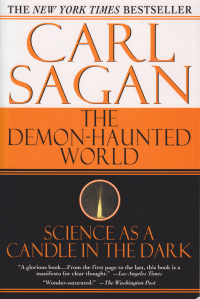
Among scientists who write Carl Sagan has always struck me as one of the more open minded. Dedicated to the scientific method, he nonetheless admits that there are some things scientists don’t know. The last time I was in Ithaca, therefore, I picked up a copy of his tour de force, The Demon-Haunted World: Science as a Candle in the Dark. I wasn’t really sure what to expect—I’ve been researching demons and I supposed they would be addressed in his book, since they feature in the title. Although that is indeed the case, the book is a collection of essays vindicating in various ways the practice and teaching of science. It is quite a scary book. It was also Sagan’s final book published in his lifetime.

Reading this just after Gabriele Amorth’s An Exorcist Explains Demons, noteworthy for its credulousness, The Demon-Haunted World was like whiplash into reality. Back into the realm of observable facts and testable hypotheses, it was indeed like a candle in the dark. Sagan admits that science can’t speak definitively on the supernatural—something that sets him apart from other science writers—but that doesn’t mean we shouldn’t apply scientific thinking anywhere it’s appropriate. And that includes the universe of politics. Published some two decades before the rise of Trump, the book is surprisingly prophetic when it points to the possibility of the rise of fascism in a nation that distrusts science. Indeed, the book shows Sagan clearly worried that an authoritarian, totalitarian government was on the rise. It’s almost preternatural in its accuracy.

The tome is large enough to dissuade a full summary within the word-limits I set for myself on these daily posts, but I can say that this book is necessary now more than ever. Sagan was a celebrity in his lifetime, a “rock star” scientist. Even so he worried about the deplorable state of science understanding among political leaders he met. For many years America has been mired in conservative causes that distrust science implicitly. Another strain that runs throughout this book is the need for education. Not only has America catered to anti-science groups, it has fallen behind much of the rest of the world in science education. Those who claim to make America great again can’t see that their very tactics have made our nation fall behind the rest of the world when it comes to education, across the board. Surely Sagan was right that a good grounding in scientific thinking is the equivalent of lighting a candle. As for the rest of the country it has been getting darker and darker, and our “leaders” have no idea even how to strike a match.