Being Written

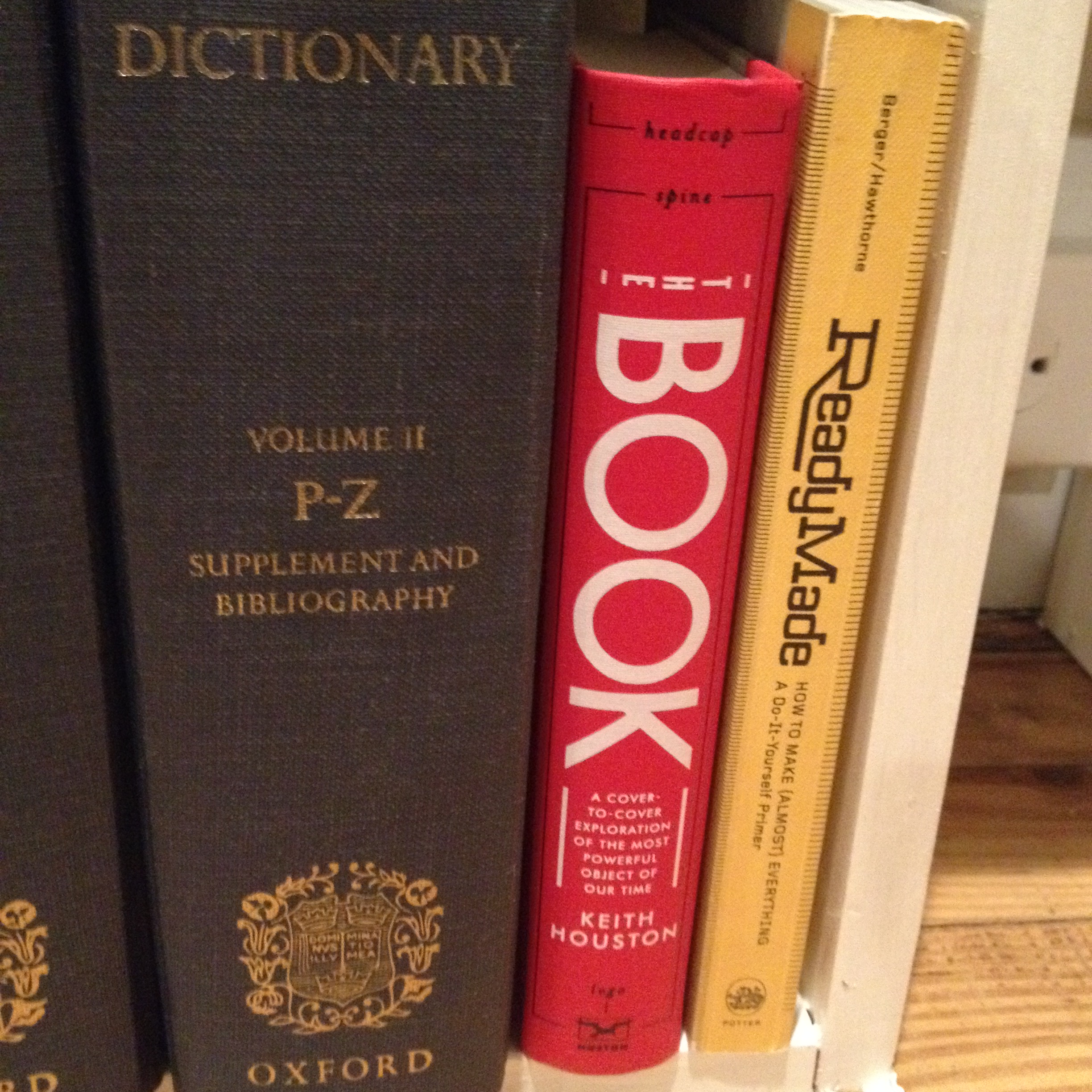
Some books want to be written, no matter what major publishers have to say.  The truth is, being an author is more like being a radio receiver than a transmitter.  Books come to you, begging to be written.  Given our culture, we equate importance with money.  Tomes that earn the most are obviously the most important and erudite.  So the (capitalistic) wisdom goes.  We follow the lucre.  If you read this blog you’ve probably had an experience like this: you find a book that you’ve never heard of that captures your interest.  You read it, transfixed.  When you tell others, nobody seems to have heard of it.  I’d say a number of books I’ve blogged about fall into that category.  The “general reader” follows what the big five publishers suggest they should.  It becomes a feedback loop.
Academic presses—university presses and others that cater to either students or professors as their primary readerships—produce some fascinating books.  Often they’re priced a bit higher than we want to pay.  That’s because they don’t sell at the volume that a big five book does.  The higher the quantity the lower the unit cost, right?  Books that wanted to be written but either price themselves out of sales, or aren’t backed up by a team of marketers and publicists, may be some of the most interesting reading material out there.  You’d never know it, though.  From the point of view of an author, most of my books came begging to me.  I occasionally think of commercial potential because, well, if you’re going to put years of your leisure time into something, you’d like to get at least a little back.  And you’d be glad for feedback, or someone what wanted to ask you about what you’d been begged to write.

Sadly, we have tunnel vision.  It only sees the shining spots crowded with dollar signs.  And since others are willing to pay for it, we have to assume that it’s good.  I’m working on my next set of imploring projects praying to be written.  I can’t handle them all, being gainfully employed helping others who write books that want to be written.  We write them for each other.  I figure that if I’m receiving the signal somebody must be sending it.  And I have a difficult time turning down an idea that pleads with me.  And if someone unexpected picks one of our books up and gives us a like, we show that even receivers can smile.
Author Pages

It takes me awhile, sometimes.  Maybe it’s a generational thing.  I’ve been blogging for sixteen years now (my blog is a teenager!) and it only just occurred to me that I should be putting links to authors’ pages when I post about their books.  I know links are what makes the web go round but I assumed that anyone whose book I’ve read is already better known than yours truly.  Why would they need my humble help?  Well, I’ve been trying to carve out the time to go back and edit my old posts about books, linking to authors’ pages—there are so many!  In any case, this has led to some observations about writers.  And at least this reader.  Most commercial authors have a website.  Not all, of course.  People my age who had earlier success with writing tend not to have a site since they already have a fan base (I’m guessing).  Most fiction writers in the cohort younger than me have pages, and I’m linking to those.

I’ve noticed, during this exercise, that my reading falls into two main categories: novels and academic books.  I suppose that’s no surprise, although I do read intelligent nonfiction from non-professors as well.  In the nonfiction category, it’s fairly rare to find academics with their own websites.  They probably get the validation they require from work, and being featured on the school webpages.  Or some will use Academia.edu to make a website.  As an editor I know that promoting yourself is important, even for academic authors.  Few do it.  Then I took a look around here and realized, as always, that I fall between categories.  No longer an academic, neither have I had any commercial success with my books.  I’ve fallen between two stools with this here website.  I do pay for it, of course.  Nothing’s free. 

Almost nobody links to my website.  This isn’t self-pity; WordPress informs you when someone links to your site and that hasn’t happened in years.  Links help with discoverability on the web, so my little website sits in a very tiny nook in a low-rent apartment in the part of town where you don’t want to be after dark.  And I thought to myself, maybe other authors feel the same.  Maybe they too need links.  So I’m adding them.  As I do so I hope that I’ll also learn a thing or two.  I’m trying to learn how to be a writer.  It just takes me some time before things dawn.  Maybe it’s just my generation.


Playing Authors

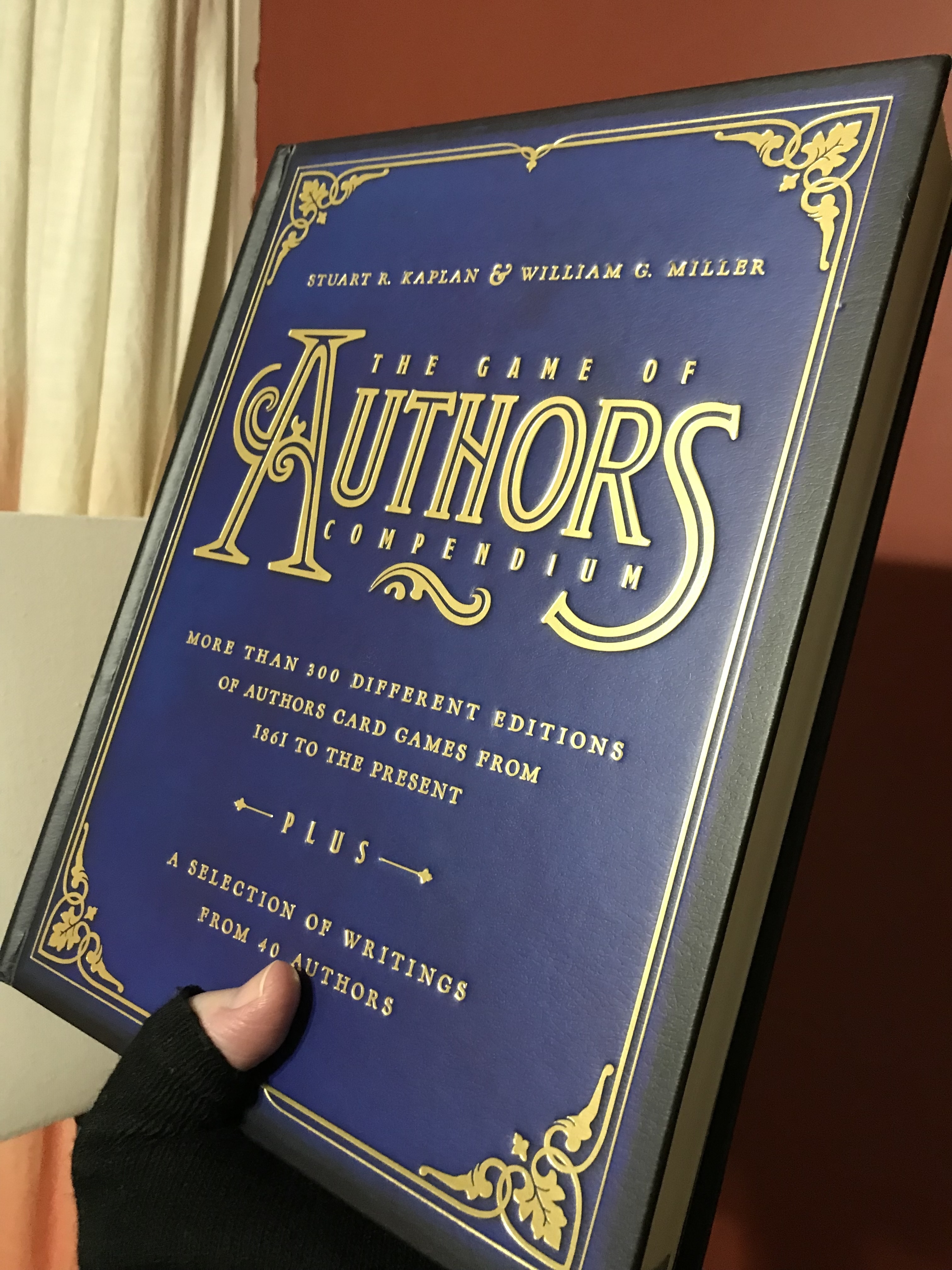
My family looked at me funnily, but not for the first time.  With a holiday gift card I’d ordered a book on the card game Authors that I’d blogged about recently.  You see, there’s not a ton of information on it on the web, and it was a formative influence in my life and I wanted to know more.  I suppose it’s typical for someone raised as a fundamentalist not to immediately think of evolution, but Authors has evolved over the years.  And quite a lot.  For one thing, you can’t copyright an idea and other game-producing companies made their own versions of the original game.  And what I’d assumed had been the original (since it was the one I had as a child) was only one of many versions.  The book even documents the Bible Authors game I’d mentioned.  My real interests included that age-old question—did it ever include Edgar Allan Poe?

Today is Poe’s birthday.  It’s fair to say that he’s one of the most recognizable authors in the world now.  He also had a tough time being accepted.  This book, which I haven’t read through—it’s more of a reference book, in any case—points out that Poe was indeed included in more than one edition of the game.  He isn’t one of the strongly recurring authors (which include several of whom I’d never heard).  This is the fate of writers.  Reading about Dickens lately, I came to realize that even after several best-selling novels (at numbers that would make any modern publisher gloat), he was effectively living off debt until well into his forties.  And he died at 58.  He was famous, but until his final years not what you could consider wealthy.  

Another realization dawned.  Writing for a wider readership means getting away from academic publishers.  I had an agent interested in my current book project for a couple of months before he decided it wasn’t for him.  I’ve also come to see that several authors I respect, and whose books are priced below $20, have published with presses that aren’t part of the Big Five.  And they earn some profit from their efforts (unlike academic publishing).  In other words, becoming an author of either fiction or non, often involves book sense that I’ve been slow to gain.  At the Easton Book Festival a few years back I met several local writers who were putting additions onto their houses with the royalties they earned.  I’d published three books at that point and was turning my pockets inside out hoping for forgotten spare change.  Authors is a game.  Those who are included are those who figured out how it’s played.


Author! Author!

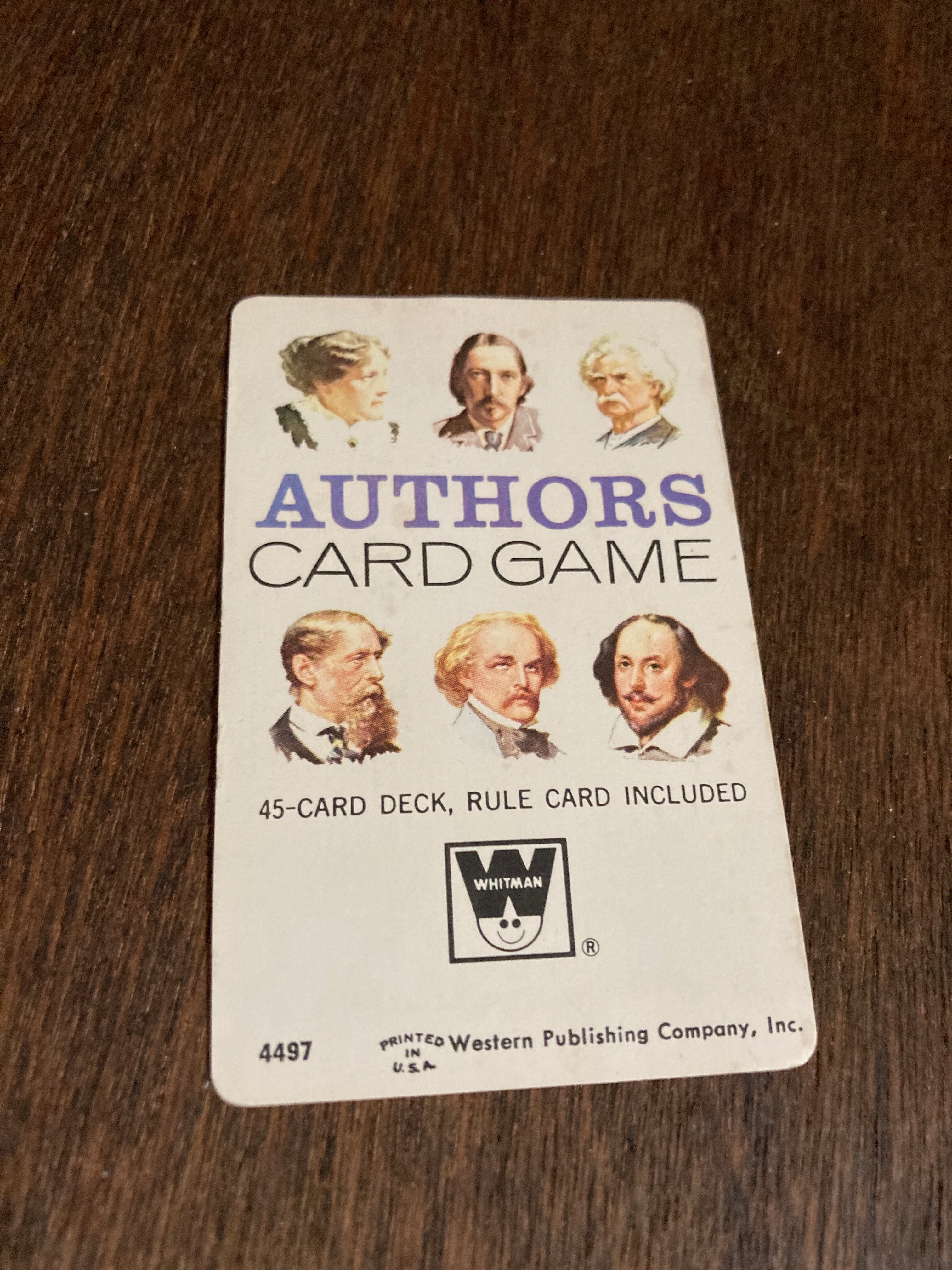
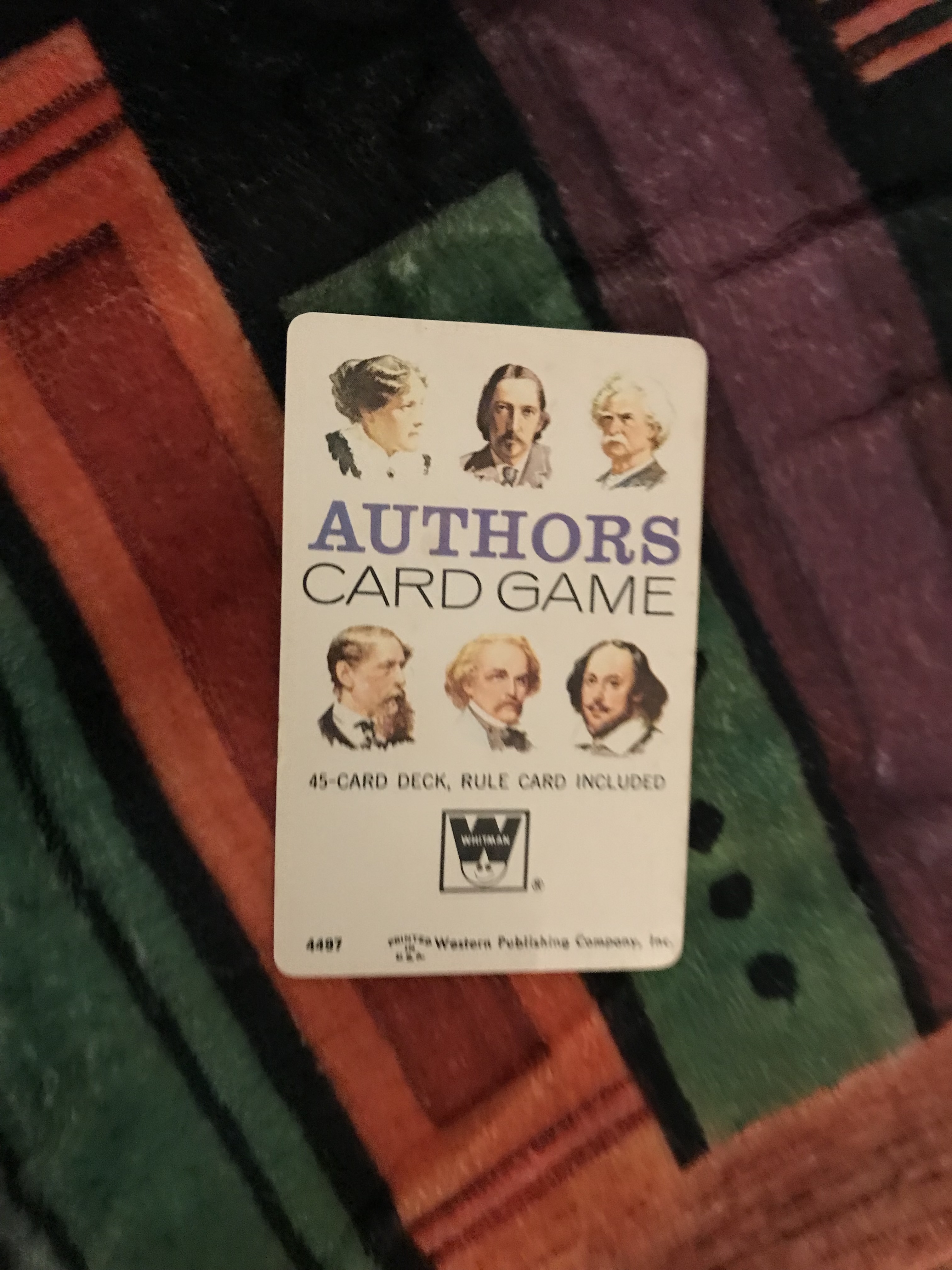
It happened in Salem.  In 1861.  The classic American card game, Authors, was published.  G. M. Whipple and A. A. Smith devised the game, which has remained available ever since then.  It’s one of the few games I remember having as a kid.  We, of course, had the Bible Authors game as well, which I’m kind of nostalgic for, but not enough to see if it’s on eBay.  The object of Authors, an early form of “Go Fish,” is to collect sets of four cards for each author.  Each card lists a different work.  Poets are represented by poems, of course, but prose authors mostly by books.  I have to confess to having eBayed this some time back and having beetlebrowed my family into playing it with me.  I noticed, however, a few curious omissions.

Edgar Allan Poe isn’t among their number.  Neither is Herman Melville.  Rather strangely, they included Shakespeare—centuries earlier than the others—and Alfred, Lord Tennyson.  The only female is Louisa May Alcott when there were perfectly acceptable Brontës in the room, as well as Jane Austin.  The game reflects its time.  A couple years back I was in Michaels—you know, the arts and crafts supplies store.  In fact, Michaels is one of those places for family outings, for families like mine.  (We tend to be creative types.)  While I’ve never been into scrapbooking, I walked down that aisle and found a set of stickers labeled “Literature.”  Two authors were represented: Shakespeare and Poe.  People smarter than me have argued that worldwide Poe is probably the best recognized American author.  I think it’s safe to say Shakespeare occupies a similar role in Britain.

Poe had fallen afoul of many in America because of an intentionally damning obituary by Rufus Wilmot Griswold, whom Poe had named his literary executor.  If it weren’t for Poe nobody would likely know Griswold’s name today.  In 1861, when Whipple and Smith were inventing their game, Poe wasn’t really considered worthy of emulation, largely because of Griswold.  He wasn’t the kind of guy you’d want your kids to be too curious about as you tried to teach them about literature.  Authors has gone through over 300 editions over the years.  I’ve never seen any of them (apart from Bible Authors) other than the Whitman edition from my childhood.  Each time I pick it up, smell the cards (go ahead—try smelling your Kindle), and thumb through the authors I feel like I’m missing something.  Go fish.


Support Roles

It seems to me that many people who strive for a particular life—say writer, actor, rock star—and don’t break through often end up in supporting roles.  I’ve looked for agents for three of my books (unsuccessfully, of course) and have noticed that many agents list themselves as authors as well.  I’ve not heard of any of their books, but then again, there are thousands of new books (likely closer to two million) published each year.  Nobody can keep up.  Since I can’t break through, I work as an editor.  A support role.  Many colleagues who haven’t made it to tenured professorships settle for the better paying but less rewarding job of being administrators.  Artists become gallery owners, guitar players sound engineers, actors coaches.  You get the picture.  We can’t all succeed at what we set out to do.

There is, however, always hope.  For the past several months I have begun each day seeking out quotes about hope.  Those who struggle, sometimes against great odds, must never give up.  I continue to write books even if they don’t sell or even get published.  Some of the writers I admire most never achieved fame until after they died.  The drive to do something noteworthy with life is strong, even if we don’t know what that is yet.  When we give up hope we become mere drones.  Automatons doing our pre-programmed work.  That is, we identify with our support roles and that becomes our life.

Photo by Faris Mohammed on Unsplash

I read about movies quite a lot.  There are many people involved, often in roles that most of us simply don’t comprehend.  Some of the more versatile people in the industry shift from role to role—director, writer, technician, producer, actor.  Those who break through are the few upon whom society smiles.  I recall learning about the Communist ideal of assigning people roles based on their early aptitudes.  I have no way of knowing if this really happened, but the idea is both scary and promising.  Scary because some of us are late bloomers.  Promising because some of us showed early talents that have been undervalued in our careers.  I don’t give up hope.  Daily, even on vacation, I awake early to work on what I hope to accomplish.  I may never break through—finding success as a writer is elusive, especially if you didn’t major in a subject others expect will lead to a writing career.  A support role gets you close enough, perhaps, to see how it’s done.  And to hope.


Literary Thoughts

A book is a physical object.  It is printed on paper and has a cover.  It has a publisher who undertakes to have it printed and bound (and with any luck, marketed and publicized).  This, I would contend, it what most authors have in mind when they sit down to write a book.  It isn’t just “content,” of which you can find far too much on the internet.  It is an object of pride that you can slot onto your shelf with a great sense of personal achievement.  It has taken a lot of work, and headaches, to get to this point.  Several months or even years of your life.  An idea that can’t be addressed in a couple dozen pages.  A book is born!

Publishers are more and more pushing the ebook, however.  The ebook is not a book in the same sense as a printed object is.  In some sense it may be more durable.  It’s certainly easier to get quickly.  But how do you get excited over writing an ebook?  Whenever I’m writing a book, there’s clearly an object in mind, not a cloud of electrons.  Ebooks have their place, but as people start talking about a post-literate future I start seeing visions of my own tombstone.  It gives me a strange kind of comfort to know that all of my books so far reside in the Library of Congress.  Some university libraries even buy copies.  Would a carpenter take pride in an electronic table she built?  Can you set your book on it?  If you don’t carve your “Kilroy was here” in stone, how will you ever prove it?

As handy as ebooks are, nothing matches the sensation of walking into a room full of books.  The sense of rapture is palpable.  Such rooms are monuments to our culture.  A screen with metaphorical tons of content may be a tribute to technology, but is any of it real without ink connecting with paper?  There’s nothing wrong with “content;” I produce some every day.  The thought process is different from book writing, however; just like the process of writing poetry differs yet again.  The publisher always looks at the bottom line.  (And I don’t mean the last line of a poem.)  And to keep “books” profitable the conversion to “content” seems attractive.  It breaks down, however, if writers no longer think in terms of books.  The book has a storied history and a long future, if we keep in mind that it’s something far more refined than mere content.


Twain Shall Meet

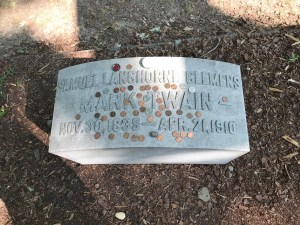
On a slightly hazy fall day, when the autumnal colors were alive, we stopped in Elmira.  To understand the significance of this stop, I should explain that from the time my daughter could appreciate it (and probably even before) we used to make fall literary trips.  We would take a long weekend and drive to where a famous author had lived.  Laura Ingalls Wilder in Pepin, Wisconsin, or Mark Twain in Hannibal, Missouri.  When we moved east we visited Edna St Vincent Millay at Austerlitz, New York, and Washington Irving in Sleepy Hollow.  More recently, in the spring, we went to see Rod Serling in Interlaken, New York.  So it was that we stopped in Elmira, New York, where Mark Twain rests.  I had always assumed Samuel Clemens was buried in Missouri, but his most productive literary period was his time in upstate New York, and it is here he remains.

His tombstone was covered with pennies and a few higher denomination coins, a rock or two, and a guitar pick.  People want to show their respects to the writers who’ve meant something to them.  I find this a moving tribute.  I suspect it happens at the tombstones of many famous people, but in Highgate Cemetery in London we found Douglas Adam’s small plot filled with pens stuck in the ground as mementos.  I travel through the world lightly, seldom carrying anything extra with me.  Somehow I never stop to think to bring a memory to the cemetery.  Fortuitously I had found a penny on the ground the morning we left for Elmira and I placed it among the others on Twain’s marker.  

What would make the appropriate calling card to leave?  I often wonder that.  If I had such a token, I suspect I would feel the need to revisit the various cemeteries of years past to leave a sign of my respect.  There are lots of them.  Edgar Allan Poe in Baltimore.  George Orwell in Sutton Courtenay.  H. P. Lovecraft in Providence.  Is there anything that ties them all together?  Pens seem an obvious choice, but stones are far more traditional (especially in Jewish settings).  The tradition is traced back to building cairns in biblical times, and the idea survives in that stones are more permanent than flowers and are a sign of respect.  Writers often have more elaborate items left, but it’s clear that they are removed from time to time by the grounds keepers.  Before I visit my next literary grave, I’ll give some thoughts to symbols and tokens and the importance of celebrating writing.