We Still Need Asherah

A very prominent documentary-making company contacted me today. It is in the research stage of planning a documentary on Asherah. I am overwhelmed that I have been asked for advice and that the old girl has finally received some public interest. Scholars are generally accustomed to spinning in smaller and smaller circles of specialization that have little draw for the wider public. Having said that, Asherah is, my own interests aside, a most fascinating deity.

One of the greatest obstacles to modern readers on ancient religion is the fact that gods don’t neatly fit into predetermined categories. We like to think of deities as the “god/goddess of –” where the blank is filled by some natural phenomenon. This is a fallacy that I once whimsically coined the “divine genitival construct.” It is easy to think of Baal as the god of rain, but he is so much more than that! I tell my students that they must think of deities as “persons” first; they are fictional characters, and like good fictional characters they have many aspects to their personalities. They are complex, multilayered, and often conflicted. This is especially the case with Asherah. She is a goddess who represents the royal female. Kind of hard to picture. Not queenship, but the power behind the throne. She is more familiar in the form of Hera in Greek mythology – the primary spouse who tries to keep a philandering husband in line. She is, however, a powerful goddess. She is mother of the gods, the character without whom no other lesser deities would exist. By extension, she is the producer of the gods who make our world possible.

Publications continue to emerge claiming all manner of hypostases for Asherah, many of which are unfounded. I believe it is because we all need the sacred mother, the female authority figure. Our society, still hopelessly patriarchal, yearns for the goddess who understands. Unfortunately, that is not this historical Asherah, it is the Asherah of the modern imagination. If she helps to assuage some of life’s inequities, however, even a mythical Asherah may still serve a valuable function today.
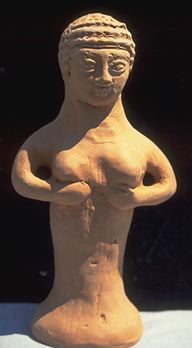
Not Asherah, unless you need her to be
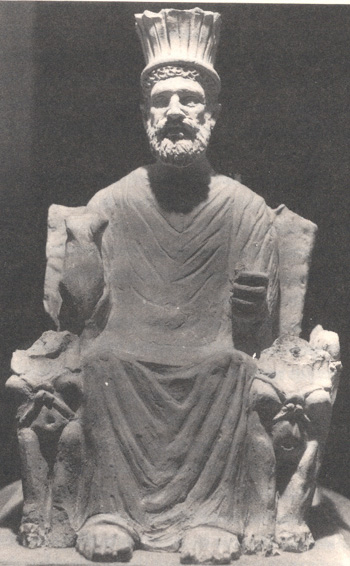

Hadad in Copenhagen

Let us talk plainly about the weather. Global warming is a reality, and yet the issue is clouded by religious conservatism. To be precise, it is difficult to determine whether it is really greed or the religious right that stands so firmly behind free-market capitalism that is driving this chariot of the sun. The strange and unholy alliance between religious and political conservatism, however, has become a force daily striving against reality and its proponents want to be on the top of the pile when the whole thing collapses.

I can not speak to the political end of this continuum; I am not a political scientist or economist. As a “religionist,” however, I recognize a deeply disturbing trend that I have followed since my youth. Fundamentalists have consistently taught their young that the “Second Coming” is only minutes, possibly seconds, away. Undaunted by the two-millennium delay in wish-fulfillment, they suppose the words supposedly uttered by Jesus indicate a kind of divine “I’ll be right back” just before pushing off from the Mount of Olives. The signs of the times given in the Bible describe the then current condition, yet modern-day Fundamentalists wish to force the almighty hand, call the bluff of the Texas Hold-‘em expert above. If the general in the sky said wars would come, well, we’ll make wars. If the only way to get his attention is by destroying the planet around us, so be it. Deny global warming for the sake of the religious right, since their world is about to end.

Baal in Copenhagen?

The rest of us might want to stick around for a while. Ancient meteorologists believed that particular gods controlled the weather. At Ugarit Baal, or Hadad, took responsibility for drought and plenty. If there was a problem, they knew just to whom to offer a sacrifice. In our monotheistic western world, we’ve pared the gods down to a single man. Not everyone agrees on his mood or character, but some are convinced that he has his bead trained right on this planet and they want to help from here below. Others believe — o the heresy! — that natural processes control the weather and that we can do something to make our situation better. We might be in a better place if those who believe the gods control the weather were relegated to theology classes rather than political offices.


Neo-Canaanites

The world of religious studies is full of surprises. Since people are forever seeking new forms of fulfillment, the endless variety of religions itself comes as no surprise, but the results of religious experimentation sometimes lead into uncharted waters. One of my students at Rutgers recently pointed me to a new religion called Natib Qadish, “the sacred path” in potentially vocalized Ugaritic. (Ugaritic, like most ancient Semitic languages, was written without vowels. Some modern scholars, basing their reconstructions on likely vocalizations known from other Semitic tongues, have tried to give voice to this dead language.) I have no idea how large a following this religion has, but it does maintain a substantial website explaining its core beliefs — the modern worship of the Ugaritic/Canaanite gods.

Unsatisfied with the tradition monotheism that eventually drowned out polytheistic voices in western religions, followers of these reconstructed religions are looking back to something more ancient, more primal, and perhaps, more human. What strikes me as odd concerning all of this is that religions such as Natib Qadish are based on extremely fragmentary understandings of ancient religions. We have perhaps a 101-level understanding of Ugaritic religion; some parts are very well attested, but there are huge lacunae that confuse the overall aspect. As I tell my students, ancient religion was based less on belief than it was on practice. Belief-centered religion is a relative newcomer on the historic scene. Ancients inherited their “religions” without question, based on where they were born. Tess Dawson, the founder of Natib Qadish, writes: “I have yet to find any word that means ‘religion’ in any of the ancient texts.” I would argue that it is because the concept of religion itself is a modern one.

Humans seem to have believed in gods from very early times. If gods are there, they must be placated. This is not religion; it is commonsense. Not to placate gods is to invite disaster. In Ugarit these gods included Hadad (Baal), El, Asherah, and Anat, among a host of others. These were the gods people “discovered” as they tried to fumble their way through a difficult existence. And gods like to eat meat, they learned. Sacrifice was born. What is a feast without ceremony? Ritual must emerge. I know this is overly simplistic, but belief doesn’t really enter into this scenario until late in the game. Heterodox belief was normative until Christianity assigned eternal consequences to correct belief, and now we are free to believe whatever we will.

As far as I can tell, Natib Qadish does not actually involve animal sacrifice to the gods (although it is based in Chicago, long known for its slaughterhouses). Like many modern Christians, the followers of this religion wish to reach back to a more pure form of ancient belief. It is an exercise in futility, however, in many respects. The framework has changed beyond recognition and we have no way of knowing what any ancient god would require of us in an internet age.

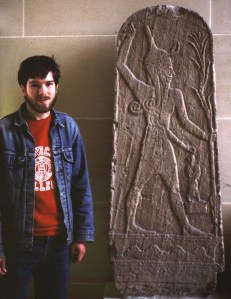
SAWHadad

A young Dr. Wiggins meets Hadad in Paris


Changing Faces of the Divine

One of the most intriguing books I’ve read on the origin of religion in the past few months has been Stewart Guthrie’s Faces in the Clouds (Oxford, 1993). Guthrie offers the suggestion that our in-born, evolutionarily driven need to see people or faces, even where these are false positives, may have led to the concept of god/s. As a respectable academic, I am obligated never to agree completely with anyone, but Guthrie seems to be onto something here. When I’m jogging in the pre-dawn hours it is amazing how many people are about — that is, until I get close enough to see that they are a small tree or a tall newspaper stand. We do see what we consider important everywhere.

The picture says it all.

The picture says it all.

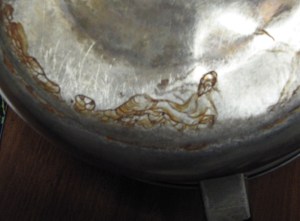
Having recently stumbled upon “Ghost Hunters,” I am amazed at how quickly some people (with the obvious exception of Jason, Grant, and the TAPS team) are inclined to claim a human shape to be a supernatural entity. This phenomenon is ubiquitous. On the web, while looking to find a good example of pareidolia to present to my class, I found an image of Michael Jackson’s face seared onto a piece of toast. If ever a divine sign was needed, here it is indeed! A more prosaic example was a natural water-stain I found on a saucepan in my own kitchen. I picked it up and asked my wife what she saw, just to assure myself I alone wasn’t crazy. Take a look and see what you see!

It looks like an oriental man reclining to me; perhaps an oriental Jesus?

It looks like an eastern Asian man reclining to me; perhaps an oriental Jesus?

Ancient religions were quick to put human forms on dangerous, threatening, or awe-inspiring phenomena. Lightning and thunder became the purview of Baal. It is a natural defense mechanism: you can pray to or offer a tasty animal sacrifice to Baal and the terrible storm will stop. Of course, in time nature itself would take care of it too. One summer at Nashotah House, however, the storms kept on coming. It was termed a “recurrent mesoscale convective system” by the meteorologists, but to the Baal worshiper it would seem that nothing could assuage the divine anger. Baal kept coming back at you. I have a photo in a shoebox somewhere of me standing nearly up to my knees in the icy rain water. Better to consider it human than to face unfeeling nature.

Today people still look for faces in the clouds to allay their fears. But we also have a rudimentary understanding of the physics of our universe. When people are forced to choose between facts and faces, when fear or extreme desire comes into the equation, the safe odds are always on the faces.


Sects and Violence

Religion-sanctioned violence has a long (overly long) pedigree. Early myths going all the way back to the Sumerians incorporate violence on the part of the gods. Depending on one’s school of interpretation, this could be seen as “form following function” — people saw the violence inherent in nature and projected its causation onto the source of nature, namely, the gods. Ancient people did not perceive of the world in terms of natural phenomena. “Nature” behaved the way it did with will and reason, the will and reason of the gods.

The stories preserved from ancient Ugarit stand as witness to this conceptual world. In one story, Kirta by title, the eponymous king Kirta seeks a family and has his wish granted by El and Baal. Hedging his bets, he makes a vow to Asherah that he forgets to fulfill. Asherah sees to it that Kirta’s divine gift comes undone. More obvious is the tale of Aqhat, another divinely granted child. Aqhat is given a bow by the craftsman god Kothar-wa-Hasis, only to have it coveted by Anat. When he refuses to release it to the goddess he is unfortunately pecked to death in a hitchcockian demise by a swarm of buzzards with attitudes. Violence is introduced into the human realm by the gods themselves.

Today, some 3,000 years after Ugarit, we still find ourselves living with violence sanctioned by religion. Whether it is as obvious as extremist factions of a religion calling for outright attacks on others, or as subtle as self-professed righteous believers destroying a colleague’s career in the name of Jesus, religion is used as a mental crutch for striking others. While I can not walk all the way with Christopher Hitchens, I do have to acknowledge that when it comes to human-on-human violence religion is a socially accepted motivation, no matter how pure its original intentions.

Hypatia, a scholar-martyr due to religious violence

Hypatia, a scholar and martyred victim of religious violence


What’s a Ugarit?

Self-knowledge for any society begins with a knowledge of its past. We identify ourselves with where we have come from and what we have experienced. As denizens of a highly technological world in which change occurs rapidly, it is easy to forget that in ancient times technology progressed at the rate of centuries, or even millennia. The rapidity of cultural change is closely linked with the efficiency of communication with large groups of people over great distances. Working together we build on the many stories already built below us, we begin on a higher level than those in the stories below us did.

When we think of the Middle East, named from the western penchant for placing itself at the geographic center, we think of it as a region of perpetual conflict. Looking beyond our accustomed frame of reference, this region of the world is also where western civilization itself began. It was here that written communication itself was conceived. Ancient Egypt and Mesopotamia have often captured the western imagination. When enumerating the important archaeological discoveries of this region, most informed people would easily tick off the Rosetta Stone, King Tut’s tomb, and the Dead Sea Scrolls. Missing from most rosters would be Ugarit, an ancient city of incomparable importance among the lower stories of the tower of our society.

The great founding nations of civilization grew along the banks of west Asian rivers. Apparently developing independently, Egypt flourished along the Nile and the nations of Mesopotamia along the Tigris and Euphrates. The Euphrates was the quintessential waterway of the ancient world, known by many as simply “the River,” just as the Mediterranean was “the Sea.” Early in human history the city-states of Mesopotamia coalesced into united ventures recognizable as nations. The same unification occurred in Egypt and among the Hittite peoples of what is now Turkey. The basic unit of civilization, however, tended to be the city-state.

(Please see the Full Essays page for the remaining text of this essay.)