Horror Homework

If you write about horror movies, you have to do your homework.  Of course, this means time away from house work (the weeds love all this rain and hot weather) and regular work (which can’t be compromised).  Mario Bava has often been cited as one of the influential horror auteurs, but until this year I’d not knowingly watched any of his films.  So, homework.  I saw a list of movies that made an impact, and one of them was Blood and Black Lace.  It’s horror of the giallo subspecies, never my favorite.  But it was free on a commercial streaming service, so, well that homework’s not going to do itself!  This isn’t generally considered Bava’ best work.  Besides, giallo is murder-mystery and I prefer monsters.  Who wouldn’t?
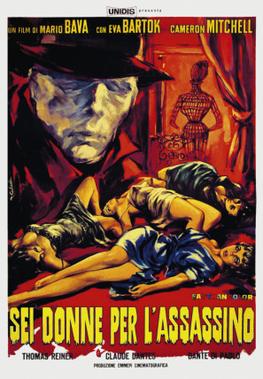
This film, with its lurid colors and stylistic cinematography, does make an impression.  The acting is poor and the script even worse—apparently it didn’t lose anything in translation.  A crooked couple run a fashion salon.  (There will be spoilers, so if you’re sixty years out of date, be warned.)  One of their fashion models is murdered, but when another discovers her diary the body count mounts.  The film lingers over the murders, which, I suppose, is one of the reasons it’s classified as horror.  With the film’s problems, however, at least this far removed, the whole thing begins to look rather silly.  The women have to die because of the first woman’s diary.  The police are singularly ineffectual, not even taking standard kinds of precautions.  Even with a run time of only 88 minutes it felt too long.

Horror in the sixties was still finding its way.  I’ve been watching a number of movies from that era—generally considered a dry spell for American-made horror—and the results have been interesting.  There are some gems tucked in amid the gravel.  What we’ve grown to appreciate in more contemporary horror cinema learned a lot of lessons from these early exemplars.  I could see foreshadowing of Suspiria here.  I’ll need to do more homework to find other direct descendants, though.  Blood and Black Lace suffers from having too few characters you get to know well enough.  The models, who all seem to have some secrets, die off before we get to know them.  Even the criminal pair behind the killings die in the end.  There’s a kind of nihilism to the story, and it’s all done for love of money.  The story could’ve been better, but you have to start somewhere when growing a genre.  And doing homework.

Yucca

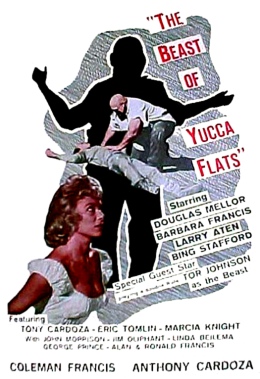
Yucca Flats isn’t the kind of place you’d like to vacation.  Not only is it highly irradiated by nuclear testing, it’s also a place where police shoot at innocent people.  The only salvation seems to be that they’re terrible shots.  Oh yes, and there’s a Russian scientist transformed into a beast by an atomic bomb blast.  As you can tell, I’ve just been to Yucca Flats.  In movie-land, of course.  The Beast of Yucca Flats, yet another candidate for the worst movie of all time, really worked hard to obtain that title.  The movie did make me curious about Coleman Francis, however.  Like Ed Wood, he tried to make his way in the rather unforgiving movie world with tiny budgets and even less native talent.  The number of scenes where guys had their butts to the camera alone raises all kinds of questions.

The numerous contradictions in such a short movie—less than an hour—and the long scenes that add nothing to the plot are signposts that we’ve entered the twilight zone of B movies.  Famously filmed without sound, the incongruous dialogue later added as voiceovers, adds to the surreal atmosphere.  The movie shares Tor Johnson with Ed Wood.  And also, apparently, a sincerity betrayed by lack of ability.  The cult status of movies like this signal hope for those who try to make their own way in a world enamored of big budgets and large crews.  It would help, though, if Francis had a clear story to tell.  He does seem to have Luddite tendencies, and he condemns violence even as he has a sheriff’s deputy literally “shoot first and ask questions later.” 

The movie has a couple of moments of cinematographic finesse.  The moment when Lois Radcliffe approaches the car, shot from the interior, when Hank lays his arm across the door, made me think something better might be coming.  Tor Johnson wasn’t the most gifted actor, but he always seems to have fun with his roles, being cast as a hulking monster.  It’s too bad he doesn’t have a bit more screen time in this, his last movie part.  He kinda makes me want to hunt down some of his other appearances beyond the Ed Wood films I’ve already seen.  There’s a story here, I expect, that really hasn’t been told.  There’s an entire world—a twilight zone—outside Hollywood where producers with no budgets but a passion for making movies plied their trade.  Their efforts, as paltry as the results may be, suggests there’s more to the movie world than it might seem.


Small Things Grow

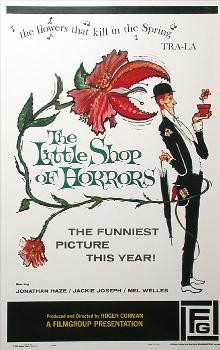
I’ve always been fascinated with origins.  I guess I’m a kid who never grew up.  Now that I’ve turned my attention to movies, I sometimes wonder about the origin of the story.  For example, The Little Shop of Horrors.  I first saw the musical movie version of 1986.  It was cute, and employed horror themes like the Rocky Horror Picture Show from the previous decade.  Then, when Roger Corman died, I read that he’d filmed the story back in 1960.  Curiosity compelled me to watch the original.  Like its remakes, it’s comedy horror, or horror comedy.  But beyond that it’s a literal farce.  Roger Corman was a showman, and that means he tried different things to entertain.  One of them was Little Shop.  The idea of the plot you probably know, but I couldn’t remember the ending as I sat down to view it.  After all, it’s not meant to be taken seriously.

I have to say that the music makes it better in the remake.  The endless malapropisms and burlesque humor are funny, but really in the original they are presented as low comedy.  The Jewish humor was early on I feared might be anti-semitic, although not intended that way.  I empathize with Corman.  It took him nine months to find a company to release the film.  Ironically, it attained cult status after being double-billed as the B movie with Black Sunday, which was a quite serious attempt at horror.  Camp has a way of living on in cult status.  Of course, the early bit part for Jack Nicholson didn’t hurt.  It isn’t bad for a bad movie.

The idea of people-eating plants is a reasonable approach for a horror story.  (I’ve used it myself.)  Plants move very slowly, however, which is one reason that the idea’s hard to accept.  Even The Land Unknown had used the idea three years earlier.  But the seed was planted.  The idea of the film lead to an Off-Broadway show, which led to the more famous movie.  Then it reopened off-Broadway and a reboot was planned (but currently seems to be on ice).  Not bad for a movie based on a desire to reuse a set that was scheduled to be torn down, and then shot in two days.  Classic Corman.  The result was a bad film that is still fun to watch all these years later.  I did miss the musical numbers, however.  When you plant seeds, you never know what might grow.


Shifting Gears

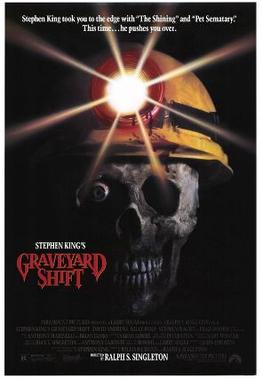
The question’s very basic: do you pay with cash, or by watching commercials.  When it’s the same three commercials the whole way through—for products you’d never buy—just paying the cash may seem the better option.  But it’s too late for that.  It’s the Graveyard Shift.  There’s no doubt  that Stephen King is responsible for the ideas for more horror movies than probably any other single individual.  I’d read his story, “Graveyard Shift,” many years ago.  I was warned, though, that this was one of the least favorite of his adaptations, and that’s a pretty low bar.  Still, it was just a matter of sitting through the same commercials over and over.  And one of them was more entertaining than the movie.  Of course, I don’t really watch for entertainment.  This is a learning opportunity.

Let’s start with the basics: You need at least one sympathetic character.  Okay, you kinda like Jane, because she shows basic humanitarian traits.  And Carmichael.  Then you want a plot that makes some sense—what is Warwick’s motivation?  The writing is particularly bad.  If there’d been a bit more intentional camp, this might’ve made a reasonable horror comedy.  I mean, you’ve already got the empty aluminum cans being fired by slingshot.  As it is, it’s played straight with an evil foreman, rats everywhere, and a giant bat in the basement.  By the end you’re kind of rooting for the bat.  And whose idea was it to use voiceovers of the sub-par dialogue over the closing credits?  Is this so bad that it’s good?  I’m having trouble deciding.

Although set around the fourth of July I wouldn’t call this holiday horror.  Nevertheless, there are some moments of religious imagery that pop out.  The graveyard sinking in the river has a listing statue of Jesus near the start of the film.  And the exterminator—the only real camp in the flick—narrates how in Vietnam they pinned victims down, like Jesus, to feed them to the rats.  The final couple of minutes—well earned, I assure you—have Hall fighting the wicked foreman with the jawbone of an animal (one has to assume an ass), inexplicably among human bones (some still in their coffins).  And his slingshot ultimately killing the giant (bat).  The references are to Samson and David, respectively.  Perhaps this movie’s an indictment of capitalism, since the basement cleanup is on Independence Day.  Or maybe it’s just tired horror tropes on a break.  (Having one of the characters reading Ben in the diner was a nice touch.)  It may become a holiday tradition after all.


Praying for Mantis

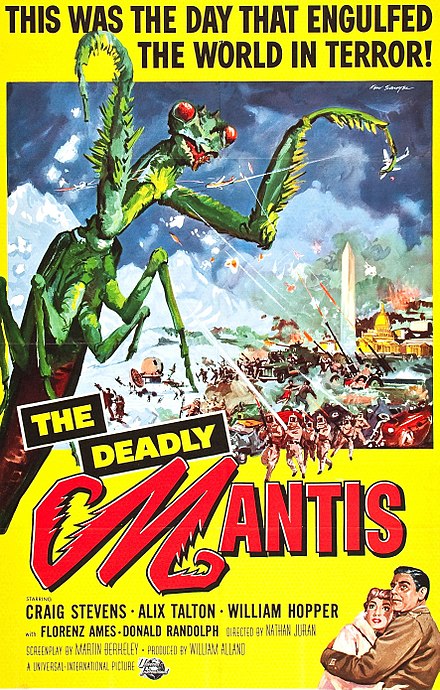
Now this is a Cold War movie.  And I mean “cold.”  The Deadly Mantis is one of those movies that hovers between “so bad it’s good” and just plain “so bad.”  I was kind of rooting for the mantis.  In any case, this was an ambitious movie for the time but it reflects the post-war paranoia in the United States.  It also makes very abundant use of stock footage, much of it military.  You almost expect a recruiting ad at the end.  (It does thank the Ground Observer Corps in the closing credits.)  Okay, so here’s the story.  A volcano in the south Atlantic causes the calving of an enormous Arctic iceberg near the North Pole.   That iceberg contains the frozen body of a 200-foot praying mantis from dinosaur times.  Even earlier.   Said frozen mantis, quite hungry after millions of years, begins attacking Arctic radar bases and flying south.  The Air Force calls in a paleontologist to help identify what they’re looking for.

The mantis is so big that it prefers people for food, although, one might note, a polar bear would’ve been easier prey.  In any case, given the technology limitations of the time, the military has trouble keeping track of the insect as it flies over the most populous part of the country.  They do get the cloudiness of the East Coast about right.  Eventually they shoot it down—actually a fighter jet crashing into it does the job—over Newark and the mortally wounded mantis crawls into the Lincoln Tunnel (called “The Manhattan Tunnel” in the film).  By this point the viewer is saying “just let the poor thing die in peace,” but they pump smoke into the tunnel, presumably to hide wires and other props, and commit a protracted insecticide.  

Now, I’m one of those people who hates to hurt any animal.  The death twitches of an insect are quite troubling, so I try to catch what I can indoors and release them.  I have trouble with the instructions to kill spotted lantern flies—it’s not their fault that they’re here.  The movie shows a bravado regarding the military and a machismo regarding the main female character that hearkens back to why it was so necessary to evolve out of the fifties.  Of course, we learned nothing from The Deadly Mantis and have catapulted back into a new Cold War and an even more robust military.  William Alland, the producer, had a real love of this genre of movie, and for that we have much to be grateful.  But even the big bug genre can produce a real groaner now and then.


No Demons

There’s a connoisseurship about it.  Making bad films, that is.  It’s a wonder that Night of the Demon—I should specify 1980 as the year—hasn’t really become a cult film of any standing.  You can tell the maker tried hard to shoot a reasonable film, but with a nearly Ed Woodsian level of incompetence.  It lacks Woods’ artistry, however.  For those just getting on the Bigfoot kick in the new millennium, it might help to know that Sasquatch was big in the seventies.  Yes, the first real efforts to sort this thing out came about when the psychedelic seventies were underway.  The documentary The Mysterious Monsters came out in 1976.  The first serious efforts to explain Bigfoot as not just a hoax began.  And James C. Wasson, Jim L. Ball, and Mike Williams took a shot at making a horror film of the hairy guy.

The acting is about the worst you’d care to see, and the script is abysmal.  The effects are anything but special, and the flashback scenes incongruous.  But it does have significance for religion and horror.  It goes like this: a professor and some students go to investigate a series of Sasquatch-related murders.  They’re led to “Crazy Wanda,” who lives alone in a remote cabin.  Wanda, when finally persuaded to talk, reveals that her crazed preacher of a father killed her Bigfoot-hybrid baby.  His followers still perform demonic rituals in the woods, worshipping the Sasquatch.  Wanda had burned her father to death in retaliation for killing her child—she kinda likes Bigfoot, it turns out.  The professor and students, naturally, fall victim to the beast.

Only the professor survives.  He’s assumed to be criminally insane and suspected of murdering his own students.  It’s almost painful to watch a movie where everyone is trying so hard to do it well, but just can’t seem to manage it.  The plot line about the cultists is immediately dropped after an intended rape ritual is interrupted by the professor.  Wanda’s preacher father, who seems to fit into no particular form of Christianity, has no motivation beyond avoiding Hell for himself.  At one point he seemingly admits killing her mother.  There’s even a scene where Bigfoot kills two Girl Scouts.  With all of this going for it, you might think it would’ve picked up a following.  It has some fans, I’m sure, but I’m not certain that it’s well enough known to make it onto lists of worst movies of all time.  More’s the pity since it would absolutely deserve it.


Movie Prophet

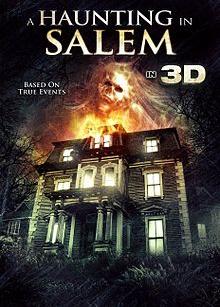
Is there such a thing as a movie so bad that it can distort reality itself?  If so, I nominate A Haunting in Salem.  A little explanation.  I am trying to develop an aesthetic for bad movies.  I’m finding it not too difficult for movies that are so bad they’re good.  Usually such movies are fun—whether intentionally or not.  But there is a class of movie that is poorly written, poorly acted, poorly lighted, poorly set, poorly premised, poorly directed, poorly paced, and all without a hint of humor.  That’s this movie.  I watch bad movies because of my expensive habit.  I stream movies.  Since I work 9-2-5 and I’m tired by 5, I do this on weekends.  I’m not paid enough to afford renting movies every single weekend, so I look for what I can find on the services I can access—Hulu, Netflix, and, mostly, Amazon Prime.  I try to find something that grabs me.

I watched A Haunting in Connecticut and A Haunting in Georgia, as well as their remakes.  The Salem in the title made me think this might have something to say about the Witch Trials.  Perhaps it did but I was so busy groaning that I couldn’t hear it.  Although set in Salem it was filmed in Pasadena (who would notice?).  They used a 200-year-old house as a 400-year-old house, as if there’s no difference.  There’s a scene where the daughter asks her mother about her father’s PTSD.  She says something like, “He shot that man in the war.  He thought he was a bad guy, but he was a good guy.”  It’s difficult to write this badly, even if intentional.  Sorry, I’m getting away from Salem.  Well, it turns out that the witches were buried on the property of Judge Corwin’s house and they kill every sheriff and all their families, when they move in.  This has been going on for four centuries but nobody has caught on?  Even a scene where the mayor is shown raising the flag outside his office had me scratching myself bald.  Is that one of the mayor’s duties?

Most of the time the actors act like there was no direction—showing the wrong emotions and not even remembering what was said just a minute ago.  And you can’t really feel for anyone other than the deputy who seems to be trying to be a nice guy.  Maybe this is my calling in life—to serve as a prophet warning my small band of readers what movies not to watch.  I can’t recall the last time I couldn’t wait for a movie to end so that I could wash my eyes out with soap.  Avoid A Haunting in Salem.  Don’t even consider it.


They Come in Batches

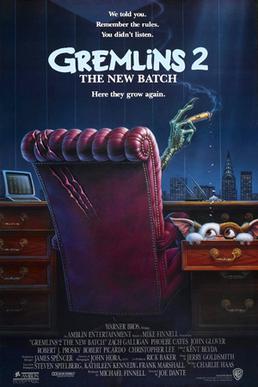
There’s horror and there’s comedy horror.  And then there’s just plain silly.  Gremlins 2: The New Batch falls into that last category but with the strange factor that it’s silly without being funny.  There are a few smirk moments, and sometimes the self-parody approaches clever, nevertheless it’s bad.  It’s a big budget bad movie.  The idea that the gremlins try to take over New York City is funny, at first, but other than Phoebe Cates and Christopher Lee, they don’t seem to know this is a satire of Gremlins.  I guess not knowing about the plot—I tend not to read reviews about movies before I see them—I was expecting something more like the first one, which I thought was pretty good.  The only reason I knew the movie existed at all was that the Blu-Ray version of Gremlins comes with The New Batch.  The late eighties and early nineties I was spending holed up in Edinburgh working on a Ph.D.  We didn’t have much money and didn’t see many movies.  We had no television (there is, or was, a television tax in the UK), so I never heard of the sequel.  

I presume we all know the three rules of mogwai, and needless to say, they immediately get broken.  The eponymous new batch takes over the Manhattan tower of Daniel Clamp.  His high-tech building needs no gremlins because the technology already doesn’t work well.  The high rise houses, among other things, a genetics lab where Christopher Lee camps it up, but which means the gremlins have access to formulas that allow them to grow wings, tolerate sunlight, and become spiders.  Sound silly?  You betcha.  One of the gremlins is even able to talk.  I watched with increasing stupefaction. 

Bad movies and cult followings are the peanut butter and jelly of cinematography.  Some bad movies never attain cultdom, but I can see why this one has.  The big budget ensured glitz and special effects.  Even the self-awareness to have Hulk Hogan being able to control the gremlins in the theater with a threat almost gives the movie an art film feel.  The horror, mostly based on the fact that there are monsters, is tightly constrained.  Although I felt increasingly like I was wasting my time as the movie went on, upon reflection I can see why some people have glommed onto it.  It may just have edged over into the so bad it’s good category.  I’ll need to think about it.  And avoid eating after midnight.


Which Witch Where?

I like to think of myself as a kind critic.  I’ve been on the pointy end enough to know how it feels when those who don’t like my work are unkind.  I’ll try to find a nice way of saying Witches of Amityville, or Witches of Amityville Academy, must’ve been shot on a very modest budget.  It must’ve been written by someone who’s still working hard to master the craft.  And the actors are continuing to improve as the director gets better at that role.  Why did I watch it?  Amazon Prime gives it four stars.  The incongruity of Amityville and witches suggested it might be a bad movie, and in that regard it did not disappoint.  So what’s going on here?

There’s a witch academy in Amityville.  Although all the cars have steering wheels on the right, everyone speaks with American accents, apart from a couple of characters.  The interior shots, however, are also pretty British for the most part.  There does seem to be some awareness that Amityville is in the new world.  In any case, said academy is run by an evil coven that is seeking to release the demon Botis.  To do so they have to sacrifice college-age women (and no, it’s not that kind of movie).  One of their intended sacrifices escapes and is found by three white witch sisters who also live in Amityville.  They decide to train this young woman who, as it turns out, is a very powerful witch.  Problem is, the director of the academy can’t release the demon without sacrificing this particular victim.  So she kidnaps her back.  The three good witches burst on the scene, actually more like just walk on, and prevent the sacrifice.  The bad witch kills herself and releases the demon, but the young witch is so powerful that she destroys him.  In the end the witches must go to Salem.

What’s not to like?  Some of us, day by day, year by year, work to improve our writing skills.  We write stories that incorporate whatever ability we’ve managed to scrape together.  And we struggle to find publishers.  I like bad movies because they are a great place to find hope.  The world’s a big place.  Even the entertainment industry is large enough to absorb movies produced by Amazon, Hulu, and Netflix, among others, including the big studios.  They’ve got to be looking for content, right?  Those of us who channel our creativity towards writing, and who keep trying to get it published, have a chance, don’t we?  What’s the harm in believing in the power of magic?


The Third

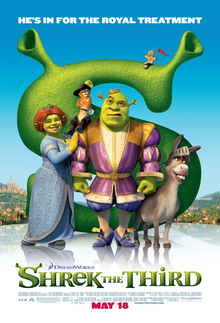
I don’t know what possessed me—and I use that verb intentionally—to suggest Shrek the Third for weekend viewing.  Apart from a Rosemary’s Baby and Exorcist mashup scene, it is a bad movie.  I’ve been watching bad movies over the past few months, and developing an aesthetic for them, but I just can’t warm to Shrek the Third.  The first two movies were quite good, and sequels frequently struggle.  I’m trying to put my finger on why this one leaves such a bad taste in a viewer’s mouth.  For one thing, it’s the writing.  Not as snappy or crisp as the first two, it drags with politically correct emotional adjustment as Arthur tries to learn to be king and Shrek reconciles with being a father.  What happened to the histrionics of Lord Farquad?  Or the cluelessness of the fairy tale creatures with no leader?  Instead there are hugs and reassurances.

Not that hugs and reassurances are bad, but they’re not Shrek material.  Sudden character shifts don’t help either.  The real thing, however, seems to me, to be the music.  Many movies patch in contemporary songs to set the mood.  The first two Shreks did this remarkably well, with one narrowly edging out two in several places.  The Third lacks this artistry.   The pop songs chosen just don’t fit.  They tank the mood time and again.  Music is important.  It can make or break a film.  In this case it’s only one problem.  To me even the animation seems rushed.

There is an aesthetic to bad movies.  I guess I was hoping to find it here (I’d seen it before, years ago).  Maybe badness in movies is harder to make good when they’re animated.  There’s an intentionality about everything when you know everything on screen was planned to appear exactly as it does.  Good bad movies entertain.  There’s a reason we come back to them, even knowing they’re not great.  As someone who’s written for his entire literate life, I tend to think that good writing can redeem most movies.  We can put up with low budget effects if the writing is strong.  There’s a reason Casablanca is a classic, despite the low budget.  The Third has the tag line, “The best Shrek yet.”  Considering the bar set by the first two, that was a boast not likely based on anything like facts.  Or taste.  I’ve got to wonder, however, when big budget animations start going off the rails, when is it decided to simply let them go and hope that a classic will emerge?


Not The Sting

Why do we make the decisions we do?  Watch the movies we do?  I have to confess that for me a number of strange factors combine to make for some weird choices.  For example, Invasion of the Bee Girls is difficult to explain apart from compounding oddities.  One is that Amazon Prime auto-suggested it too me (for free).  Yes, I have a history of watching bad movies and this definitely fits that bill.  Fuzzy-headedness during my weekend afternoon slump time probably played into it.  Along with the fact that I’d been researching bees and that brought the movie The Wasp Woman back to mind.  Wasp woman, bee girls?  It’s free and I’m not going to be able to stay awake otherwise.  The movie is about what you’d expect from a low-budget 1970s sci-fi horror film.  It did make me think I should read about movies before I watch them rather than after.

Nevertheless, I’m trying to develop an aesthetic for bad movies.  If you’re a regular reader you’ll know that I have a fascination with Ed Wood and his films.  I even read a book about him and also read a book on why it’s okay to like movies that we tend to label as bad.  No matter how you parse Invasion of the Bee Girls, it’s bad.  The acting, the writing, the plot.  Still, some of us have a taste for films from the seventies—it’s kind of a nostalgia trip since I was really only becoming aware of the odd world of science fiction about then.  Nicholas Meyer, who wrote the initial screenplay wanted his name removed after he saw the changes that’d been made.  That should be telling you something.

Meyer, while not a household name writer, did pen some good detective stories about Sherlock Holmes, and wrote, uncredited, both Star Trek II: The Wrath of Khan and Fatal AttractionInvasion of the Bee Girls has a somewhat salacious plot that fits the Zeitgeist of the seventies of which I was unaware, growing up.  The seventies were my sci-fi high point, it was good escapist material for someone living in a situation less than ideal for day-to-day living.  I watched, for example, Killdozer about that time and thought it was great.  Now that streaming is how we watch, the amorphous internet has a record of what we’ve seen and then recommends products for us based on our record.  I really thought we outgrew being tracked all the time.  Little did any of us know that it was only getting started in high school.  And as long as you have a penny to spend, those who track us will try to figure out how to take it.  You could get stung.


One Demonic Night

I only discovered after watching Night of the Demons (2009) that it was a remake.  Eventually curiosity got the best of me and I had a spare moment to watch the 1988 original.  It’s still kind of a bad movie, but it is scarier than the remake.  It’s also a horror comedy, but the emphasis is a bit more on the horror here.  A group of ten high schoolers go to Hull House, which used to be a funeral home, for a Halloween party.  When the power goes out they decide to have a séance.  Unbeknownst to them, however, there is a real resident demon.  This demon gets passed on through kissing, and it animates the kids who’ve been killed along the way.  Although the final girl is pretty clear from the beginning, in a usual twist the only surviving guy is African-American, the son of a preacher.

The concept of demons here is explained as entities that were never human.  This is the explanation Ed and Lorraine Warren used, often without making reference to fallen angels.  Since the demons are using the physical bodies of the kids, they can be stopped by locked doors, but killing them doesn’t really help, since they keep coming back.  It seems that there’s really just one actual demon, a dragon-headed entity that lives in the crematorium.  Rodger, the Black man, brings the element of religion to the story.  He objects to the séance in the first place, and suggests that they pray as he and Judy, the final girl, are attempting to escape.

In-between all this is sandwiched the gore and violence that make it pretty typical horror.  The humor involved, however, makes it less intense than a typical slasher.  Although I didn’t walk away thinking this would be a favorite movie, I could see why it’s garnered a cult following.  As is often the case, the original is better than the remake.  For one thing, it understands that religion seasons horror quite well.  Demons are, by definition, religious monsters, at least traditionally.  And the two “good kids” who survive are uncomfortable with messing with spiritual forces to begin with.  Judy just wants to go to the dance, after all.  The movie went on into sequels as its cult fandom grew.  If I ever do a sequel to Nightmares with the Bible I’ll need to include this franchise, I guess.  For a sleepy weekend afternoon, there are worse bad movies to watch.


Through the Woods

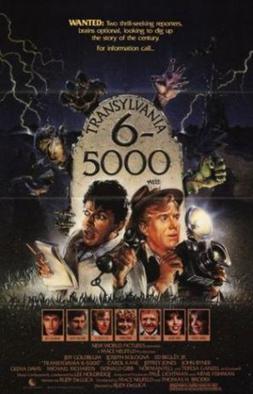
The thing about appreciating bad movies is that it’s difficult to be disappointed.  On a recent weekend I’d watched a horror film that didn’t sit well with me (or maybe it was the last night’s supper), and I decided I needed to see something else.  Something that was free on my streaming service.  I’d read about Transylvania 6-5000 someplace, but I couldn’t remember where.  The list of stars won me over: Jeff Goldblum, Ed Begley Jr., Jeffrey Jones, Geena Davis, Michael Richards—why don’t more people talk about it?  Because even for a comedy it has trouble working.  Well, a horror comedy, to be precise.  Emphasis on the comedy, which tries too hard.  I couldn’t get over the fact that this was a tall guy movie—Goldblum, Begley, Jones, and Richards are all over six feet tall.  Usually other actors literally have to look up to them.

Even though it’s a groaner, it’s not without worth.  It was filmed in what used to be Yugoslavia when it was rare for anything to come from behind the Iron Curtain.  Set in Transylvania, it wasn’t too far off.  (Transylvania is located in Romania, of course.)  Some of the performances aren’t bad, Davis’ vampire nods to Frank-N-Furter in Rocky Horror, and Carol Kane is fun to watch as Lupi.  The male roles are generally the problem.  In case you’re wondering, the plot is that two reporters—Goldblum and Begley—are sent to Transylvania to find a story.  The locals laugh at them, insisting Transylvania’s a modern country with no monsters.

When the classic monsters do appear, they all have rational explanations.  There are riffs off vampires, werewolves, Frankenstein’s monster, swamp monsters, and the mummy.  There’s even a mad scientist.  The problem is the movie really doesn’t give itself over to either comedy or horror.  There are ways to make that combination work.  And, as with C.H.U.D., the title put me off.  I didn’t know until reading about it later that it was also a riff, but from the Glenn Miller song “Pennsylvania 6-5000.”  I’d never heard the song before and was unfamiliar with its title.  Rudy De Luca, the director, had worked with Mel Brooks and perhaps if they’d collaborated on this one the results might’ve been better.  So, it’s a bad movie.  That doesn’t mean it isn’t worth watching.  Movies like this sometimes serve as an homage to the monsters with whom we grew up, and who even met Abbott and Costello in their own lifetimes.  Just be prepared not to take it too seriously and not to laugh too much.


Gateway Horror

I’m in two minds about The Gate.  Part of me says “bad movie” while another part says, “Yeah, I’d watch it again.”  A third part of me knows I probably will.  It came out in 1987 as family-friendly horror.  There’s far too much going on for the run-time and the acting is lackluster (child actors who can really pull horror off are rare; perhaps those with more life experience make it believable).  It does have some Poltergeist vibes, though.  So, Glen (12) and his sister Al (15) are allowed to stay home without a babysitter for three days.  A couple nights before, a storm blew over a tree in the backyard, and Glen, with his friend Terry, accidentally open the eponymous gate at the hole by breaking open a geode, allowing demons to come into the world.  And, of course, the parents are gone.

Glen fears he is losing his sister to, well, growing up.  They used to do model rockets, but now she’s interested in boys.  Terry listens to heavy metal and discovers in an insert to an album of a European band, Sacrifyx, that they’ve opened the gate.  As night falls, the stop-motion demons attack.  They’re little and can be blocked by doors.  Al, Glen, and Terry have to figure out how to stop the demons and seal the gate without the Dark Book insert from the Sacrifyx album.  What to do?  They grab a Bible and try reading a bit.  When it doesn’t seem to be working, Terry utters an expletive and throws the Bible into the hole.  It works!  But, ah, this is only the false resolution.  The really big demon bursts through a hole in the living room floor after Terry and Al are both taken.  Glen, left to his own devices, launches a model rocket at the demon, destroying it.

Okay, sounds bad, right?  The reason, it seems to me, is that it doesn’t put religion to work for itself.  The instincts seem good—use the Bible—but the demons are too corporeal and too physical.  There’s no possession here.  In fact, the demons are the old gods (we’re in Lovecraft territory now) who want to take over the world once again.  There’s some good material to work with in The Gate, and if I ever get around to a sequel to Holy Horror I’ll have to include this one.  Overall, the message seems to be that if the Bible doesn’t work, use a rocket.  Oh, and don’t give up on your sister.


Not Handel’s Messiah

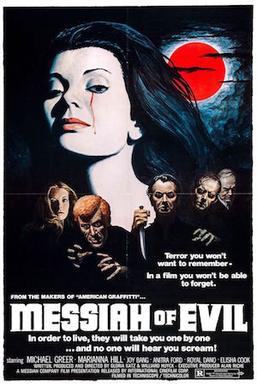
It’s polarizing.  Even now, nearing fifty, Messiah of Evil is either adored or excoriated.  So it was at its release.  I was pointed to the movie by an adorer—a somewhat unexpected New York Times seasonal article.  Suggesting that there’s nothing else like it, the article recommended it for autumnal viewing.  So, what’s it all about?  I’m not really sure, but that won’t stop me from trying.  Arletty is a young woman who wants to find her father (with you so far).  He’s moved to New Bethlehem, California, now known as Port Dome.  She finds his house abandoned, and the locals decidedly unfriendly.  Her father’s diary explains that he’s transforming into something inhuman.  The locals are cannibals, it turns out, awaiting the return of, well, the messiah of evil.  (The title is never used in the movie.)

Although I learn more towards the excoriating opinion of things, this is a great horror and religion film.  The original messiah of evil was a preacher stranded with the Donner party.  He started a new religion and, wanting to spread it, went to California.  Now, whenever a blood moon comes, he arises from the sea and his followers become aggressive.  The movie is set a century following this first appearance, and the dark master is due to return.  His followers await him on the beach, and Arletty is their intended sacrifice.  Elements of Lovecraft are clearly evident—people transforming, old gods, evil emerging from the ocean.  Yet, there are many things unexplained.  Or maybe I’m just naive.

The male lead, Thom, travels with a mini-harem.  He’s in Port Dume because he likes to gather folktales—like the blood moon—and he likes Arletty’s father’s art and came to buy some locally.  The movie features a blind art dealer, cops who apparently know nothing about the infestation of ghouls in their town, and a guy who could drive away from the attacking hordes who decides to run instead.  The directors (Willard Huyck and Gloria Katz) were a talented couple, but this wasn’t their best collaboration.  Still, many recommend this as an overlooked horror gem from decades ago.  Others not so much.  I’m glad to have seen it, although I fall into the latter camp.  Mainly because it continues a theme that I’ve tried to pick up at several points on this blog—that horror and religion have a great deal in common.  Even if one (or both) shows its age and fails to impress.