Persistence of Demons

Although released in April, Insidious is a film for the long nights of winter. At least with my schedule of keeping up with a culture that is moving too fast, this feels like a reasonable rationale for having just watched it. I tried not to read reviews of the movie when it came out since I prefer to experience the thrills first hand when I watch a film. Like many horror movies, Insidious revolves around the supernatural. Specifically, Insidious takes on the specter of the afterlife. Unlike The Exorcist, the demon in Insidious is not expelled by a priest, but by a psychic, borrowing a few celluloid feet from Poltergeist. Adding a couple of ghost hunters to the plot reinforces the idea of the secular demon that so often appears in the learned discussions of the TAPS team as they tilt with unseen entities on SyFy.

In an increasingly secular society, the fear of the dead is very much alive. Even a casual stroll through Barnes & Noble (the only show in town now) will demonstrate the popularity of the paranormal. Somehow sitting in pews listening to a sweaty orator go on about what he (sometimes she) thinks God is wanting us to do has disconnected us from the realm of the dead. Paul Tillich famously declared that God is a person’s “ultimate concern.” In an age when technology is hovering on the edge of keeping consciousness alive forever, people wonder what happens to the self when the body dies. Call it soul, consciousness, mind, or personality, we can’t deny—no matter how secular—that something inside makes each of us unique. The myth of flying about with angels playing harps doesn’t match everyone’s expectation of an afterlife any more. At least some of us hope for electric guitars.

Insidious opts for a realm like Limbo known as “the Further.” This is a place we have been before. The hopelessly corny The Seventh Sign gave us “the Guf” as a now empty federal reserve of souls. The Greeks gave us Tartarus and the Zoroastrians “the place of worst existence.” No matter what we call it, our brains like to believe there is some place out there that we go when the biomass we drive each day finally hits the wall. Increasingly it has become a negative place where darkness reigns. Insidious’s “the Further” is a hopeless realm of the dead, acting out their evil intent. There are no angels, but demons abide. It seems that we’ve outgrown the concept that angels are watching over us, but we can’t escape the creeping sensation that diabolical entities are peering at us from the shadows. During these long nights of winter, Insidious invites us to take a journey to where there is no heaven, but hell is surely not hard to find. All we have to do is close our eyes.

Bookless in Manhattan

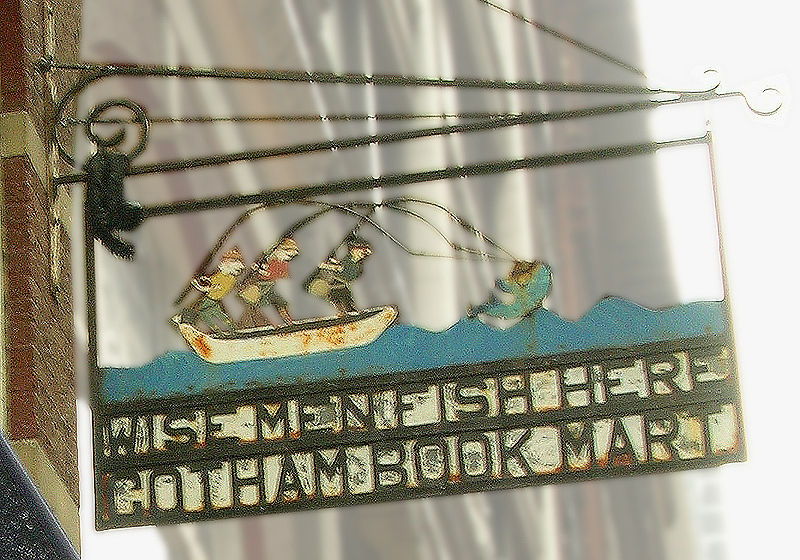
I suppose the fact that I still harbor an inordinate love of dinosaurs, geology, ancient civilizations, and liberal politics should prepare me for the demise of books. The short road to extinction lies along the path of my interests. Except, of course, Bible. There must be a portrait of a very old, decrepit scroll somewhere in someone’s attic. The culture of books, apart from the library, is a fairly recent one in human history. Even the concept of stores dedicated to books is one that has had a very tenuous lifespan. Now that Borders is gone, I’m sometimes reduced to skulking about Barnes and Noble to find my quarry. So on my lunchtime yesterday I decided to visit the Barnes and Noble on Fifth Avenue and then swing by the Gotham Book Mart. I had heard of the Book Mart before—the store that hosted visits by Truman Capote, James Joyce, Arthur Miller and many, many more luminaries. I thought it would be a good antidote to B&N, and besides, the address is just blocks from my office.

Barnes and Noble is the last resort of a reading man. I don’t have much time for holiday shopping these days, so I figured I’d nip in with my list (nothing too obscure; in fact, I’d seen the titles in an indie bookstore over the weekend, but my family was with me) and be back out in a jiff. Fifth Avenue. Midtown Manhattan. The choice of books was atrocious. Purely lowest common denominator selection. It is symptomatic of America’s love affair with the ordinary, the lower-quality-if-higher-quantity mentality. Cosco of the intellect. Barnes and Noble is the only show in town and they don’t have the selection or panache of many a much smaller Borders. I had to walk out empty handed. Well, at least there was the Gotham Book Mart to look forward to!

I suppose my first clue should’ve been the fact that the photo on Google maps showed a storefront reading “Food World” at the address which still maintained the bookstore name. I thought maybe the Book Mart was behind it or something. No Gotham Book Mart. Back at the office, chewing a dry peanut butter sandwich, I stared crestfallen at the computer screen. Wikipedia informed me that the famed Gotham Book Mart closed four years ago. Rising rents in Manhattan and the very Barnes and Noble I’d just visited drove it out of business. e e cummings, George Gerschwin, Jacqueline Kennedy Onassis, and J. D. Salinger passed their hours here. Katharine Hepburn, Woody Allen, and Charlie Chaplin were no strangers here. When the remaining stock—valued at 3 million dollars—came up for auction, it was purchased for $400,000. By the landlords. So ended an era.

From monks hunched over their vellum by the sallow light of candles to the modern dreamer in the glow of her or his laptop screen, we have brought writing an unimaginable distance. Unfortunately, many of the landmarks along the way have vanished without the blink of an entrepreneurial eye.


A World Without Borders

When Borders announced it is closing its remaining stores earlier this week, part of me died. My first Borders experience was with the original Ann Arbor store after moving to Michigan to be with my (then) fiancée. Since then my wife and I have spent many happy weekend hours browsing at Borders. The sensory, indeed, nearly hedonistic pleasure of being among books in a casual, friendly environment where ideas seemed to roam as freely as the bison on the plains before the Louisiana Purchase, is, sadly, about to end. Barnes and Noble never attained that balance nor has it ever aspired to it. I once met Jeff Bazos, the founder of Amazon, and he is a very nice guy. But when I buy books from his store, I never leave my living room. One of the intellectual’s guilty pleasures has been eradicated.

I grew up in a town with no bookstore beyond the local Christian supply shop. When a mall was built nearby and a Waldenbooks came in, I thought I was in heaven. Even the town where I attended college had no bookstores beyond the campus supplier. Borders represented the intelligent side of book buying, without appealing to the lowest common denominator. I can hear the nails being driven in from the pillow in my coffin. Our society is a post-literate one. As a person who has had many an unrepentant love affair with words, it feels like civilization itself has received a mortal blow. As I tell my students: the mark of true civilization is writing. Ever since the Sumerians invented it, it has been a means of release from reinventing the wheel with each generation. Our hearts, however, have gone after technology and gadgets and left bookstores in the dust.

Please allow me my eulogy here—I realize that reading will continue, but its context has morphed almost beyond recognition. I have watched while every employment for which I am suitable has silently gone extinct: higher education, libraries, museums, publishers—the pillars of culture itself. Gone is the day when a kid receiving his summer paycheck would beg his mother to drive the forty miles to the nearest bookstore where he would come out with not a cent in his pockets but his arms full of books. We can read about such idiotic behavior online. A border has been crossed, but some of us will linger on the other side hoping that the civilization we knew might somehow survive.

I had no idea this would become a collector's item


Erector Set Religion

When you think of robots, the first personality type to come to mind isn’t generally the religious sort. Engineers and mechanical wizards, those who understand electronics and pneumatics, computer programmers – they are the masters of the robotic world. Yes, I’ve been to meetings of robotics parents where mention of my ill-fated career is a conversation stopper. I can nearly hear the gears inside the heads of engineers when I tell them I am a former religion professor. They are trying to formulate a logical response, I always suppose, but I know that one does not exist. What more humanistic enterprise might there be than robotics? Humans making creatures in their own image, or in the image of entities stranger than anything found on Noah’s ark, intended for functions too difficult or too unpleasant for their human masters? The triumph of rational thought!

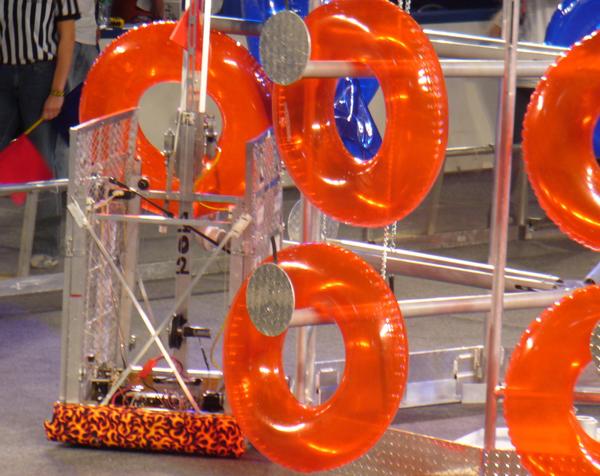
Yesterday I attended a regional middle school FIRST Robotics competition. These events always generate an enthusiasm that belies our national attitude toward the intelligent. (Americans have always distrusted those who think too much.) I feel a little out of my league. Actually, I feel like a T-ball second-stringer up to bat in the World Series. These kids (and adults) are smart. I may be president of a club, but I can’t even find a job, so I know the score before I go in. But the cars tell the true story. In a parking lot full of competitors I always notice how present God seems to be. The license plate right across from us read “HEISLRD” – registration-speak for “He is Lord,” and we all know who He is. A couple cars down a bumper sticker shouted “God rules.” Under these strictures, even a robot that I construct might have a chance. Inside, well-wishers often conclude with “God bless.” And yet they create godless, mechanical beings.

I sometimes wonder what the god of the robots must be like. A cross between Alan Turing and Eli Whitney, I suppose, only a bit more angular. A Transformer-like super being who can run even without a rechargeable battery and can wander far from the electronic grid. One who can be born without the messy organic compounds that make up biological life. The miracles this god creates would be perpetual motion, pristine lubrication, and the ability to heal computer viruses without the assistance of a programmer. Pure artificial intelligence. As I kneel, in my mind, before this non-organic, unfeeling deity of absolute rationality, I take comfort in knowing that we have become the old gods who breathed the first life into these creations and have stepped back to let them rule.

They look innocent enough

By the way, if you are purchasing anything online from Barnes and Noble between December 12 and 17, use Bookfair ID 10378297 and my robotics team will get a teeny-tiny cut of the profits. I plan to purchase a new edition of I, Robot.