Giving Trees

They’re not exactly worshipping the tree, but the Basking Ridge Presbyterian Church is holding a memorial service for the old oak tree. I’ve written about the Basking Ridge oak before. I learned about it only in January, and I visited it this summer. Some say it’s the oldest tree in the state, while others make that claim for the Great Swamp oak, which isn’t too far away. The climate change we’ve introduced, as well as natural aging, appear to have doomed the tree. It had leaves this summer, but not in the profusion that signals health to botanists. The decision has been made to take the tree down before any massive branches fall and cause injury or damage. In the light of these sad developments, holding a service seems perfectly natural. The tree is older than the church over which it presides, after all. It’s even older than John Calvin who started the Presbyterian tradition.
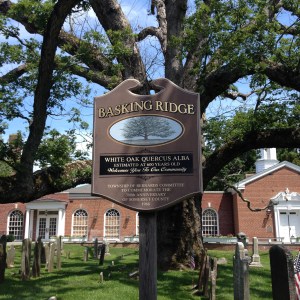
img_2878

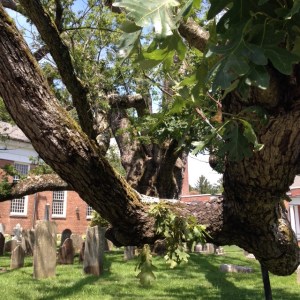
My first book was on Asherah, the goddess often associated with trees by scholars. As those who’ve read my book will know, I’m a bit skeptical, on the basis of the actual evidence, that Asherah was a “tree goddess,” but it is also clear that trees are ancient objects of veneration. From the human perspective, they can live a very long time. There is a bristlecone pine in this country that dates back to before Noah’s flood (something the creationists conveniently ignore). With that much life-force, which, we’re told, is really a fiction, these trees deserve special respect. After all, they were in the neighborhood long before we got here. Still, the Basking Ridge oak has been artificially preserved before. It’s been on life support for years. Concrete was poured to support the massive trunk, and many ponderous branches are shored up by support rods. We respect our elders.

Maybe it’s not tree worship. Maybe it’s worship beside a tree instead of worship of a tree. Prepositions can make all of the difference. Nevertheless, it’s an occasion to stop and consider our place on the planet. The fear many of us feel regarding this week’s election is a mere second in arboreal memory. The independence of this country came after the oak had been here centuries already. It may not be tree worship, but we should respect the memories of such a tree. A country young and optimistic rather than old and jaded. Maybe this tree knows a secret that it’s willing to bequeath to those of us whose lives are but a few leafing seasons in length. Good-bye, Basking Ridge Oak. It was a pleasure to meet you.
Madness of Kings

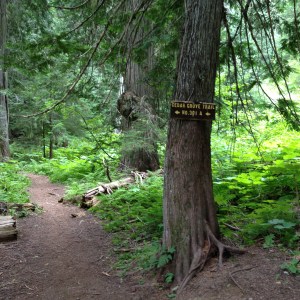
The Roman Empire ruled the known world. Christianity owes much of its form and structure to the fact that the Romans expressed their rule in a military way and prized what they thought was order and fairness. While all of this was happening across the ocean, what are now ancient cedars had begun to grow in Roosevelt Grove, Washington. Having survived the many forest fires that sweep through this area of the northwest, these trees may be up to 2000–3000 years old with an average of about 800 years per tree. Impressed by such longevity, this year on the East Coast I’ve visited the two oldest trees in New Jersey (posts about them may be found in January and July of this year’s offerings). The Great Swamp Oak may be 700 years old, and the Basking Ridge Oak is over 600. The longest lived trees in the country, however, are out here in the west.

IMG_2890

The cedars of Roosevelt Grove aren’t the oldest. There are Bristlecone Pines further to the south that are twice again the age of these millennial trees. One survives from the days when writing itself was first being invented and has lived through most of human civilization. Wisely, its exact location has not been disclosed. We all know how, in a moment of foolishness, a single human being can easily destroy that which can’t be replaced. The story of the Bristlecone Pines is illustrative. A naturalist studying the trees took a core sample of the tree that, at that time, was the oldest living tree known. When his bit broke off in the tree the solution was to cut it down to retrieve the bit. Fortunately an even older tree was later discovered in the same forest and those who know where it is don’t say. It’s a form of collective madness that makes humans want to conquer. Romans and trees both stand witness.

A few miles south of Roosevelt Grove stands the Shoe Tree. For reasons unknown, decades ago campers began leaving shoes on this great conifer. Shoe trees actually exist in several locations around the country. This particular exemplar was a well-known local attraction. Shoes had been nailed to the trunk, or tied together and tossed high into the branches. Whimsical and illogical, it would have drove a Roman crazy. Then a few years back someone decided to set the tree on fire. Thinking the act had ended the joie de vivre, one unthinking person sought to change history. After the act of destruction, however, shoes were once again nailed to the now dead tree, and once again tossed into its lifeless branches. The tree next to it, I noticed, has started to acquire its own sets of footwear. If it outlasts the empires of today, there will be those of generations yet unimagined wondering about the madness that those who insist on conquering leave in their wake.


Holy Oak

IMG_2876 copy

It was already ancient when first discovered by the early European colonists of New Jersey. The Basking Ridge oak is a well-known and time-honored New Jersey denizen. Over six centuries old, the white oak, it seems, is dying. Like it’s cousin, the Swamp Oak that I mentioned back in January, this tree is dear to many in the state. It is also historical. An article in the New Jersey Star-Ledger begins with some religious associations: George Whitefield, one of the evangelists responsible for “the Great Awakening” from which we’re still trying to awaken, preached under this very tree. George Washington also knew it. It has been tended and cared for by the town for so long that there is a reluctance to let it go. In the words of another New Jerseyan, “well everything dies, baby, that’s a fact.” Job, in a more optimistic moment, declared, “there is hope for a tree.” Like the Good Book, the good folk of Jersey wax religious about this sexcentarian, and for good reason. The human outlook is far too short.

Think, for example, of what was happening when the Basking Ridge oak was a mere acorn. In the early 1400s there were no Protestants yet. That didn’t stop Jan Hus and Joan of Arc from being burned at the stake, however. Although the Vikings, and perhaps others, had ventured here from across the ocean, North America was blissfully unaware of those waiting to claim for their own any land they could set foot on. Good thing too. The Inquisition was still underway and witch trials lingered on, flying in the face of enlightenment. Cambridge and Oxford University Presses were, in some sense, neophyte businesses. This Eurocentric view overlooks the great achievement of Machu Picchu down south. As the Dark Ages were beginning to lighten, this oak began its life’s journey. We who are a mere blink of its slow eye are still spouting hate for those who are different and are determined that nobody should outlive us.

The Holy Oak, as it is known, stands beside a Presbyterian Church. One of the trustees of the church is in charge of the tree. In the article he stated that this is about eternal life. From our perspective, trees seem to live forever. That’s because we are so dreadfully short-sighted. It’s surprisingly easy to become nostalgic for a tree so old. In terms of accomplishment, we think humans are exceptional for surviving a century of all the misfortune we dish out for one another. The tree, however, seems innocent by comparison. We’re changing the climate even now, making it more difficult for trees to thrive. We continue to shoot people for the color of their skin and although we don’t call it witch-hunting any more we still find ways of oppressing anyone who is different. At this rate we may need six more centuries to come to our senses. If only we had the perspective of a tree.