
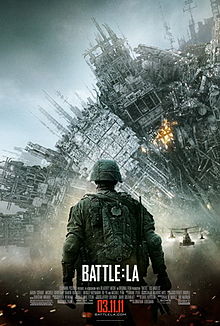
 Over the weekend I finally got around to watching Battle Los Angeles. Now, I’ve never been a fan of war movies, but I do have a soft spot for aliens, so I decided to tough it out and see who won. I knew the historic event upon which the premise of the film was based took place in 1942, before flying saucers captured the American imagination. The official Air Force story suggests that old nemesis to our control of the air: weather balloons. Considering that Los Angeles was blacked out and ground forces lobbed 1,400 artillery rounds at the things, I wonder why the balloons at my daughter’s birthday parties never managed to last the night. In any case, the movie runs with the premise that aliens have taken over the city of angels and the U. S. Marines are the ones to get the job done when it comes to taking out aliens. (The Air Force, one expects, is too busy chasing weather balloons.)
Gratuitous aliens and science fiction action may be merit enough to get into this blog, but there is actually a more compelling reason. Back in my teaching days, I tried to demonstrate to students how deeply the Bible pervades our culture. When I taught those long summer and winter term courses, sometimes lingering four hours into the night, I would break up the inevitability of my lectures with a few movie clips to show them just how often the Bible shows up in films. Sometimes the cameo appearance is a matter of fleeting seconds, but when directors pay attention to every detail of a scene, we can be sure that Bibles don’t just show up by accident. Battle Los Angeles is no different. As our platoon is being air-lifted into the alien hot zone, one of the soldiers (I couldn’t figure out which one, since most of them get dispatched in fairly short order) is shown reading the Bible. The camera hovers there a second before pulling back to show the pre-battle chatter.
The viewer is probably supposed to be reminded that there are no atheists in foxholes, as the saying goes. Or it is a sign of how serious this is: before the big guns come out, bring on the Bible? In our culture the Bible has that kind of role. I recently read of a Catholic astronomer who was seeking alien civilizations in order to convert them to Christianity. The premise is as intriguing as it is arrogant. Human beings can be tenacious when it comes to matters of belief. In Battle Los Angeles, however, we speak with our guns and our missiles. But first we read our Bibles. Without wishing to ascribe to much intentional subtlety to the movie, this might be the underlying paradigm. Once the battle begins in earnest, the Bible never comes back into play. It is human ingenuity that wins the day, and perhaps the aliens are being taught to pray.
 Steve A. Wiggins