
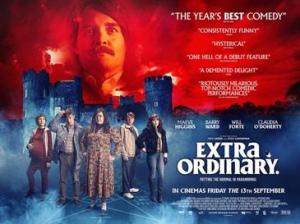
Spoofs can be a great way of preventing us from taking ourselves too seriously. Extra Ordinary is a film I’d completely missed until my wife made a gift of it. We weren’t quite sure if it was a horror film or a comedy, and genres aren’t always helpful here. I would call it a spoof on possession movies, something of particular interest after writing Nightmares with the Bible. Apart from being a bit of much-needed silliness after a terribly serious year, it’s also a demonstration of how genre can be helpful in knowing how to interpret what we see. Not knowing anything about the film, it begins with the statement that it’s based on a true story. There’s an interesting history behind that phrase, but when it comes with a spoof it only adds to the fun.
Extra Ordinary follows the adventures of Rose Dooley, a driving instructor who was raised by a ghost-hunting father. Blaming herself for her father’s death, she’s taken on an anodyne career that she feels is safer. A particularly desperate widower whose daughter is targeted by a hapless Satanist, brings her back to her true calling. Although there are some horror-comedy scenes (that’s an entire sub-genre often eschewed by horror fans who don’t like to laugh at themselves) the witty dialogue and crude jokes make it fun rather than anything to be worried about. Possession occurs in a specific way to move the plot along—Rose has to have a partner (the widower Martin Martin) accept possession by the ghost in order to send it to the beyond. Although there are clever takeoffs from The Exorcist, the idea of possession is much different.
What is evil? The film asks the question directly (if comedically). Although washed-up rock star Christian Winter has become a Satanist, the demon in the film is Astaroth, a later development from the pre-biblical goddess Astarte. As discussed in Nightmares with the Bible (for which this film could’ve been profitably discussed), there’s a confusion among demons. (Beelzebub is also mentioned by name.) The element that ties them together with the human condition is clearly sex. The frantic search for a virgin, and the communal shaming of unwed mothers makes that obvious. Although deliberately campy, Extra Ordinary answers the question of evil by noting that it is a person using their powers (magical, in this case) for their own benefit rather than for the good of others. There is a moral to it, after all. And if we can’t laugh about the human condition once in a while, we deserve to be spoofed.
 Steve A. Wiggins