
Early to bed, early to rise, and people’ll think you’re weird. At least in my experience. Making an island into the place where hundreds of thousands have to commute to get to work may not’ve involved a great deal of foresight. My bus leaves early, and I don’t argue. On the days when I work from home I still rise early—I’m old enough that constantly shifting schedules is more effort than it’s worth, so I like to greet the sun with coffee in hand and say to it, “what took you so long?” This time of year I like to jog at first light when I don’t have to commute. As I do so, I notice where the lights are on. You get an idea who sleeps in and who doesn’t.
With all the political nonsense about lazy immigrants, I wonder what time congressional leaders get out of bed. I sometimes go jogging before 5 a.m. The lights I see on at that time of day are often those of the apartment complexes where immigrants tend to live. The affluent houses of the white are generally dark. If you have the luxury of driving to work in one of your cars, you can afford a little sleep, a little slumber, a little folding of the hands to rest. Immigrants often take the bus. In fact, the majority of early morning commuters, it seems, are not the privileged classes. It may have been Benjamin Franklin who said “Early to work, early to rise,” but it was the foreigners who saw the wisdom of his words.
It’s a sad nation that denigrates its hard workers. I realize I’m looking in the mirror as I write this, but sitting at a desk all day is not hard work. My first job, starting at 14, was physical labor. Most of the time it was light enough—such things as painting curbs, bus shelters, or fences. At other times it involved sledge hammers under the hot sun. The kinds of jobs few people enjoy, but which are necessary. Jobs that don’t pay well, but will keep you alive. Now I sit behind a desk and have to jog just to stay healthy. I see the monied in Midtown walking slowly to their expensive health clubs where they can sweat and let other people see. And I know that there are many out there—immigrants mostly—who are sweating from doing the jobs that likely pay less than the membership fee for this swank gym. And I wonder which is healthy and wise. The wealthy part is fairly obvious, even this early in the morning.

 The specific form of penny offerings seems to go back to Benjamin Franklin’s burial, at least in America. A few years back while in Philadelphia, I saw for myself that people still leave pennies on Franklin’s grave in Christ Church Cemetery.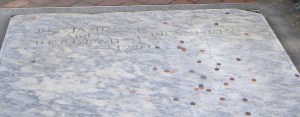
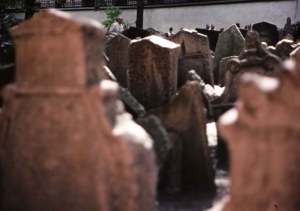 I recalled having seen stones on tombs outside Jerusalem some years back, and I even had a student bring me a stone from Israel to keep as long as I promised to put it on her grave after she died. This practice in its recent form is associated with Judaism, but again, it has ancient roots. The building of cairns, or piles of stones, is often associated with the Celts or the pre-Celtic inhabitants of the British Isles. On our many wandering through the highlands and islands we saw several Neolithic examples in Scotland, particularly in the Orkney Islands. The practice of putting stones atop the dead also goes back to ancient times. One plausible suggestion is that it was intended to keep the dead in their graves. A more prosaic conclusion is that digging deep holes takes more work than hauling over a pile of rocks.
 Steve A. Wiggins