
One of the greatest problems in reconstructing ancient religions is the ambiguity of the evidence. Most ancient artifacts are not labeled (they probably didn’t need to be for the original viewers) and few have textual materials explaining them. This became clear to me when studying the famed inscription found at Kuntillet Ajrud in the mid-1970s. The most (in)famous aspect of this artifact was that an inscription overlapped a doodle, and due to the urgent desire to interpret the inscription a particular way, the line drawing was supposed to be an illustration of the inscription. The inscription is commonly translated as something along the lines of “I bless you by Yahweh of Teman and his asherah.” Many scholars took asherah to mean Asherah, the goddess, despite no evidence for pronominal suffixes on personal names in classical Hebrew. The doodle shows three figures, perhaps related, of which two were said to be Yahweh and Asherah. Despite the very clear resemblance to the Egyptian dwarf-god Bes (Kuntillet Ajrud is between Israel and Egypt), it was argued that the figures in the “foreground” should be considered Yahweh and his main squeeze, Asherah.
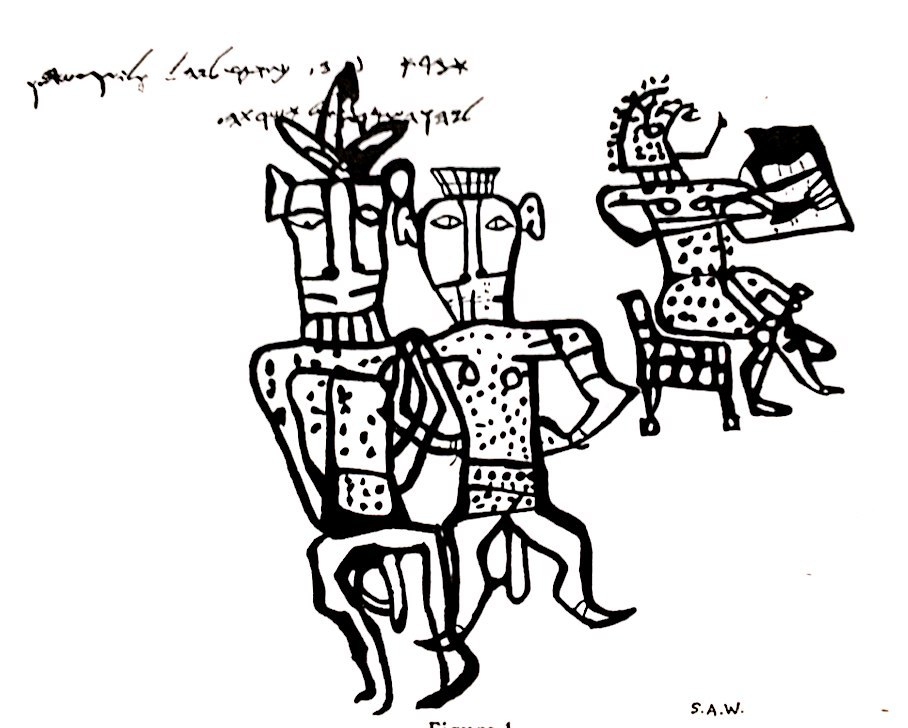
The artistic analysis of these doodles has always been torturous. Tiny, perhaps insignificant, details were ascribed great importance—particularly those indicating the gender of the figures. For the Yahweh-Asherah connection to work, one had to be male and the other female (with the male preferably in front). The problem was that both figures seemed to have penises (in keeping with Bes’s typical representation). In order to make it clear that the right-hand figure was female it was claimed that she was wearing a lion skin and the “penis” was literally a tail, the leopard’s tail, seen between “her” legs. The problem seemed to be a possible scrotum appeared to be present. The left-hand figure, larger (therefore, in front) had a clear scrotum, and that sealed the case, in a manner of speaking. Little chestal circles were said to be breasts on the right-hand figure, but male nipples on the left-hand figure were lacking. Oh, and they were dancing, as shown by the woman playing the harp in the “background.” Believe it or not, seriously scholarly debate raged over this—nothing short of the discovery of Yahweh’s wife seemed to be at stake! A colleague recently emailed me to tell me the final report of the archaeologists concludes that the “scrotum” on the right-hand figure was a mere dust smudge and so, aha!, she is a female after all!
I argued years ago that this drawing was clearly a representation of Bes. The connection with the inscription is accidental (the jug on which the inscription occurs is full of doodles); if someone wanted to illustrate an inscription, they would not draw figures that actually obliterate part of the caption. Assumption is built on assumption here, however, making for a very shaky foundation indeed. Don’t get me wrong: I would like to see Yahweh as happily married as the next deity. It is not good for the god to be alone. Still, it is going to take more than a divine sex-change operation to transform Bes into Asherah. If nothing else this divine gender-bender ought to serve as a cautionary tale for scholars, yet somehow I doubt that it will. We see what we want to see.
 Steve A. Wiggins