Making Monsters

It’s not so much I’ve been away from monsters lately, but that life has intervened between them and me.  Life can be scarier than monsters sometimes.  In any case, the summer is when my mind turns back to haunting even as on the breaks during heat waves a whiff of autumn can be caught on the air of a July morning.  Yes, we’ve past the solstice and days are getting shorter.  Slowly, of course, but that’s what builds suspense.  And there are local signs that I need to get my haunting in gear.  It is finally time to get Holy Horror out of wraps and give the book a proper launch.  Being published around Christmas last year was poor timing for a subject so readily coded for fall.
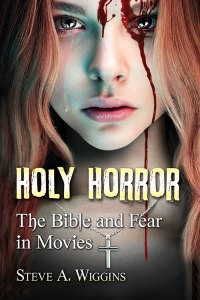
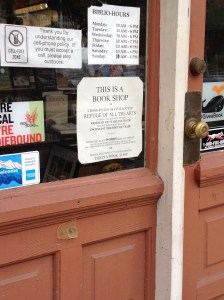
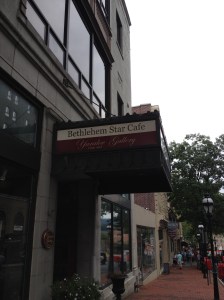
I received the welcome news this week that the Moravian Book Shop—the oldest continually operating bookstore in the country—will be hosting a book signing for Holy Horror in October.  This is a fortuitous turn of events because when I first approached them with the idea the price of the book made the idea look unrealistic.  But we’re now thinking of autumn, and with autumn comes Halloween.  There have been a spate of horror films this summer, all of which I’ve unfortunately missed.  Time, as Morpheus notes, is always against us.  There does, however, seem to be a lively interest in the genre and the curious wonder what it has to say about what we believe.  Horror loves religion, and indeed, thrives on it.  So it’s been from the beginning.

October will also see the Easton Book Festival in this area.  I will be on the program for that as well.  While none of this is earth-shattering, these events represent the first successes in trying to build awareness of Holy Horror.  This was a book written for a general readership, but not priced for one.  Working in the academic publishing world, this is a phenomenon with which I’m all too familiar.  Many colleagues offer to read and spread news about your book.  It seldom happens, though.  Academic presses can’t afford book tours (especially if they have to price books at $45), but these self-driven presentations are opportunities to spread the interest in ideas.  That’s what those of us who write really want—to be part of the conversation.  We’re in the midst of a heat wave here.  It’s the height of summer.  Even so, those who know about monsters can feel them coming, even from here.


Born Once More

Every once in a while a reader, either here or on other social media, asks me what my religious beliefs are.  The expected answer to such a question is the standard label of a denomination of some sort.  My response, however, is that knowing the group I belong to (and I do) should not effect the way my thoughts are viewed.  With the exception of some groups suspected of mind control, standard religions are generally trusted as being motivated by pure intentions.  Having both attended and taught in seminary settings, and knowing a great number of clergy, however, it becomes clear that denomination is less important than one might think.  In short, I answer this question in the public forum of neither classroom nor blog as I truly believe there’s nothing to be gained by readers/students knowing where I personally seek meaning, denominationally.

It’s no secret that it was once the Episcopal Church.  (I could not have taught at Nashotah House otherwise.)  It was made pretty clear after being at said seminary for many years that the Episcopalians had no official place for me.  Even when I worked a few blocks from the church’s headquarters in New York City I could find no one willing to listen or consider my credentials.  Its Church Publishing branch wouldn’t consider me in their book wing.  Were it not for some former students who still minister to me, it was clear they did not miss me.  So it was with some surprise that I found myself in Nativity Cathedral in Bethlehem on Saturday for their Celtic Mass.  The Cathedral itself is lovely with a négligée of wrought iron tracery for a reredos, appropriate for a city built by steel.  Eight angels with outspread wings stood atop it.  Like most sanctuaries, it was a place of refuge from the busy, noisy street outside.

The reading from Amos 7 stood out to me.  Lectionaries, by definition, take pericopes (selections) out of context.  Amos’ vision of the plumb line is actually part of a series of visions, but here stands alone with the episode of Amaziah trying to send Amos back to Judah.  The prophet responds by saying he’s not a prophet, but just a guy who’s received a message from God.  In ancient times there were prophets paid for their services.  They supported the government positions and governments made sure they were cared for.  The situation hasn’t much changed, at least among conservative religious groups under a Republican administration.  There were other parallels here, but saying too much on them might end up giving too much away.


Whose Bus? Omnibus!

The long-distant commute is an extended social experiment.  Although some of the people on the bus know each other—from overheard conversations while in line it’s clear that many of these commuters go to New York daily—they want to sit alone.  The idea behind a bus, short for omnibus (Latin, “for all”), is essential equality.  When I commuted daily from central New Jersey, I was a passenger from the originating city on the route.  By the time New Jersey Transit buses got to New York it was rare for a seat to be empty.  Now I take TransBridge, a bus line that operates out of Bethlehem.  The buses are much nicer, but I’m no longer from the originating town.  By the time the bus arrives at 4:30 a.m., it’s already half-full.  (Half-empty if you’re an optimist.)  That’s not a problem, of course, but the way people claim territory is.

Typically those who get on at the initial stop sit in the aisle seat, place their bag in the window seat, and do their best to fall asleep before reaching my stop, which is only 15 minutes away.  When you go to get on, in other words, there are almost no seats and the happy, dreaming commuter knows you don’t want to wake him or her to get them to move their bag and let you in.  Like most people I’d like to have two seats to myself—who wouldn’t?  But the fact is the bus will be full and these people who do this every day should know that.  But still they try to block others out.  As a social experiment, it is worth some consideration.  If you put your bag in the aisle seat it’s easier to accommodate the person who’ll inevitably sit next to you.  But this is Trump’s America—everyone for himself.

I’m a fairly quiet person, and I don’t want to disturb anyone’s slumber.  Many people not only sprawl out like they’re in bed at home, but they wear dark glasses and headphones so that you have to nudge them to get their attention.  Then they act as if you’ve insulted them.  Or they’re doing you a favor by letting you sit in “their” seat.  I suspect the fact is that none of us wants to have to go so far to work.  And I know that sitting next to a stranger can be less than ideal.  When I buy my ticket, however, I know that I’m opting for an omnibus, and those who do so should be clear on the concept before handing over their money.  Or maybe I’m just dreaming.


Iron Ages

I find myself in Pittsburgh again.  We set out from the former steel city of Bethlehem and ended up in the former steel city on the other side of the state.  I’m not here for the metal, of course, but to visit family.  Making our way over the great eroded spine of the ancient Appalachians, I was thinking of how cities often take on the identity of their industries.  Pittsburgh and Bethlehem vied with each other for their facility with unyielding iron—one of the technologies so important to human history that we still use the Iron Age as a marker of advancing technology.  Pittsburgh’s now a tech city, much reduced in size from its heyday when only fifteen cities in the country were larger.  Bethlehem, it seems, is still trying to figure out exactly what it wants to be.

Back in college, I used to work in a church in the south hills.  I haven’t been to Windover Hills United Methodist Church since those days.  I was weighing my future then, deciding to attend Boston University School of Theology—the seminary the pastor had attended—and exposing myself to liberal thinking rather than more of the conservative milquetoast that was mistaken for milk and honey at Grove City College.  The memories that attended the drive were powerful and poignant.  I only lived in Pittsburgh two summers—the second working as a bagger at a grocery store (I should’ve known then where a college degree in religious studies might lead, even if summa cum laude).  As iron sharpens iron, so the Good Book says.

Recently I tried to recall all the addresses at which I’ve lived.  This seems particularly important because many of the buildings no longer stand and I greatly fear being erased.  Those of us who write often do.  I can recall the cities and even a few of the streets.  Numbers often escape me, for they seem to be mere place holders.  My days in Pittsburgh were decades ago, when life was really only just beginning.  Now I drive these hills with memories my only maps, wondering if I can find the place I’m seeking.  This place is part of me, even as Bethlehem is now becoming such a piece.  Cities change depending on the laws of supply and demand that can, as we know, even break iron.  And those of us who live in such places know that any industry is subject to memory, whether of God or of steel.


Thunder Towers

It sounded like brontide.  The Martin Tower, the tallest in the Lehigh Valley and once corporate center for Bethlehem Steel came down yesterday morning.  Completed only in 1972, the following decade saw the collapse of the steel industry, and the building has sat vacant a dozen years.  Now it’s gone.  The reasons the building could no longer stand are many and I won’t try to explain them as if I understood.  The fall of the tower, however, put me in mind of human folly and the belief that corporate profits will only ever grow.  Capitalism is built on a set of myths that the wealthy truly believe—I suspect many others do too, otherwise the system couldn’t possibly last.  Adam Smith may have been right academically, but in reality humans are greedy, venal, and shortsighted.   At least those who “rise to the top” are.

We didn’t move to the Valley for the steel.  Having settled in New Jersey just about when the Martin Tower was abandoned, like many other displaced academics I was looking for a job.  There were cities in the Midwest—we weren’t far from Milwaukee or Madison—but there was no work.  If you’re “overeducated” your best bet is to settle near a huge metropolitan area, as closely as you can afford to.  Then hang out your shingle.  Capitalism, however, has made New Jersey affordable only for the excessively wealthy.  Besides, I was born within the imaginary lines that we call the Commonwealth of Pennsylvania.  In fact, when I got my license transferred last year the computer asked me if I still lived in Venango County, where I was born.

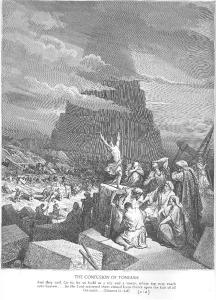
I didn’t see the tower come down.  It’s not visible from my house, but it was always right there when I drove to Lowes to pick up some necessary hardware to survive in this area.  (Weed-whacker and lawnmower—reel variety.)  My mythology of towers always takes me back to Babel.  In the biblical worldview towers were a sign of arrogance.  God seemed to think they were trying to invade divine turf, and so he made it so we could no longer understand one another.  There hasn’t been a moment’s peace since.  We build towers tall to show what we can do.  We don’t really need an angry deity to come down and confuse our language any more.  We’ve got capitalists and their excess money to lead the way.  The sound of thunder roared and I divined just where such leadership will guide us.


The Dots

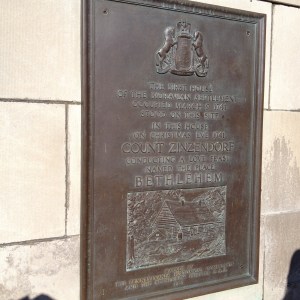
Connections have always fascinated me.  Maybe it’s because life is a random stream of stuff constantly thrown at you that makes a mockery of any plans you might try to implement.  Me at Nashotah House?  Really?  Nevertheless, these events shape us and everything that happens thereafter is seen in light of them.  So when connections occur amid this continual flux, I sit up and take notice.  For example, I had never thought of moving to eastern Pennsylvania.  Now, around Christmastime, I find myself not far from Bethlehem.  Bethlehem was so named because it was founded on Christmas Eve by Moravians who’d settled in the area.  Although not counted among the most numerous of Protestants today, Moravians had a profound effect on the founder of Methodism, John Wesley.  In fact, he met Count Zinzendorf, whose name appears on this handsome plaque in historic downtown Bethlehem, at a pivotal moment in his own spiritual journey.

Having grown up Fundamentalist, the United Methodist Church would not have been our choice, although we had unwittingly attended one of the Methodist offshoots—the Church of the Nazarene—from time to time.  In one of those unplanned things, we found ourselves in Rouseville, Pennsylvania, where the only Protestant church was United Methodist.  Once ensconced in the UMC it was my plan to become a minister in that tradition.  That led me to Boston University School of Theology where I first learned about the Wesley-Zinzendorf connection.  It was also there that I met my wife.  And subsequently joined the Episcopal Church.  Why?  John Wesley had been adamant that his followers not drop out of the church in which he was an ordained priest.  I was only following instructions.

Had that not happened I would never have had my first, and so far only, full-time academic job.  Nashotah House was conservative, and I was not.  We nevertheless had a connection.  Growing up I’d barely heard of Wisconsin, let alone planned to live there.  When Nashotah no longer required my services my career had to change as well.  None of this was in the plan.  Who plans to move to New Jersey?  And now everyone thinks of me as an editor, a fallback position if there ever was one.  Since I work in New York City, moving back to my native Pennsylvania wasn’t really on the agenda.  An outside agent led to that.  So I find myself near Bethlehem in the Christmas season, staring at Count Zinzendorf’s name, which I first heard of in a seminary now far away.  Connections, even with those long gone, are always worth noting.


Christmas Time

As children we can’t wait for Christmas because we’ll be getting things.  Now that I’m older I try to avoid the frenzy building up to the holiday, although I look forward to the vacation days that I’ll cash in to take time to be with family rather than business.  It’s not that I don’t like holidays—it’s just I’m no fan of hype.  Still, now that December is nearing, and Thanksgiving has reminded us that work isn’t everything, I can feel the anticipation.  Yesterday I attended the Christkindlmarkt  in Bethlehem.  Amid the backdrop of the truly colossal, rusting stacks of the former Bethlehem Steel plant, this is a seasonal event with nothing but good spirit.  People of all descriptions were crowded into the massive event, but rudeness and complaining were strangely absent.  Everyone seemed to be having a good time.

When I worked at Nashotah House, the atmosphere for Advent was austere.  We weren’t really encouraged to look forward to Christmas, bringing a tree home before the 24th was frowned upon.  It was a time to reflect on our sins, not to anticipate our rewards.  Still, I had a kind of epiphany among the secular crowds seeking to get into the spirit of things yesterday.  Bethlehem is a city that has known hard times.  Its industrial base eroded away, residents were left unemployed and wondering about a very (and increasingly) uncertain future.  Recasting itself as the Christmas City is a way of throwing new light on a holiday famous for its commercialism.

Christmas can be about resurrection.  It’s a season to think of birth.  It matters not if the mother is a virgin or if the child is for an exclusive sect.  People throng here for hope.  Beauty in the midst of ruin.  Some businesses clearly spend all year building up to Christmas, selling ornaments so delicate that I feared even to look too hard at them lest they shatter.  Handcrafted goods that represent the livelihood of others who compel strangers that art is worth more than money itself.  Wandering through the four tents of booths, the feeling of resurrection was palpable.  We were all here seeking something.  Loosening the grip on the wallet just a bit.  Wanting to make others happy for a while.  Birth is the symbol of hope.  Advent, it seems, need not be a dreary season of wallowing in unworthiness, awaiting a mythology taken too literally.  The proof of the goodness before us is just down the road in Bethlehem.


Whelmed Over

I have to admit I feel overwhelmed by the task.  You see, I spent twelve years living in a town that went from one small used bookstore to none.  Within a half-hour’s drive I could be at two bookstores—indies, of course, since B&N doesn’t always count.  One of the shops was the Princeton University bookstore, so that was almost unfair.  Now I live in a region with many bookstores.  I wasn’t truly aware of this when deciding on where to settle; the decision was made on practical matters such as being able to get to work, and affordability.  It turns out that central eastern Pennsylvania is unexpectedly bookish.  I’m not complaining, you understand.  I haven’t had much time to explore, and that’s why I’m overwhelmed.  That, and Banned Books Week.

I’ve been to the oldest continuously operated bookstore in the world, The Moravian Book Shop, in Bethlehem.  Twice already.  But there are many more within an easy drive from here.  “Lead us not into temptation,” the prayer goes, but if we’re honest we’ll admit we love the challenge.  Home owning is expensive.  There’s always something that needs to be done—the sort of thing you used to let the landlord handle—they are lords, after all.  And time for reading is scarce.  Add to this that there are bookstores I haven’t even entered yet, not far away, and a kind of anxiety grows.  You have to realize that even in Manhattan reaching a bookstore on lunch hour was difficult.  They are few and far between.  It’s overwhelming being in a region where indie bookstores have held on.

My wife recently showed me an ad for an indie bookstore over the border in New Jersey.  They were looking for new owners.  We’ve often discussed how perhaps a retirement job for us might be just such a thing.  Of course, business sense isn’t my strong suit—just learning how to own a house seems pretty hard.  The idea of making a living surrounded by books, however, is appealing.  (You might think an editor reads all day, and while that sometimes happens the reading is generally embryonic books.  Besides, there’s something serendipitous about discovering fully fledged books that you didn’t know were coming.)  To buy a business requires capital, and we’re more the minuscule type, when it comes to finance.  As we settle into our house we decide which books go where, and it is remarkably satisfying.  After I’m done being overwhelmed by all there is to do in the house, I’m looking forward to being overwhelmed by exploring the bookstores of central eastern Pennsylvania.


Holy NRA

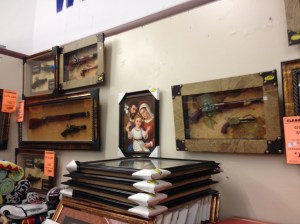
A religious nation in love with guns leads to some strange juxtapositions.  In a home goods store that I won’t name—hey, you can have fun trying to find it!—we came across just such an oddity.  Appropriately for a franchise near Bethlehem, there was a framed painting of the holy family: Mary, Jesus, and Joseph, halos and all.  Completely surrounding the Prince of Peace and company were framed replicas of guns.  I’m sorry to state that the holy family, notwithstanding divinity, was sadly outgunned.  There’s only one such family, but of the making of firearms there is no end, and much shooting wearies the body.  Of all the weirdness that has plagued Christianity, this love of guns among the evangelical followers of the Prince of Peace has to rank near the top.

Believe me, I know what it is to be afraid.  I grew up with more than my share of phobias, and since buying a house different ones from my childhood set have come to light.  People want to feel safe, and the gun industry has successfully spread the message that a firearm or two will do the trick.  Often it backfires.  Those meant to be protected are killed in an accidental discharge or a domestic dispute turns deadly.  The real drawing power of guns, I think, is the sense of power.  The message in our society is that God wants you to protect your property.  That doesn’t mean that the government can’t take it away, but hey, at least you’ve got a gun, right?

I’ve always felt that ownership was a strange concept.  I look out the window and see the birds perching on “my” roof.  I see the squirrels digging in “my” yard.  I see the rain soaking “my” investment.  In what sense do I own this house?  Am I not just borrowing it long enough to live here while I’m alive?  We met one of the former owners.  Who lived here before him I don’t know.  I have no idea who built the house.  Besides, the money to purchase it came from a bank, and if I don’t pay my mortgage, the real “owners” will step forward and sell it to the highest bidder.  I own no guns.  They’re dangerous and costly and would I ever find peace after shooting anyone?  I look at the holy family.  Joseph and young Jesus have firearms aimed at their heads.  If the holy family isn’t safe, what hope do the rest of us have?


A Star in the East

The times they are a, well, you know—nobody wants to violate copyright.  In any case, nothing stays the same for long.  New York, for example, is a city in a constant state of transformation.  Fully grown buildings now stand where there were literally holes in the ground when I began working there.  One building near Times Square recently had a facelift that revealed the steel girders beneath.  On the I-beam were the words “Bethlehem Steel.”  And it’s not just New York.  Our cultural transformation has been taking place over the last few centuries as populations have moved to urban areas, abandoning farming to the few who remember how.  Being from western Pennsylvania, I pretty much thought the eastern part of the state was Philadelphia.  I’d heard of other urban regions, of course, such as Scranton and Allentown, but they were well outside my experience.  We didn’t get out much.

Now that I’m here in the eastern part of the state, I’m begun to explore the ever-changing micropolitan area of Allentown-Bethlehem-Easton.  The three cities blend at the edges, and this region is the third largest population zone in the state, after Philly and Pittsburgh.  It’s also the fastest growing region in the commonwealth.  I suppose we might’ve helped with that statistic.  The other day I had to run an errand in Bethlehem.  I pulled over to marvel at the hulk of what had once been Bethlehem Steel.  Now, I grew up in a town with an active steel mill, and Pittsburgh grew to fame for the same metal, but this was a behemoth of a plant.  Subdivided and open to development, it now houses a casino, in part, and an arts center.  And still there’s more space.

Bethlehem was founded on Christmas Eve by the Moravians.  Perhaps appropriate for a town trying to resurrect itself, Bethlehem calls itself the Christmas City.  Star imagery abounds, and many businesses name themselves with this Christian symbol.  The image is quite different from that of a steel city with hard-working men on the shift.  The grime and din of industry.  Bethlehem, like many places in the state, was named for its biblical forebear.  On my visit to the original Bethlehem many years ago I was, like many tourists, disappointed that it isn’t “O little town of” anymore.  There were people everywhere and it was difficult to imagine a quiet stable inside a noisy stone church thronging with the faithful.  Clearly things don’t remain unchanged for long, even in towns famous for their remoteness.  Although far from New York, they share a common heritage of people everywhere, and that heritage could bring us peace if only we would allow it.  The answer, it seems, is blowin’ in the, well, you know.


Away and a Stranger

“And Joseph also went up from Galilee, out of the city of Nazareth, into Judaea, unto the city of David, which is called Bethlehem.”  Strangely enough, the great physician (although we know nothing of his medical practice) Luke was writing about a place an ocean and a sea away from here.  The place names of eastern Pennsylvania demonstrate the religious awareness of the early colonial Europeans who brought their Bibles and diseases to this nation.  Bethlehem, Pennsylvania was known more for being a house of steel than being a house of bread.  It’s just down the road from the little town of Nazareth, made famous by The Band’s classic hit, “The Weight.”  The road to Emmaus is nearby.  And the major medical facility is, you guessed it, St. Luke’s.

The Band had an influence somewhat surprising for those who may have trouble recalling their nondescript name.  “The Weight” is a story of a traveler coming to, of all places, Nazareth, Pennsylvania.  So taken by the song was a Scottish band that they adopted the name Nazareth before informing us that “Love Hurts.”  This is something the evangelist and purported doctor Luke presumably knew.  If you go down from Nazareth even unto Bethlehem, you’ll find the steel city recast as the Christmas city.  For those of us who grew up in the western part of the state, Pittsburgh was the real steel city anyway.  When I was growing up, Pittsburgh was the 16th largest city in the country.  It now sits at 65th, because, like Bethlehem it had trouble drawing people without the natural hardness that is Pennsylvania.  There’s a parable in a city transforming from a heavy metal to a holiday.  There’s no Pittsburgh in the Bible.

When Luke begins his Christmas narrative (think of this as one of those “Christmas in July,” or August things), quoted above, he ironically leaves Mary until the next verse.  Joseph, whom later tradition will say had nothing to do with the conception anyway, still gets first billing.  One wonders what might’ve been different had Mary led the way.  It was much later, after the gruesome crucifixion account, that Emmaus came into the picture.  Two unnamed disciples were walking along that road and didn’t recognize who Jesus was.  Had they kept walking, I wonder if they might’ve ended up in Pittsburgh, for the biblical names soon give way to places like Kutztown and Fleetwood, the latter of which, I have to admit, I never got into.  Had Mary taken a load off in Nazareth, this story would’ve been completely different.  Thus saith The Band.


Bread Line

“Her smoke rises up forever,” apart from describing the fall of Babylon the Great, can also describe our toaster. The thing has been with us for many years now and the lifespan of a toaster is often measured in months rather than decades. I suppose I could go to the store, but the internet is right here, so when I began searching for toasters I found, yes indeed, The Jesus Toaster. I’m sorely tempted. Of course, I haven’t had breakfast yet, but I wonder whether this device is diabolical or devotional. Often it is difficult to tell the difference. Pareidolia, the tendency to see human faces and forms where they don’t exist (false positives), seems to be an evolutionary device to get us to pay attention for possible dangers in our environment. Now that we live hermetically sealed lives, our minds still find faces, and often attribute religious significance to them. We’ve all read of cases of Jesus casting his divine face upon a humble piece of toast, or a tortilla. Or a bruised toe or a garden shrub—the holy visage is not just for breakfast any more. So some clever wag decided to engineer a toaster that puts Jesus right on your bread. A private sacramental, still, you might want to go lightly with the jam. But is Jesus toast used for good or evil? What is your houseguest is Hindu or Jewish? Will they awake to conversion or controversy?

JesusToaster

The association of Jesus with bread is deep and abiding. Seminary students everywhere learn that Bethlehem, the place where Jesus was born according to Matthew, means “house of bread” in Hebrew. We know that Jesus had a reputation for feeding vast crowds with a few loaves of bread. By the time we get to the Gospel of John he is lingering long over the matzah at the last supper after claiming that he is the bread. In many churches he is weekly served in pressed little wafers without much flavor, but, we are told, with infinite substance. Jesus and bread go together like, well, bread and butter.

So, should I buy the Jesus Toaster, as seen on TV, or just some regular box of hot coils to warm my mornings? I’m not sure there’s ever any going back once you’ve seen the other side. But wait, there’s more! You can buy a Poe toaster, or a Virgin Mary toaster. They may have a surfeit of meaning, but do they satisfy as toast? As I sit here the time for work draws inexorably closer, and I haven’t decided on my toast yet. Does the Jesus Toaster do bagels? Will my English muffin include Joseph of Arimathea? Does whole wheat toast suggest an African Jesus? My morning has suddenly become too full of options. Besides, the day is usually downhill from here. I think maybe I’ll just have cereal instead.


Piece on Earth

The New York Times recently ran a story about the academic boycott of Israel by the American Studies Association. For those unfamiliar with the ways of academics, many who teach in higher education participate in professional organizations. In my line of work it is usually either the American Academy of Religion or the Society of Biblical Literature. These organizations take on personalities of their own, often representing the character of the strongest voices within them. For example, a few years ago the American Academy of Religion decided it didn’t like the Society of Biblical Literature any more, and decided on a trial separation from their joint annual meeting. Like in most divorce cases, the children suffered. Eventually the two got back together and the study of religion could move ahead apace. The American Studies Association is an organization that has run out of patience with the Palestinian issue in Israel. The academic society is boycotting scholarship from Israel, as if professors agree with and support the policies of the government. A rare scenario indeed.

Growing up as a middle child, I often find myself in the role of peacemaker. Like AAR and SBL children, I know the lifelong insecurities caused in kids by divorce, and I know that it is important for people to talk to each other. The situation between Israel and Palestine is fraught. It is so much easier to make a decision about who is right when you don’t have as both sides populations that have been historically victimized. Like most people I have my personal opinions about who is in the wrong here, but I also realize the situation is far more complex than this small-minded biblical student’s ability to declare anything ex cathedra. It seems surprising that any academic organization would be willing to take such a stand. In most instances I’ve read of, it is politicians, not professors, who are the problem.

Of course, at the very root of the situation lies, like a snake curled, ready to strike, religion. It seems that mixed messages have been received from on high. Bethlehem, much in people’s minds this time of year, represents the issues coldly. Two groups claim the same land, broadly speaking, claimed by three major religions. Despite their common ancestry, the three major monotheistic faiths differ vastly from one another. The problem is, there is only so much habitable land. Historic ties going back hundreds, and in some cases, thousands of years, are not easily severed. Divorce hardly seems an option when both parties continue to live in the same house. Academic societies have minimal influence on public policy. They, however, can show public faces. Perhaps the best way forward does not involve silencing the voices of any who wish to speak. After all, we are told, even angels sang over the lowly town of Bethlehem in a time of deep political turmoil.

Ich habe einen Traum.

Ich habe einen Traum.


‘Tis the Season

A news story last week related how a traditional park area in Santa Monica, California had been “taken over” by atheists who wanted equal time with traditional Christmas displays. The park, which houses 21 display areas generally populated by nativity scenes of one sort or another, had so many requests for space this year that a lottery was instituted—a lottery that the atheist groups won. Claiming 18 of the spaces, the atheists groups have vastly reduced the visibility of traditional Bethlehem mythology. Does anybody else feel a culture war coming on?

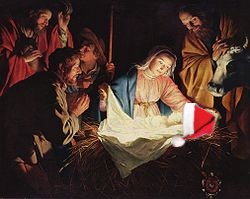
The whole “Keep Christ in Christmas” campaign that has been fermenting over the past decade or so has made many Christians paranoid. Society has forgotten, they claim, whose birthday we’re celebrating. A plain view of the facts, however, calls this assertion into question. No one bothered to record the date of Jesus’ birth. The stories about it, in the Gospels of Matthew and Luke, were written after a lifetime of reflection by people who were not eyewitnesses to any of the events. Historians of the era mention no celestial anomalies and there are no records of crazy old Herod killing babies among his own people. (His domestic affairs, however, may be quite another story.) What is absolutely clear is that the stories have grown with the telling. Many a child can tell you the names of the three wise men. Luke doesn’t even place them at the first Christmas, does not name them, and does not say there were three. No records of Zoroastrian migrations to Israel verify this story either.

The true loss is the loss of story. We live in a society that abuses the words “just” and “only.” That’s just a myth. That’s only a story. Ancient people—from the time of Jesus—appreciated the truths a story conveys. Consider the parables of Jesus. They cite not sources neither do they seek verification. They are only stories. They are also cited as the basis of many church teachings. Even atheists can be taught to appreciate the value of stories. Who could object to a myth advocating peace, harmony, and goodwill? Even if it’s just a myth.

Santa Claus might come to Santa Monica’s rescue. Yes, diehard fans of historical veracity will say there was a saint called Nicholas. We all agree that he didn’t wear red velvet trimmed in white and that he didn’t possess magical, northern latitude cervid stock. Even before the days of forced air heat he didn’t slither down every chimney in the world in one night. Few would dispute, however, the value of giving gifts of good will. Just ask any member of the Salvation Army who appear at this season every year. Instead of arguing about whom to exclude, why don’t we invite everyone to our celebration? Jesus, angels, Santa, Jack Frost, Heat Miser, and Christopher Hitchens—what a party this could turn out to be!

Is there no room in the manger?


Astronomical Chances

I am sure that I am not alone in the sense of relief that the solstice has finally arrived. Light will gradually begin to increase as the northern hemisphere slowly wobbles back toward the sun. And if I didn’t have another final exam to administer a little later this morning I would’ve stayed up to see the total lunar eclipse last night. Conditions were perfect, if cold, for viewing the event in New Jersey. NASA states that the last time a full lunar eclipse occurred on the winter solstice was in 1638. Those of us who survived to see last night’s events, whether with our eyes on the skies or on the Internet, have witnessed a rare astronomical coincidence. So rare, I’m sure, that some people have taken it as a sign.

This is the season for signs in the sky. The Gospel of Matthew narrates how Zoroastrian astrologers followed a star to Bethlehem. Over the years many astronomers have puzzled over what this anomaly might have been. (They might benefit from reading a little mythology now and again.) While still in Wisconsin my family went to see a University of Wisconsin planetarium show on the subject, and these family-fun science-and-religion public-relations events are anything but rare. It is in the spirit of the season.

Ancient civilizations bestowed upon us the gift of looking for signs in the sky. In antiquity’s three-tiered universe, the gods literally lived “up there,” so portentous occurrences above our heads were a bellwether of divine intention. Religious specialists had to be able to interpret the omens in the air. That fascination has remained with humanity ever since, no matter how rational we’ve become. While driving home in the relatively developed region of New Brunswick a few weeks ago, I saw a meteor. This was remarkable because the light pollution of multiple streetlights along with the volume of raging traffic headlights was intense. My eyes were glued to the taillights before me when it fell. It felt like an epiphany – it was the brightest meteor I’d ever seen, and over the years I suppose I’ve seen my fair share. It left me with the feeling that something momentous had occurred, an emotion that persisted for a few days. No wonder ancient astronomers found the night sky so impressive. The only negative aspect of the lengthening of the days is the corresponding shortening of the nights.