Step Far

It made a bit of a splash when it came out, Longlegs did.  It took a while to get to a streaming service I can access, but I can say that it’s a movie with considerable thought behind it.  And religion through and through it.  I would’ve been able to have used it in Holy Horror, and it is one of the very few movies where a character corrects another, saying “Revelations” is singular, not plural.  Somebody did their homework.  Although the plot revolves around Satanism, you won’t be spoon-fed anything.  The connection’s not entirely clear, but it does seem to involve some form of possession.  The plot involves ESP and a literal deal with the Devil.  Things start off with a future FBI agent encountering Longlegs just before her ninth birthday.
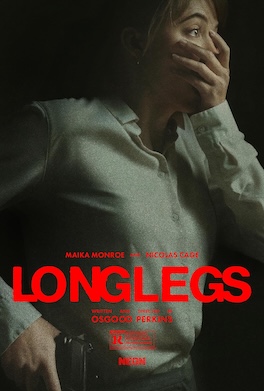
As an adult, she’s forgotten the childhood encounter but a set of murders with a similar MO indicates that a serial killer, called Longlegs, is on the loose.  The murders are all inside jobs, and it turns out that a doll with some kind of possessing ability is responsible for inspiring fathers to murder their families.  No details of the connection between the dolls, Satan, and the reason for the killings ever emerges.  The movie unnerves by its consistent mood of threat and menace.  Satan, the guy “downstairs,” appears more properly to be chaos rather than a kind of literal Devil.  Satanic symbols are used and there are plenty of triple sixes throughout.  The Bible has a role in breaking the killer’s code, but talk of prayer and protection also find their way in the dialogue.  Longlegs uses a ruse of a church to get the dolls into his victims’ houses.

I’ll need to see it again to try to piece more of the story together, but Longlegs is another example of religion-based horror tout court.  Serial killers are scary enough on their own, but when their motivation is religious they become even more so.  Nicholas Cage plays Longlegs in a convincingly disturbing way, but there’s definitely some diegetic supernatural goings on here.  The art-house trappings make the plot a little difficult to follow, particularly early on.  Religion, however, shines through clearly.  The FBI agent, although psychic, has ceased believing in religion while trusting the supernatural.  Even as the credits rolled I had the feeling that I’d missed some important clues.  And those clues would be important, particularly if I ever do decide to write a follow-up to Holy Horror.

Sequel Pondering

Of course I’m working on another book.  I can’t say what it is at the moment, but one of the projects I’ve long been contemplating is a kind of sequel to Holy Horror.  The problem is that if the first book didn’t sell very well (the premise is perhaps too academic), a sequel couldn’t be expected to do any better.  I’m still working on sloughing that academy skin.  But I keep watching what we insist on calling “horror” and the more I do, the more I find the Bible in it.  Others have taken up the gauntlet—mostly academics who have jobs that encourage such behavior—of connecting horror and religion.  The Bible’s role, while a subset of the larger field, has its own particular parameters.  In one of my notebooks I have a list of 23 movies to add to my analysis.  I know that there is a twenty-fourth, but it’s only streaming on an exclusive service and still costs a bit too much for something that doesn’t come with a plastic case.

In any case, Holy Horror just scratched the surface.  One of the factors I’ve mentioned before is that there is no database of the Bible’s appearances in film.  It would be an extensive list altogether, and a substantial number of horror films would be on it.  In general, it seems, people really aren’t too interested or intrigued by this fact.  I certainly am.  Our society is a curious mix of sweet and salty.  We want to think we’re too sophisticated for religion, but religion undergirds just about everything we do.  Otherwise it’s pretty difficult to explain how the Bible keeps showing up in horror.  Usually as a mysterious artifact.

I recently saw myself referred to as a biblical scholar.  There’s no doubt that I taught biblical studies for many years.  I even wrote a book interpreting one aspect of the Good Book.  My degree, and my interest, however, has always been historical.  I follow this history of ideas.  Although many people don’t understand my current horror fascination, it’s clear this is another jog down a trail of history.  How did we get to the point that a totemic (the scholarly phrase is “iconic”) Bible became a stand-in for God in movies?  I’m not sure I’ll ever be able to write Holy Sequel, although, if my profession ever permitted it, I’d certainly have the interest in doing so.  There’s a lot to be learned from such explorations.  That’s true even if the books containing the information only appear on a few dusty library shelves.


Spiritual Alterations

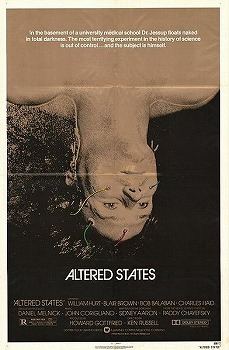
I’d been meaning to watch Altered States for quite a few years.  I suspect the reason (it’s been long enough that I can’t recall for sure) is that I knew it had a story line tied in with religion.  The tale follows Edward Jessup, a psychopathologist, who is attempting to understand schizophrenia.  He’s particularly taken by the religious nature of some schizophrenic delusions, and he uses sensory deprivation on himself to trigger something similar.  A trip among tribal Mexicans leads him to a psychoactive substance that he decides to combine with sensory deprivation to enhance the effects.  Along the way he explains to his girlfriend, and eventual wife, that his father was religious but died a horrible death.  He therefore became irreligious but his altered states of consciousness are often full of images from Revelation.

While the Bible theme eventually gives way to biological regression to pre-Homo sapiens, one of Jessup’s experiences has him coming to his dying father again and dropping a Bible on him which turns into the veil of St. Veronica on his face, which he then rips off and throws, flaming, to the floor.  Another instance of the Bible in horror, the film also uses crucifixes and hellish images to demonstrate the religious nature of these alternative states.  Jessup’s goal is to regress to the original thought, to encounter, as he puts it “God.”  This desire, combined with the potent Mexican drug, transforms him physically, and, in the end, emotionally.  Instead of being dissociated from his wife (whom he is planning to divorce), he realizes that love is the only thing that can save him from the terror of his experiences.

This is some profound stuff.  Paced like a movie from 1980, it has a quality not unlike 2001: A Space Odyssey.  The message seems to be sound—the need for encountering the “divine” ends up convincing Jessup (that may autocorrect keeps changing to “Jesus”) that love is really what it’s all about.  The transformation scenes, while not shown in the detail of An American Werewolf in London, are nevertheless convincing enough.  It’s a rare movie that treats religion respectfully.  Here Ivy-League scientists are motivated to understand it.  In real life, alternative states of consciousness are quite real, if poorly understood.  They’ve been part of religious practice from the beginning and are a far cry from sitting in the pew and singing anodyne hymns week after week.  The more movies I see, the more it seems that a sequel to Holy Horror will be necessary some day.