Stratego

lossy-page1-428px-CLiff_being_undermined_by_the_Virgin_River._West_wall_of_Canyon_above_Temple_of_Sinawava._-_NARA_-_520458The idea is a simple one. When someone undermines, the very foundation of an idea is left with no foundation. We are taught not to undermine ourselves; for enemies it’s okay. Encouraged even. The Bible contains the seeds to its own undermining. The claim that it is a sacred book encourages—even demands—serious attention be paid to it. When it is examined closely, however, it becomes plain that the status accorded it as a book undermines its own claims. Believers can respond in several ways. One is to declare the Bible inerrant and to claim that contradictions are not contradictions and that what history has proven false is actually true. The keenest breed of such inerrantists hardly exists any more, since it does require a stable, geocentric view of the universe, if a universe there be at all. On the other extreme there are believers who make sacred writ so highly symbolic that we need not worry about the obvious factual errors—they were never meant literally anyway. And, of course, every position in between.

The Bible is not a unified composition. This was evident to the person, whoever it was, who first joined the Prophets to the Torah. Or even Genesis to Exodus. We have no way of knowing if s/he (mostly likely the latter) really believed that Moses wrote all the stories from the creation of the world through his own death, but the books of the Pentateuch roughly hang together in an extended narrative with plenty of instruction along the way. The “Bible” that Jesus knew had considerably fewer books than our “Old Testament.” And one gets the sense that Paul’s letters were tacked on in a catch-as-catch-can fashion, with everyone knowing (as the letters themselves say) that material is missing. And what Paul authoritatively wrote to the people of Galatia may not have been the same advice he sent to the Corinthians. Tides and times. Bibles and believers.

When scholars began, out of deep devotion, to look closely at the Bible the cracks in this historical facade began to fracture. Once the breach is in the dike, one dare ignore it only at great peril. The first shaft had been dug. By the time of Julius Wellhausen, the undermining was already engineered and well underway. And it couldn’t be stopped. Biblical scholars had choices to make: ignore the evidence and continue to sing the Lord’s song in a strange land, or climb out of that tunnel before it caves in. And the church, unsuspecting of what it means, insisted on an educated clergy. Serious study of the Bible shows what many believers wish it didn’t. And yet we continue to make claims based on evidence that is faulty. Just as long as these supporting pillars hold up we have nothing to worry about. And the undermining continues daily, lest we all find ourselves in the breadline.


Shaky Ground

HigherGroundFor the past few years I have been drawn to the spiritual memoirs of women. I suspect a deep disconnect prompts this interest. Religions—in this case primarily the monotheistic traditions—put a premium on fairness and justice, yet treat women as somehow outside these mandates. Women nevertheless respond to the human religious impulse somewhat more seriously than most men. This leads to a dissonance that surfaces in women’s memoirs. Carolyn S. Briggs’ Higher Ground: A Memoir of Salvation Found and Lost proved somewhat of an epiphany for me. In this story of an Iowa girl’s encounter and seduction into a Fundamentalist faith that never quite managed to smother her rationality, I recognized many aspects of her adopted religion from my own tenure in literalism. The real strength of Briggs’ account is her vivid recollections of how her own Fundamentalist mind worked. For many of us who’ve gone through that spiritual wasteland, dredging up those memories can be a harrowing experience. What shone through in Higher Ground, however, is how the fantasy-prone literalist imagination loses its tenuous hold on reality while promising deliverables that are always pushed off into the future. It is not a faith for the here and now.

The non-denominational, yet Calvinistic, Briggs’ church home convinced the author, for some years, that she was inferior to her husband. There can be no doubt that this is “Bible-based” teaching, for the Bible is the product of a patriarchal age. Literalism grows more oppressive with the passage of time, for despite neo-con posturing, society is better for many than it was in the “good old days.” Fundamentalist traditions seek to reestablish the mores of the first century two millennia later, as if a simple transfer were possible. Society has offered progress for women while literalism is rife with regress. This double standard led to the loss of one of their own because over two thousand years much water flows under the bridge and brig.

Higher Ground is not an easy memoir to read—the accounts of those who experience repression seldom are. Religion is generally a conservative force in society, even if based on radical principles. The sayings of Jesus, for example, remain revolutionary even today, but they are often hidden behind the (male constructed) facades of organized religious movements. In school we teach our children that the sexes are equal, in Sunday school the opposite. Fundamentalism is not, however, in any danger of dying out. As Briggs demonstrates eloquently, the very thought process of a rational person is altered by it. Briggs leaves us guessing at what happened after the story ends but she has nevertheless contributed yet more evidence that demands a verdict. Until the judgment of fair and just can be rendered, religions will repeatedly be called to the witness stand.


God Spell

I had some good news from God recently, if the Jehovah’s Witnesses are to be believed, anyway. It had been a trying week in some ways, and who wouldn’t welcome good news? Back when I was unemployed, I used to natter with the Witnesses when they came around. Like a stray that you feed one time, however, you’d better be expecting them back from time to time. I was reminded of a phone conversation I overheard (in New York City generally everything is overheard by at least someone) where a woman was saying, “I keep praying Jehovah will straighten her out.” I didn’t know who the “her” was, but I did wonder why the Witnesses keep using a name that we know is technically incorrect. “Jehovah” is actually what you get when you read the Masoretic device of using the vowels from “adonai” with the consonants for “Yahweh,” in a Germanic language. Since Jews don’t pronounce God’s name, they used this little symbol to remind the reader to use the sobriquet “lord” (adonai) instead. Some literalists lined the letters up and came up with a Teutonic-Hebraic name that was never historically used for God.

Watchtower

Well, the good news volume of the Watchtower addressed that. Sort of. Chapter 2, “Who is God?” notes “In English it [God’s name] is usually pronounced ‘Jehovah.’ But some people pronounce it ‘Yahweh.’” Historically and critically it is the other way around, but who’s counting? Orthodoxy doesn’t always make somebody a good person. In fact, most of the Witnesses I’ve met have treated me better than the majority of people in my own faith tradition. Familiarity, they say, breeds contempt. Religion often has a way of bringing out the worst in people. Since this was the good news, I decided to accentuate the positive. I turned to chapter 8 to learn “Why Does God Allow Evil and Suffering?” Theodicy is probably the largest generator of atheism that monotheism faces.

“Evil began on earth when Satan told the first lie.” Although, I wonder how you define a lie? According to Genesis 3.17, the conclusion to God’s first word to Adam was, “But of the tree of the knowledge of good and evil, thou shalt not eat of it: for in the day that thou eatest thereof thou shalt surely die.” The last part of the sentence, “surely die,” is an emphatic in Hebrew, the original language of Jehovah. But it doesn’t literally happen. Most literalists allow this infelicity to stand, or explain it away as a “spiritual death,” while the Hebrew is quite plain in its meaning. Thou shalt surely die is non-negotiable. Not exactly true, however. I’m no theologian. I’m just a reader attempting to make sense of the world I see around me. Good news is there certainly, every now and again. But that theodicy question trips me up every time. Until we can face the implications of not surely dying, I’m not sure we’ll ever find out.


Forget this Alamo

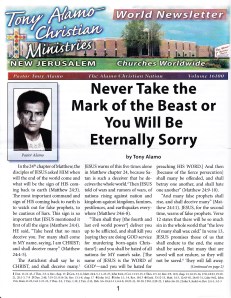
A person’s car is a haven of sorts. Very expensive, dangerous and yet necessary, they have made life a fair bit easier than caring for horses when you need to trot down to the Apple store to pick up a charger for your iPhone. When we leave our cars we don’t have to strap on the feedbag, but in many parts of the world, we do have to lock them up. From a young age I was taught not to touch somebody else’s parked car. People are very possessive of them and some folks get upset at even a smudged finish. I always find it strange, then, when a flyer ends up tucked under the windshield wipers. Not that it happens often, but around the holiday season some promoters will go in for the cheap advertising trick of that paper that first makes your heart skip since it looks like a ticket, and then annoys you when you find out it’s just more junk mail. The other day my wife came home with a new type of flyer under the blades. It was from Tony Alamo Christian Ministries.

To be honest, I’d never heard of Tony Alamo before. I seemed to remember the last part of his name, though. In any case, the earnest-looking evangelist warned loudly in the headline “Never Take the Mark of the Beast or You Will Be Eternally Sorry.” This was a cheerful way to greet the holiday season, but I decided to give him a hearing, or at least a brief reading. By the second short column I’d discovered his “Bible only” technique included interpolating [in brackets] his own reading of the Scriptures, but still enclosing them in the quotation marks. This is, categorically, not so different from preaching—the practice of making your followers believe that you have an inside line on what God meant to say in the Bible, but obviously didn’t spell out very clearly. This is the problem with all Bible literalists movements: they claim solely Bible [but only when interpreted their way]. Those who’ve found their windshields thus violated have grounds to be suspicious [if I understand this technique correctly].

It turns out that Tony Alamo is currently in prison [one suspects the parallel to Paul of Tarsus, or at least Silas, has passed his mind] for ten counts of transporting children across state borders for illicit purposes. I’m not sure which Gospel condones child molestation [perhaps “suffer the little children to come unto me”], but from the Illinois State Pen he still reaches out to put his grubby flyers beneath the nation’s windshield wipers. He also seems to be terribly worried about the end of times. With a 175 year prison sentence, anybody would be [unless, of course, they’ve be persecuted for righteousness sake, in which case they are blessed—and that’s actually in the Bible]. So beware the paper that get wadded up beneath your wipers. Sometimes the Alamo is best forgotten.

Alamo


Big Top

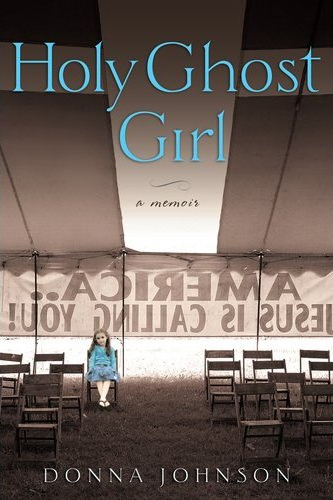
Being raised by a woman who staunchly kept her evangelical faith no matter what the world threw at her has undoubtedly left a deep impression on me. Over the past few years I’ve found myself reading the memoirs of girls raised in evangelical settings who’ve discovered truths often hidden from males in similar circumstances. Clearly one of those truths is that male privilege is the substrate for any kind of biblical literalism. I’ve just finished reading Donna M. Johnson’s Holy Ghost Girl and once again I’ve seen the light. Before I read this book I’d never heard of tent revivalist David Terrell, but I had attended a revival or two with my mother in my younger years and I knew, at least in theory, the evangelist is less important than the message. So they would have us believe. What Johnson accomplishes, however, is no less than astonishing. She presents a portrait that neither condemns nor condones her erstwhile stepfather, although her childhood was frequently undermined by the perils that accompany being raised by a revivalist groupie, and particularly being a girl in that situation.

Plaintive and reflective, Holy Ghost Girl raises questions that evangelicals often leave hanging in the air, such as when Brother Terrell’s son asks why he has to go to school when the rapture will come any day. Why indeed? When a court order had been issued, Johnson describes the puzzlement of the evangelistic team as they tried to decipher the letter: “Dreams, visions, prophecy, and scripture, our primary tools for making sense of the world, offered no insight on how to deal with legal issues.” This sentence suddenly explained so much of my own youth that I felt as if I’d missed out on the class that informed evangelicals of what was expected of them. The rules of this world do not apply here. Men are superior to women and girls who question that do so at their eternal peril. This becomes clear as Johnson reveals while the story unfolds that Terrell kept at least two secret families hidden from his wife, and, more importantly, from his followers. When Johnson’s mother found herself pregnant by Terrell and her daughter asked what she would tell the kids when they grew up the answer was pat: Jesus will return before then.

The idea of being excited for one’s belief is admirable. Evangelicalism has made an industry of it, conflating emotion with spirituality. Biblical literalism will always exact a heavy cost on girls. Those of us who study the Bible professionally learn early on that the Bible reflects the social conventions that gave rise to it and that world was unapologetically patriarchal. That stain will necessarily accompany any form of literalism—the sexes cannot be equal when the Bible says it ain’t so. Herein is the dilemma of the girl raised in an evangelical world: to question authority is to risk hellfire, and authority rests with men. Those who insist on women’s equality are of the devil. Johnson, obviously, took that great risk of making a deal with the devil and became a normal person. All of us raised evangelical have to come to grips with such issues if we want to make a lunge for normalcy, but the cost will always be far higher for girls.


Biblically Married

The Bible says—. Fill in the blank. Go ahead, someone will believe you. The problem with biblical literalism is that it is often held by people who don’t read the Bible. Well, it is a gosh-darn big book—well over a thousand pages—do you know how much quality television watching time that represents? So many fundamentalists are surprised to find out how little the Bible has to say about marriage. In fact, it says almost nothing. There are no marriage rites given, and marriages are mentioned but not described in detail. So when modern-day readers want to find guidance about political policy they have to—to be frank—make a lot of stuff up.

Take North Carolina, for example. Next week they are scheduled to vote on an issue of defining marriage. The intent, apparently, is to bring the state in line with the Good Book. In comes Matthew Vines, an evangelical Christian who’s also gay. Being a Harvard student, he has immediately impressive credentials. He has an on-line biblical exegetical exploration of what the Bible says, and more importantly, doesn’t say, about homosexuality. The other solution, to actually read the Bible, is a little too much to ask. Another part of the problem is that the Bible was written in a very different context, and to understand the Bible’s view on anything, you need to fit it into its context. All this Bible reading—and context too? Better leave it to someone on the television to explain it all.

Leonard Pitts Jr. is a columnist that I’ve come to trust. His good sense comes through in all his work. In Wednesday’s column, he highlights Matthew Vines’ hour-long talk as an example of what happens when common sense meets the Bible. For those who bother to read it, it will become clear that the Bible nowhere defines marriage. It says nothing about sexual orientation. The few passages on homosexual acts have a narrow context (that word!) that must be considered. Nowhere in the Hebrew Bible nor the New Testament is marriage considered a religious matter. It’s simply what people do. So as North Carolina heads to the polls, Bibles clutched in hands, but not in their heads, it might do to watch Matthew Vines as homework. I haven’t seen the video myself. An hour is just too long to take from my busy television-watching schedule.


Denying Truth, For Profit

Sometimes I’m questioned about why I bother with creationism. Everyone who’s intelligent knows it is religious ideology masquerading as science and people will eventually figure it out. But will there be time? An editorial in yesterday’s New Jersey Star-Ledger pulls the curtain back on creationism’s incestuous cousin, climate-change denial. As the editorial notes, key documents of the Heartland Institute—one of the major propagators of climate change as “just a theory”—have been leaked and show that they have learned their lesson from creationist tactics. They want “debate the question” instilled in science classes in lieu of facts. And much of their money comes from big oil. It is the hope of such institutes that an American public already woefully pathetic at understanding science will be led to believe “just a theory” equals “likely not true.” The data are stacked completely against them and the entire rest of the developed world knows that.

While the issue may seem less religious than creationism—which is based on getting Genesis 1 in the classroom as science, no matter what you call it—it has deep roots in that same insidious cocktail of politics, religion, and dirty money. Biblical literalists tend to believe the world is about to end. The belief has been around for at least two millennia. It is a damning and damaging belief that declares the world was made for raping because it is about to end. This deranged thinking is fueled, literally, by unrestrained economic interests. Sometimes the groups can’t see beyond the Bible to realize that they too are being screwed. Science is objective, and it is science that has been challenged by various religious and political groups since the 1920s. Today, when there is far too much information for anyone to stay on top of it all, and in an American society deeply distrustful of higher education, I smell an explosive amount of methane in the air.

Climate change is real. The “theory” is so well supported by evidence as to be fact. Is anyone really surprised that supporters of the Heartland Institute have also backed Newt Gingrich’s campaign? We have placed ourselves in a very dangerous position as the last remaining “superpower.” I tried to read a book on environmental issues that Routledge published, but was so scared after the first three pages that I had to put it down. What is the lesson here, class? Is it not that money is the root of evil? And that, my dear literalists, is biblical.

The future of human economic evolution


Bible Experts All

I seldom write follow-ups to my own blog posts – I’ve always found self-referential academics somewhat distasteful, and besides, what is creativity without some variety? Nevertheless, it seems that yesterday’s post has garnered a bit of interest in the disaffected outlook of a self-professed biblical scholar. (Actually, I have three “higher education” diplomas rolled up neatly in tubes in some untidy closet that show that some universities also accuse me with this charge.) Perhaps I need to clarify.

When reading a blog post, it is very difficult to determine the position of a writer’s tongue in relative proximity to his/her cheek. (Those with eyes to see, let them hear!) The subject might be funny if it weren’t so deadly serious. Despite my reservations with Christopher Hitchens, Sam Harris, and Bill Maher, they have all underscored a vital point – biblical literalism is very dangerous. This is even more so the case when, in their own minds, all people are Bible experts. We attend school and learn to read. Some learn to read more deeply than others, yet all “know what the book says.” There is no way to dispute that belief. Belief is belief, requiescant in pacem. Some commenters wondered why the opinion of “Bible experts” should matter at all.

When I’m feeling ill, I would prefer to ascertain the opinion of someone who has actually earned a proficiency in human physiology. When the car breaks down (again), I prefer to have someone who understands machines well as the repairer. When many, many people want to know what God doth require of thee, they turn to individuals who have not been thoroughly trained in Bible. I taught in a seminary for many years, and as an administrator, became quite familiar with the accrediting requirements of the Association of Theological Schools, the nation’s main seminary accrediting agency. I may unequivocally state that few seminarians emerge as full-fledged Bible scholars. Some “denominations” do not require any seminary training at all. So when your spiritual life breaks down, most folks head to an “expert” ill-equipped to handle the Bible, a homeopathic (no slur intended) literary diviner.

Purely from my own perspective, I would prefer to know what the Bible, in its own context, language, and words, is more likely to have meant. Delusions and all. Can’t buy that at your local church, with rare exceptions. That is the role of the humble Bible expert. As with any field of study, it is obvious when you have found a true expert. Such a one will readily admit that she or he has more questions than answers.


Neo-Cons and Mockingbirds

Among my high school catch-up reading is one of my favorite novels, required in my own youth, Harper Lee’s To Kill a Mockingbird. While a certain distress accompanies the fact that I read this book over thirty years ago, as I reintroduce myself to the welcoming characters of Scout, Jem, and Dill, I lament that there is so much to read that we can’t simply linger on the great works of literature we’ve loved before. Reading the novel as an adult there is much, I am certain, that I missed the first time around, not knowing what to expect as I approached the story with no preconceived notions.

One of the constant stresses I lay on my students is how the Bible utterly suffuses American society. We are bombarded by Bible, whether we know it or not. It was with appreciation, therefore, that I saw the exchange between Scout Finch and Miss Maudie in chapter five. Miss Maudie, complaining that “foot-washing Baptists” take the Bible a little too literally, declares, “but sometimes the Bible in the hand of one man is worse than a whiskey bottle in the hand of – oh, of your father.” (The incongruous image of Atticus Finch drinking whiskey is not lost on his young daughter.) This statement summarizes much that is true in today’s society as is evident in Max Blumenthal’s Republican Gomorrah. Many Americans create an idolized image of the Bible that is used to gain control over others. When such individuals gain political power everyone else is at risk.

In the backlash to having a moderate man elected to the presidency, the news is full of biblically constricted complainers who fear the impotence of the Bible. Their fears are unfounded. Our society has been constructed on foundation blocks of biblical literalism and although the superstructure is unaware of it, the Bible continues to root many Americans firmly to their planet. The “founding fathers” were not Christians, but many of their country-folk, Puritans and others fleeing the formalized religions of Europe, were. The aggregate of their descendants has been tapped successfully by neo-con politicians to win elections and referenda around the nation. There is no end in sight. If only the wisdom of Miss Maudie were taken a little more seriously, we might have a chance to move beyond the illusion of a pristine yesteryear that never was.

Killing me biblically