Life After

Robert T. Bigelow is wealthy enough to speak his mind.  A hotel and aerospace entrepreneur, Bigelow has made no bones about his belief that aliens are among us, for example.  After the death of his wife in 2020 he initiated a contest for essay writers to give their best proof that consciousness survives death.  The results took the form of a five-volume, twenty-eight essay collection that, according to those who’ve read all, is impressive.  Having spent my life studying religion, I can trace my motivation back to this basic concern.  As a child I was terrified of Hell—a fear that has never abandoned me—and consequently studied religion as a means of reassurance.  I’m not alone in this; the whole Methodist movement began because of John Wesley’s similar concern.  Most of us don’t have the money Bigelow has to attempt reassurance.

Having said that, some time ago, the Bigelow Institute for Consciousness Studies—the organization behind the essay contest—offered $500,000 for the first place essay.  The second received $300,000 and the third $150,000.  Those who were selected for publication received a copy of the five-volume set.  Then, the Institute made an announcement: while supplies lasted, anyone with a legitimate interest in the subject could write to them for a free copy.  I’m not of the intellectual caliber of these essayists, but I have studied religion my entire life.  And I am quite interested in what the BICS is calling “absolute proof of life after death.”  All it cost was an email.  They even paid for shipping.

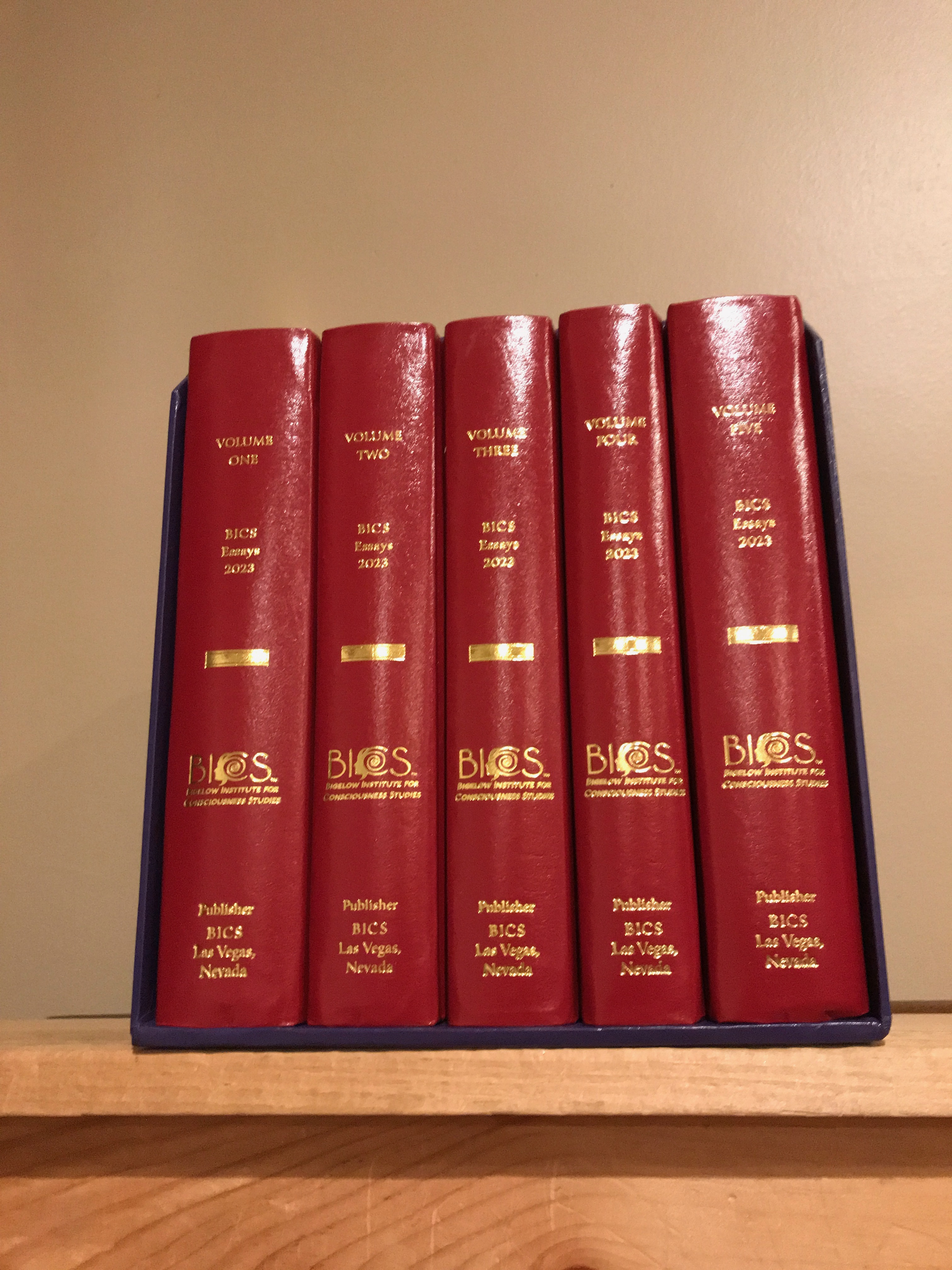
The set arrived yesterday.  The postal worker at the door seemed apologetic (I had to sign for it), noting the package was heavy.  Now, this is going to take some time to get through.  The five volumes are handsomely produced.  The hardcovers are printed in full color (I know from work this is quite costly).  They have gilt edges and ribbon markers.  And a wealth of thought within.  I guess you’ll need to stay tuned here to find out, after I finally finish, if the results are assuring.  Glancing through the table of contents, and having looked over the judges of the contest, I’m optimistic.  Although Robert Bigelow stands at the opposite end of the political spectrum to me, we both understand that deep-seated human need to know physical death is not the end of who we are.  Even the famous skeptic Harry Houdini wanted the answer to this question as he debunked mediums in search of someone legitimate.  In any case, I’ve got years of interesting reading ahead of me.

Thinking Big

Depending on who you are the Bigelow Institute for Consciousness Studies (BICS) may set your eyeballs to rolling.  You might know that extremely wealthy Robert T. Bigelow made his fortune as a hotelier and then began investing his money in aerospace technology.  He publicly admits to believing that aliens are already among us, and has contributed to advances in space travel components.  (It seems that many of the uber-wealthy are looking for a way off this planet at the moment.)  Not an academic, Bigelow is keen to admit his interest in what is often laughingly labeled the “paranormal.”  If you’ve got money you really don’t need to worry about what other people say.  I recently ran across an announcement regarding the winners of a BICS essay contest regarding the survival of consciousness after death.

As I’ve noted before on this blog, the paranormal and religion are close kin.  Nevertheless it does me good to see that so many people with doctorates (both medical and of philosophy) entered the contest.  I’m glad to see not everyone is buying the materialist narrative.  We’ve been so misguided by Occam’s razor that we can’t see reality is more complex than they teach us in school.  Churches may not be doing it for us any more, but it does seem that “there’s something out there.”  With a top prize of a half-a-million dollars, there was certainly a lot of interest in this enterprise.  If you go to the website you can download the winning papers.

Consciousness remains one of the great unexplaineds of science.  Answers such as “it’s a by-product of electro-chemical activity in the brain” don’t mesh with our actual experience of it.  Indeed, we deny consciousness to animals because our scientific establishment grew out of a biblically based worldview.  Even a century-and-a-half of knowing that we evolved hasn’t displaced the Bible’s idea that we are somehow special.  Looking out my window at birds it’s pretty clear that they’re thinking, solving problems.  Dogs clearly know when they’re pretending, as in a tug-of-war with its weak owner.  We don’t like to share, however.  Being in the midst of my own book project I really haven’t had time to read the essays yet.  I do hope they come out in book form, even though they’re now available for free.  I still seem to be able to carve out time for a book, which is something I consciously do.  I’m not convinced by the materialist creed, although I’ve been tempted by it now and again.  I like to think that if I had money I’d spend it trying to sort out the bigger issues of life, no matter what people call them.