Remembering Winter

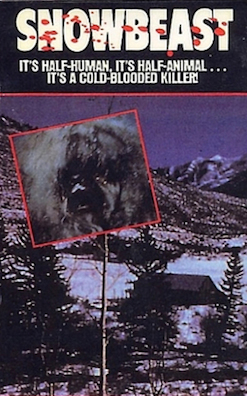
There’s a deep satisfaction at attaining a goal, no matter how low the bar.  Having rediscovered the “Beast Collection” after looking to see if Snowbeast was on it—it was missing from another DVD collection I have—I determined to watch my way through.  It took two or three months, maybe four, but I finally finished it out with Snowbeast itself.  One of a spate of Bigfoot films from the seventies, this was a made-for-television movie.  Many retrospectives show a movie going up in critical estimation over the years, but this one seems to have sunk down into the “bad movie” category.  But still, of the seven (!) Sasquatch films in the pack, it is clearly the best.  A low bar, as I say, but still, it has the advantage of being relatively well written.  Joseph Stefano, who wrote the screenplay, was one of the minds responsible for The Outer Limits.  He also had credit for writing the screenplay for Psycho

Decent writing can help redeem bad movies.  But more than that, you can actually care for the characters.  In some bad movies you have a difficult time raising any feeling for the people portrayed—that’s true for more than one of the other films in this collection.  Here are people that doubt themselves, but have good hearts.  The story isn’t complex (one of the reason modern critics scorn it).  A ski resort in Colorado—much of the movie shows people either skiing or snowmobiling—a young woman is killed by the eponymous snowbeast.  When the owner of the lodge insists on keeping it open for a festival, the current manager (her grandson) is reluctant to kill something that’s so human.  There’s a bit of a moral quandary here, which provides some traction on a slippery slope.

The beast then kills a member of the search and rescue team, and they know they have to destroy it.  The principal characters track it down, and after the beast gets the sheriff, they shoot it.  As I say, not much of a plot, but the characters have some depth.  It’s not a great movie by any stretch, but it doesn’t leave you feeling as if you’d have more enjoyed doing your taxes.  And that’s saying something for a collection of movies that cost less than most single DVDs.  Now if that makes me sound old, keep in mind that this movie was from the seventies.  And even if most re-appraisers think it has grown worse over time, I’m willing to disagree.  After all, I just accomplished something by watching it.

Pseudo-documentary

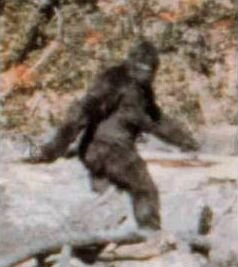
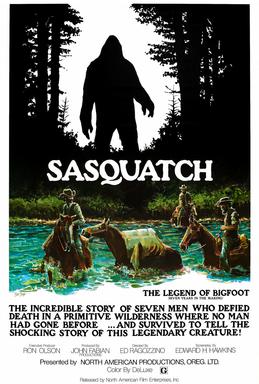
Documentaries have an honored place in visual education.  Of course, there are some who want to spice them up a bit with dramatic re-enactments.  These are sometimes called docudramas.  Then there are those who fake the documentary style to make mockumentaries, generally as a species of comedy.  Sasquatch: The Legend of Bigfoot is none of these.  A pseudo-documentary, it comes with “The Beast” collection I’ve mentioned before a time or two (mainly to excuse my bizarre viewing).  It presents itself as a documentary, but pretty much everything about it is fake.  The only real people are Roger Patterson—the movie shows his famous Bigfoot film—and perhaps the miners at Ape Canyon.  Oh, and Teddy Roosevelt.  In any case, the movie follows seven men as they make their way into remote British Columbia where “the computer” tells them sasquatch likely live.

The pseudoscience is easily enough spotted early on, but the movie never lets up its purported intent to bring low-budget proof back from the wilderness.  I’m not sure how the actual wildlife footage was captured.  In this slow-paced horror film there is quite a bit of actual nature thrown in.  I also wondered how they managed to get a cougar to attack a horse train and a bear not to maul one of the incompetent actors.  These two scenes aren’t special effects, and it strikes me as being either foolhardy or that trained animals were used.  It doesn’t seem to have had the budget for the latter, but a real mountain lion does land on one of the horses before quickly making an escape.  Although shot at night, the bear attack doesn’t seem entirely fake.  These things kept me wondering.

After about two months of horseback riding the crew makes it to the computer-predicted sasquatch homeland.  Bigfoot attacks the camp at night—no question that this one is fake—and after all these weeks of riding they decide to leave the next day.  Getting there is, apparently, most of the fun.  Fun, however, isn’t a word I’d use to describe this movie.  The hokey caricature characters (the old-timer, the dopey cook, the injun, the scientist—who does nothing but measure a thing or two) are worth a pseudo-laugh or two but the story struggles to keep the viewer awake on a cold weekend afternoon.  I kept wondering, in the Pennsylvania chill, how the weather in northern Canada was better in late September than it was around here in April.  I had to remind myself that Bigfoot was big in the seventies.  Big enough to handle both documentaries and fiction, and movies that are the latter, pretending to be the former.


Capture and Release

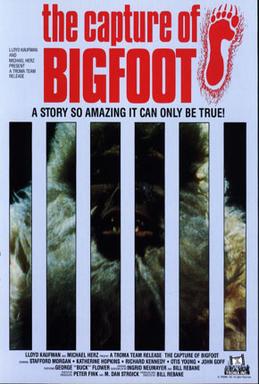
Waste not, want not.  I place some stock in old sayings.  With the way things are going, prices are sure to rise and so saving a penny or two may be wise.  So I turned back to my boxed set of “The Beast” for my horror fix.  As I’ve explained before, I bought this DVD set before streaming was a thing, and I was feeling nostalgic for Zontar: the Thing from Venus.  Being a fan of bad movies, it was worth every cent.  The set is actually (mostly) themed around Bigfoot.  I’ve talked about a few of these movies before, and trying to be frugal, I’ve determined to watch the whole set, no matter the cost.  Besides, there’s an aesthetic to bad movies.  The Capture of Bigfoot, no doubt, is a bad movie.  Knowing this before I slipped the disc in, I have no business acting outraged at the poor acting, directing, writing, or any cinematic sins.  Except one: a horror movie can’t be boring.  And Capture is b-o-r-i-n-g.  If you like movies about people slogging through knee-deep snow, this may be for  you.  

What really amazes me is the talent the compilers of such collections have at locating truly obscure bad films.  Now, I have a soft spot for 1970s horror.  Nostalgia carried me through, floating on those seventies’ vibes.  The clothing, especially.  And more particularly, the winter coats.  Although set and filmed in Wisconsin, the winter coats the kids wear in this movie are just like those everybody was wearing in Pennsylvania at the time.  And yes, I trudged through knee-deep snow my fair share of times.  That part just opened the flood gates of memory.  So, the story goes like this…

An evil businessman (I lost track of how many people he killed, or tried to), wants to capture Bigfoot (shown early, in winter white) to put the town on the map.  Paying stooges to go get the beast, he finally builds an elaborate trap that succeeds.  The local game warden, with his girlfriend/wife and her little brother, decide the creature isn’t evil.  Using Batman-style tying skills, bad guy’s henchmen assure that most of his enemies escape to trudge through the snow some more.  A mysterious Indian character tells the game warden that the creature must be set free, which it is.  The evil businessman dies in a fire inside his wicked mine where he’s keeping the beast.  In the end, two families—the warden and the Bigfoot—pay mutual respect.  I do wonder about the mentality of someone making a movie like this.  But then, some forty years later, here I am writing about it.  Win-win. 


Littlefoot

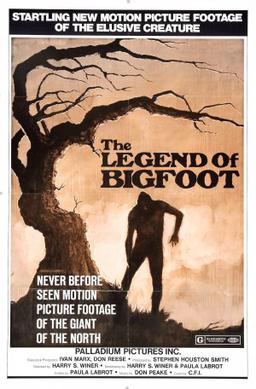
A film is an object.  Just like a book, a film exists and waits for someone to discover and promote it.  The vast majority of both don’t make the cut and exist in obscurity.  The Legend of Bigfoot by Ivan Marx is one of those obscure films.  I only knew of it because it was included in the DVD pack called “Beast Collection,” which I’ve already mentioned a time or two.  This set of movies is united by a few different themes which have little to do with one another.  The “Bigfoot Terror” disc includes Marx’s Legend although there’s no terror here and it presents itself as a documentary.    Interestingly, this movie actually had a theatrical release.  Of course, the mid-seventies were a high-water mark for Bigfoot interest in general, prior to the current phase.  Marx followed up his movie with a couple sequels and to his dying day claimed that his Bigfoot footage was authentic.

As far as the movie goes, it is just plain bad.  The wildlife footage, shot by Marx, is actually impressive a time or two.  Most critics dismiss his Bigfoot footage as a hoax, a view supported by the fact that the bona fide Bigfoot researchers he worked with eventually distanced themselves from him.  The movie is rambling and dull but intriguing at the same time.  It’s amazing, for example, that he was able to get this into theaters at all.  But what drove the producers of “Beast Collection” to include it, beyond it perhaps having been cheap and bit of filler on a disc claiming “approx. 5 hours of yeti scares”?  Well, it’s an object.  And it fits the theme of “yeti” but not really that of “Terror.”

There’s not a ton of information on Ivan Marx online.  IMDb has a mini-bio of him, noting the others who worked with him.  Even his wife, Peggy, who appears in the film, gets a little IMDb notice.  Such movies as this are hopeful artifacts.  Those of us who struggle against obscurity can take heart that, although probably a hoax, a movie that would otherwise likely have been forgotten made its way into a schlocky collection of horror movies to be purchased by the gullible and the hardcore.  As I mentioned in my post on Search for the Beast, I bought the collection to see Zontar: Thing from Venus, which, at the time, was available nowhere else.  I got what I wanted, and oh so much less.


No Demons

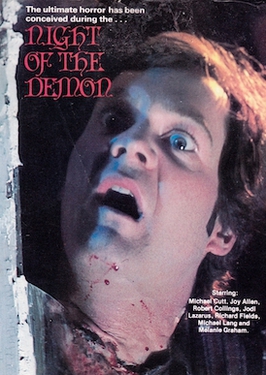
There’s a connoisseurship about it.  Making bad films, that is.  It’s a wonder that Night of the Demon—I should specify 1980 as the year—hasn’t really become a cult film of any standing.  You can tell the maker tried hard to shoot a reasonable film, but with a nearly Ed Woodsian level of incompetence.  It lacks Woods’ artistry, however.  For those just getting on the Bigfoot kick in the new millennium, it might help to know that Sasquatch was big in the seventies.  Yes, the first real efforts to sort this thing out came about when the psychedelic seventies were underway.  The documentary The Mysterious Monsters came out in 1976.  The first serious efforts to explain Bigfoot as not just a hoax began.  And James C. Wasson, Jim L. Ball, and Mike Williams took a shot at making a horror film of the hairy guy.

The acting is about the worst you’d care to see, and the script is abysmal.  The effects are anything but special, and the flashback scenes incongruous.  But it does have significance for religion and horror.  It goes like this: a professor and some students go to investigate a series of Sasquatch-related murders.  They’re led to “Crazy Wanda,” who lives alone in a remote cabin.  Wanda, when finally persuaded to talk, reveals that her crazed preacher of a father killed her Bigfoot-hybrid baby.  His followers still perform demonic rituals in the woods, worshipping the Sasquatch.  Wanda had burned her father to death in retaliation for killing her child—she kinda likes Bigfoot, it turns out.  The professor and students, naturally, fall victim to the beast.

Only the professor survives.  He’s assumed to be criminally insane and suspected of murdering his own students.  It’s almost painful to watch a movie where everyone is trying so hard to do it well, but just can’t seem to manage it.  The plot line about the cultists is immediately dropped after an intended rape ritual is interrupted by the professor.  Wanda’s preacher father, who seems to fit into no particular form of Christianity, has no motivation beyond avoiding Hell for himself.  At one point he seemingly admits killing her mother.  There’s even a scene where Bigfoot kills two Girl Scouts.  With all of this going for it, you might think it would’ve picked up a following.  It has some fans, I’m sure, but I’m not certain that it’s well enough known to make it onto lists of worst movies of all time.  More’s the pity since it would absolutely deserve it.


Black Lagoon, er, Lake

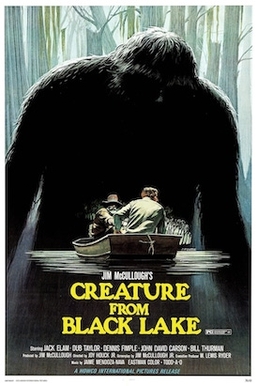
There’s value in watching bad movies.  For one thing, it’s a learning opportunity.  (For another, they’re more likely to be found for free on streaming services.)  The Creature from Black Lake drew me in with its title similar to The Creature from the Black Lagoon, and its very low price tag.  It kept me watching with its poor dialogue and obviously low budget.  One of the spate of “Bigfoot movies” that came out in the seventies, this one is the story of two (unintentionally) inept college students looking into a Louisiana swamp creature, based on the beast of Boggy Creek legend.  They end up in Oil City (I had to keep watching now), Louisiana where the local sheriff warns them off and where his daughter is, naturally, attracted to them.

I won’t spoil it for you (although the creature of this creature-feature is so clearly a man with a gorilla mask) but the movie does have a cast of some recognized B-list (or C-list) actors.   And it was a very early effort by Dean Cundey, a cinematographer who went on to work with horror auteur John Carpenter on Halloween and The Thing.  (And also The Fog, although that one’s lesser known, but covered in Holy Horror.)   You’ve got to start somewhere and the premise is good enough, being “based on a true story”—something the movie doesn’t claim for itself since the events, as portrayed, never happened.

Riffing off the earlier Legend of Boggy Creek—a cryptid docudrama from three years earlier (1973), it fictionalizes the Fouke monster incident.  The Fouke monster (which my autocorrect hates) was a creature reported around Fouke (no, I don’t mean Fluke), Arkansas, starting in the 1940s.  This earlier film went on to become a cult classic.  Black Lake suffers from poor direction and even worse writing.  College students, one obviously suffering from post-traumatic Vietnam issues, try to make out with girls they know are in high school only to be saved from criminal offense by a monster attack?  They wind up in jail anyway only to be released by a tough but gullible sheriff who simply trusts them to leave Oil City since he told them to.  I grew up near the earlier and, I’m tempted to say, original Oil City, and I know of no movies set in that town with all its drama and weirdness.  Even with its issues (Jack Elam is a delight to watch, however) this film is a bit of bad movie homework that’s hard to pass up when it’s free.


Big Shoes

Belief in the supernatural seems to be alive here in the northwest. At least if the culture at Sea-Tac Airport is anything to go by. I’d noticed, last year, that a sasquatch graces a restaurant in the N terminal, where jets from Newark tend to land. This year we had a bit of a layover, so we strolled through the C concourse. There I found sasquatch approved salmon in the somewhat anomalous Hudson News. Then, as I sat in one of the stylish, Seattle seats, a young woman came up next to us and sat down wearing a Sasquatch Volleyball shirt. I’m past the age when I can get away with innocently asking young ladies if I can take a photo of their shirts, so you’ll just have to use your imagination for the latter. The point is, bigfoot has been mainstreamed.

When I was growing up you got pretty mercilessly teased if you expressed any interest in such things. Now that I’ve got a respectable career others can get away with what captured my imagination as a young man. I’ve never thought of myself as being ahead of the curve. Or really ahead of anything, for that matter. Still, I trust my instincts. Maybe religion will come back into vogue some day. Or maybe it will simply be called something else. A tainted name is difficult to live down. The supernatural—or paranormal—often shares conceptual territory with religion, and although the pews aren’t getting any fuller, the number of those looking for some kind of meaning in the unusual seems to be holding steady. Physics can take us only so far in understanding what it is to be human.

Times change. Yesterday’s jokes are today’s orthodoxies. Those who spend a great deal of time peering back into history won’t be surprised by this. What is true today is true for today. New facts will be discovered and if we lived long enough we’d find that the future world will believe quite differently than we do. Not that the truth is relative. It is, however, temporary. Massive religious wars have been fought over trying to keep truths timeless. The sad irony is that the truths had already changed by the time such wars had been waged. The more rational we become, it seems, the more we open the door for the supernatural. I won’t presume to be one declaring such truth. That would take more weight than I have to offer. And anyone making such a claim would have some awfully big shoes to fill.


Red Eye Religion

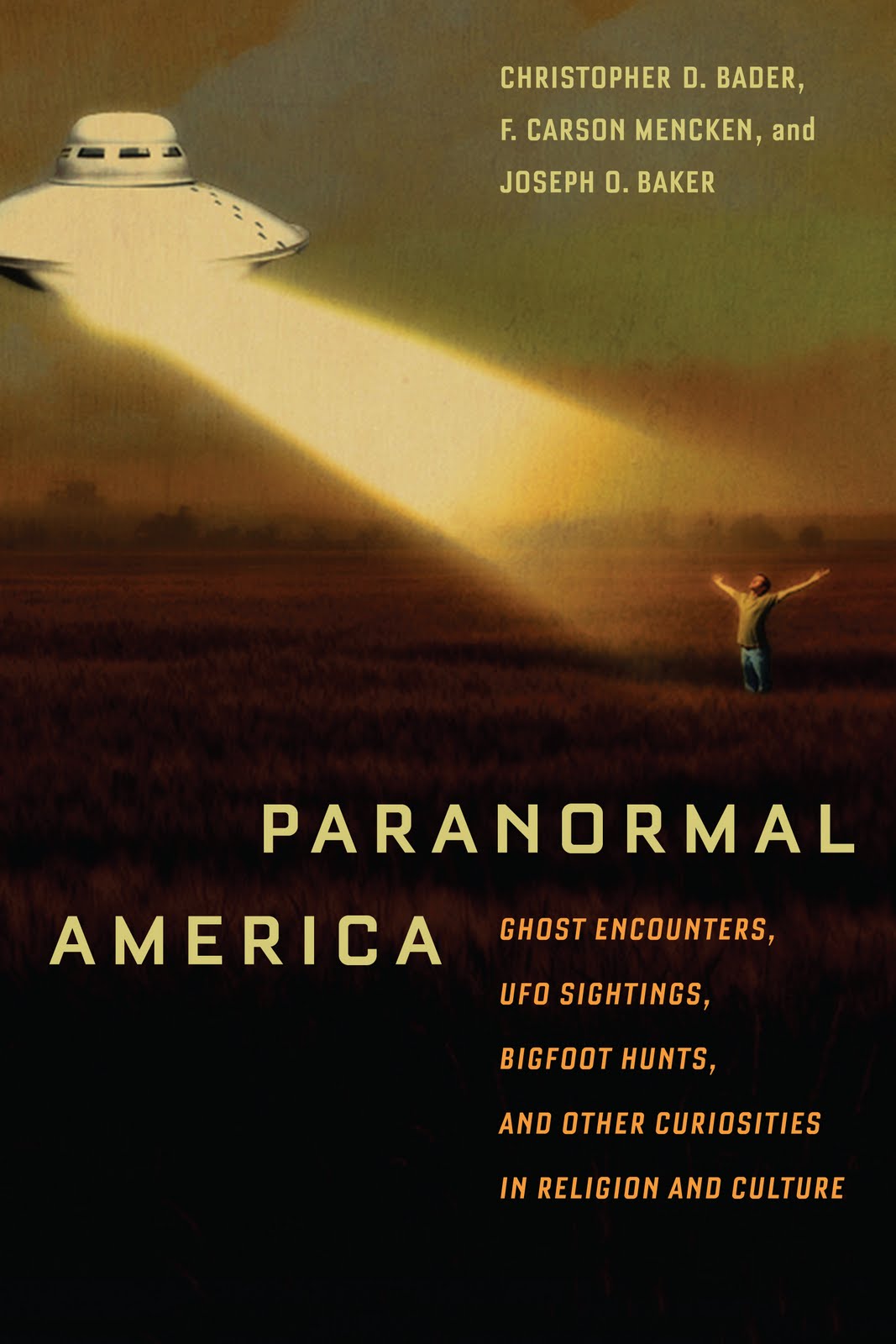
It is a slow news day when Bigfoot makes the front page of the New Jersey Star-Ledger (without a body being found, of course). Not even halfway through the article the word “supernatural” shows up. This illustrates once again my contention that paranormal and religion often share mental space. A few months back I posted on the recent book Paranormal America by Christopher D. Bader, 
F. Carson Mencken and 
Joseph O. Baker. The authors, sociologists by trade, expressed a revealing connection between religious belief and willingness to accept the paranormal. One exception stood out, however; professionals who engage the hunt for sasquatch often toe the line of science and disparage the popularizing notion that their quarry is supernatural. There’s no doubt that Bigfoot has a growing clientele. Whether mythic or biological, there can be little doubt that the big guy’s here to stay.

Appearing in the newspaper as a bit of New Jerseyana, the local tradition about Big Red Eye—the north Jersey version of Bigfoot—suggests instant comparison with the Jersey Devil, a tactic the paper takes. Similar to responses presented when religious behavior turns criminal, adding a light touch helps to ease the tensions. Both religion and the paranormal thrive in the realm of belief. As I waited all morning in the garage for car repairs yesterday, the incessantly chatty morning talk-show hosts were going on about some quote that the Tea Party had been compared to terrorists. One of the gambolers stated, in rather self-righteous tones, “they are entitled to their beliefs-the constitution protects our right to believe what we want,” or something to that affect. Belief is a very powerful motivator. Even those who thrive on science alone secretly imbibe.

The physical reality of a phenomenon is not the sole indication of its significance. People are meaning-seeking creatures. Our concepts of what life means range from nihilistic, to simple, to complex. Even those who claim life has no meaning arrived at that place after the search. The significance of the unseen, the unknown, is that it provides an Ebenezer for meaning. Does Bigfoot exist in New Jersey? I can’t say. If so, it would still not rank as the strangest thing I’ve seen here. Nevertheless, among the fervent critics and uncritical adherents a common bond exists. Belief can’t be measured in any laboratory (yet) but only the most naïve would assert that it doesn’t exist.

Do you want to believe?


Back to Paranormalcy

Belief is a paranormal phenomenon. Or so it would seem. Having just finished the fascinating sociological study of Christopher Bader, F. Carson Mencken, and Joseph Baker, Paranormal America: Ghost Encounters, UFO Sightings, Bigfoot Hunts, and Other Curiosities in Religion and Culture, the implications are thought-provoking. I’ve known the work of Christopher Bader, the lead researcher, for some time. Instead of trying to prove or disprove the phenomena under study, he performs a rare feat in actually addressing something most scholars avoid: what people really believe. As becomes clear throughout the book, a substantial majority of Americans believe in some paranormal phenomena at some level. The official story is that nobody believes this stuff, but the numbers beg to differ.

It is appropriate that such a topic should be undertaken by sociologists of religion. One of the difficulties the authors have is differentiating between religion and paranormal. Both religion and paranormal subjects involve going beyond empirical evidence. There is no “proof” that their objects of interest/devotion exist. The authors ultimately decide that what separates belief from God from belief in aliens is a matter of numbers: is it a generally accepted belief or one that is outside the norm (i.e., paranormal)? Since a vast majority of Americans believe in God, that is religion. Since far fewer believe in ghosts, they are paranormal. As I have suggested before, the main problem is one of definition. Religion stands on a continuum with “paranormal” beliefs. One society validates, the other it castigates.

I sensed a hesitation as I read this study. Grouping psychics alongside ghost hunters may seem reasonable, but how do Bigfoot and UFOs fit in? Those who research these latter topics often claim they are physical phenomena, as real as the keyboard I’m using, only undiscovered. Does an unsubstantiated phenomenon qualify as paranormal? Who decides what is really real? Academic institutions often distance themselves from subjects that might be suspect. (They also distance themselves from fair hiring practices as well, but that is perfectly normal.) It seems to me that the problem with “paranormal” comes in the grouping. Some of the individual subjects may indeed have merit: ghosts are perceived, reported, and some would say even photographed and recorded. They make up one of the earliest facets of religious belief. The psychic down the street has a less sure pedigree.

These fringe subjects, regardless of veracity, have a wide following. Even highly educated people generally believe in some form of “paranormal” phenomenon. Religion, widely accepted and practiced, ventures beyond the empirical as well. The difference is only, it seems, a matter of degree. Where is Fox Mulder when we really need him?