Preserving Culture

When I travel (remember travel?) I try to visit the places of famous writers.  It doesn’t matter much whether I’ve read a lot of their material; I know kindred spirits when I feel them.  Last summer—the one before the pandemic—I had to make a business trip to Oxford.  Now Oxford has a long, long list of literary illuminati, and I didn’t have much free time.  My hotel, however, turned out to be just a couple of blocks from the house of J. R. R. Tolkien.  One patch between meetings, I wandered over to the house.  It’s behind a high wall, so you can’t see much.  Like most European private homes, it isn’t ostentatious—over here we like to make it obvious when we’re wealthy.  In any case, I stood as long as a stranger can comfortably stand outside someone else’s house and tried to commune with the spirit of the former occupant.

Just the other day I noticed a New York Times headline that stated a movement is afoot in merry old England to purchase Tolkien’s house to make it a museum.  Although there’s no scientific way to prove it, people are somehow connected to the places they live.  There’s no other sensation like returning to your home town.  If, for some strange reason, anyone wishes to recall me after I’m gone (perhaps my pen name will take off someday), they’ll find precious little.  Not one of my pre-college homes still stands.  Not that that’s that unusual in the low rent district.  Still, when I visit my hometown, small as it is, almost nothing of me remains but it still feels like I belong.

I can’t say that I felt much other than my own awe at standing outside Tolkien’s house.  It’s on a residential street, and people were driving and walking by.  I was the only one who seemed to be hanging about.  Probably a bit suspicious-looking wearing a tweed jacket and in general appearing like a displaced academic.  Much of the tourism industry, however, is based on the draw of certain locations because someone famous lived there.  We want to be in touch with them.  Show our respects, perhaps.  If visiting Oxford weren’t always a work occasion for me, I could quite enjoy wandering its literary haunts and ending up for a leisurely afternoon spent in Blackwells.  We congregate in such places for a reason.  I’ve lost track of all the authors’ homes I’ve visited over the years.  Each time, I’m compelled to say, I’m glad someone thought to preserve them.


On Publishing

I fear I may be transitioning.  I may actually be becoming someone who knows something about publishing.  Reading about the merger between Cengage and McGraw Hill actually seemed interesting.  What’s happening to me?  Actually, the largest impact has been the realization that scholars need to become more aware of the world around them.  As a doctoral student I was taught to find an unexplored subject and write obscurely on it.  Then, when it’s time to publish, to say to the editor that general readers will understand and find it compelling.  It took some time, however, even though I frequented Waterstones and Blackwells, to realize that the books they housed were not the kinds of books I’d been taught to write.  Back in America, where the brands were Borders and Barnes and Nobel, the same thing applied.  People want books they can understand.

Two articles that caught my attention recently addressed the plight of the academic monograph.  One was “Worried About the Future of the Monograph? So Are Publishers” from the Chronicle of Higher Education.  The other was “Making Monographs Open” from Inside Higher Ed.  Both share some common themes: scholars write books so obscure that even academic libraries won’t buy them and since it’s “publish or perish” it becomes the publisher’s problem.  Listen, I understand that mentality.  Isolated in the woods of Wisconsin with the wind howling through the trees, writing about weather in the Psalms seemed perfectly natural.  Forgetting that the average reader doesn’t know Hebrew, I assumed everyone would find my disquisition irresistible.  Even back in the early 2000s publishers disagreed.  Life is so interesting!  There are so many minutiae to explore!  If you haven’t had the pleasure of following in the tracks of a thought that won’t let you go, you’ve never been really seduced.  But then, somebody’s got to pay for all this.

Scholars are reluctant to acknowledge that publishing is a business.  Indeed, higher education is now a business as well.  Everything’s a business.  To stay solvent publishers have to sell enough books to cover the cost of making them.  As these articles point out, that cost isn’t negligible.  The scholar who explores the publishing industry (as rare as that may be) will discover plenty of resources to help rethink academic writing.  Even without reading the industry rags, just paying attention when you’re in your neighborhood bookstore can be an eye-opening experience.  I was looking for a book (hardly even academic) last time I was in Ithaca, New York.  If any town is likely to have such books on the shelf, it’s Ithaca.  I had to ask and leave empty-handed.  There are lots of books out there, colleagues!  And if you want to get yours published, it pays to do a little research.  Your time will not be wasted.  And I fear I’m becoming someone who knows a little about such things.


Biological Imperative

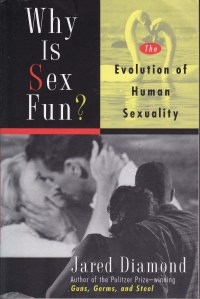
DiamondNothing used to make you feel smarter than being in a British bookstore. With that curious blend of proper, insane, and bawdy, books are displayed that you might find surprising. Alarming, even. Last year as I strolled around Blackwells in Oxford, I spied Why is Sex Fun?, by Jared Diamond. I mean, it was sitting right there, face-up, on a table with perfectly respectable, straight-laced books. Curious, but not curious enough to pick it up in a public place, I remembered the title so that I might find it on Amazon, where it could arrive in a nice, safe, opaque box. I finally stored up enough points on Amazon to get it, but then the problem was how to read it. I do a great deal of my reading on public transit—a place where you inordinately care what others might think of you. Finally, planning a seating strategy that would hide the cover by sitting on the left-hand side, next to the window, I took the book along, hoping it would keep me interested to and from work.

Subtitled The Evolution of Human Sexuality, the book isn’t salacious at all. It is scientific, but not clinical. I’ve mentioned before that all religions have something—quite a lot, usually—to say about sex. While religion doesn’t play into Diamond’s book, morality does. What I found interesting is his use of the phrase “God or Darwin,” which comes up a few places in the book. Diamond is a witty writer, and he explains that not all his phraseology is to be taken literally, but I appreciated his hedging his bets, nevertheless.

This book isn’t really titillating. In fact, it’s somewhat depressing. Perhaps it’s just phrasing again, but the production of offspring is described in economic terms. Resources, investment, efficiency, and the like. I think back to being a child. My family life wasn’t ideal, but I never thought of myself as anyone’s resource or investment. I was just me. That delusion stayed with me until I started working in the corporate world. I quickly discovered that others considered me a resource. “Human resources,” we call it. An investment. My efficiency was valued. Was it God or was it Darwin? Although I learned a lot from this little book, I wonder if it was worth the effort of having to hide the cover on the commute. After all, we’re all stuck together on this bus, units of investment, born to yield a profit. Why not have a little fun on the way?