Author Pages

It takes me awhile, sometimes.  Maybe it’s a generational thing.  I’ve been blogging for sixteen years now (my blog is a teenager!) and it only just occurred to me that I should be putting links to authors’ pages when I post about their books.  I know links are what makes the web go round but I assumed that anyone whose book I’ve read is already better known than yours truly.  Why would they need my humble help?  Well, I’ve been trying to carve out the time to go back and edit my old posts about books, linking to authors’ pages—there are so many!  In any case, this has led to some observations about writers.  And at least this reader.  Most commercial authors have a website.  Not all, of course.  People my age who had earlier success with writing tend not to have a site since they already have a fan base (I’m guessing).  Most fiction writers in the cohort younger than me have pages, and I’m linking to those.

I’ve noticed, during this exercise, that my reading falls into two main categories: novels and academic books.  I suppose that’s no surprise, although I do read intelligent nonfiction from non-professors as well.  In the nonfiction category, it’s fairly rare to find academics with their own websites.  They probably get the validation they require from work, and being featured on the school webpages.  Or some will use Academia.edu to make a website.  As an editor I know that promoting yourself is important, even for academic authors.  Few do it.  Then I took a look around here and realized, as always, that I fall between categories.  No longer an academic, neither have I had any commercial success with my books.  I’ve fallen between two stools with this here website.  I do pay for it, of course.  Nothing’s free. 

Almost nobody links to my website.  This isn’t self-pity; WordPress informs you when someone links to your site and that hasn’t happened in years.  Links help with discoverability on the web, so my little website sits in a very tiny nook in a low-rent apartment in the part of town where you don’t want to be after dark.  And I thought to myself, maybe other authors feel the same.  Maybe they too need links.  So I’m adding them.  As I do so I hope that I’ll also learn a thing or two.  I’m trying to learn how to be a writer.  It just takes me some time before things dawn.  Maybe it’s just my generation.


Little Things

Those on anti-clutter campaigns (whose lives I can’t imagine) claim that we have too much stuff.  That may be true, but when you reach a certain age these realia can serve to remind us where we’ve been.  How we’ve become who we are.  We moved to our house in a whirl.  Neither my wife nor I had enough vacation days to take any time off and we had to move 55+ years of stuff over a weekend.  Lately I’ve been going through some of the boxes of little things you keep.  They were generally mixed in with papers I didn’t have time to file, bits of hardware, and a few things I’m not sure why I kept.  In the archaeology of my life, the layer labeled Nashotah House retains a prominent place.  It took many years before I could look at my little Nashotah House things without being overwhelmed by emotion.  Nearly twenty years on, I hope I’m beginning to get over it.

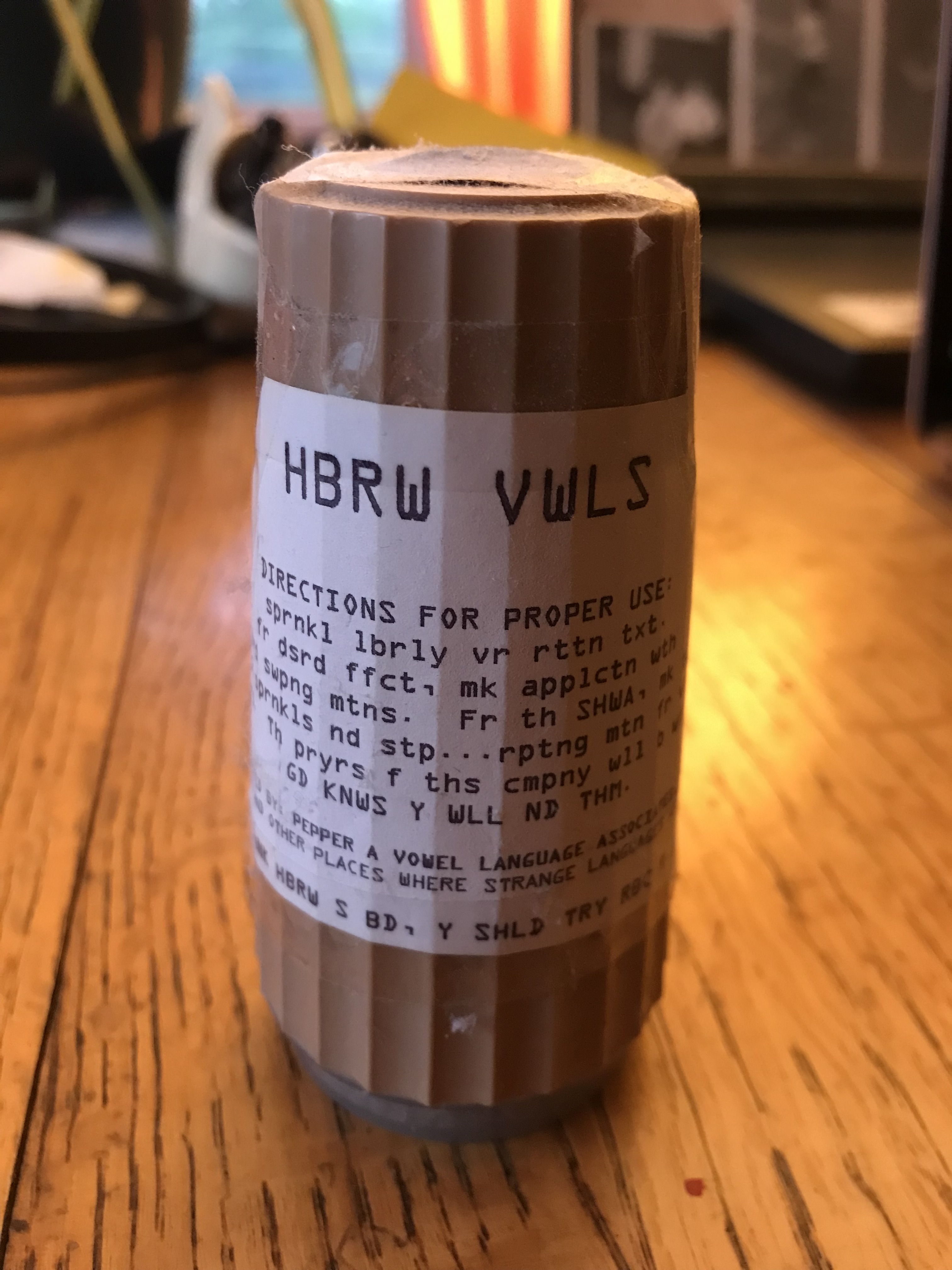
One of the little things I unearthed was a pepper shaker.  One of my students (now sadly departed) had made a label to express her frustration and humor at trying to learn Hebrew as a mature woman.  I’m probably now the age she was then.  This little artifact has been with me through a great number of momentous changes in my life.  It can still bring a little smile, however.  I see it and I remember Judy giving it to me with a laugh.  I probably shared it with the class.  Even now it has two-decade-old pepper in it.  The declutter experts would say it belongs in the dumpster.  They’re wrong.

Nashotah House was the only job on offer following those intense Edinburgh years.  As all of these things recede further and further into the past, they become more valuable.  No matter how small, these objects played a part in what I remember and rubbed me in a way that influenced my shape.  I don’t know what that final shape will be, but I jealously guard my little things, these boxes of years.  They are points of contact between my life and those of others.  I found many other pieces of myself in these miscellaneous boxes.  I know that someday, all things being equal, this stuff will probably end up in some landfill somewhere, waiting for some future archaeologist wondering what realia we kept back in the years when the world went insane.  And if s/he is really brave, they might even try some of the pepper on their future lunch.


Unique?

Is it embarrassing, or simply confirmation?  It used to be considered embarrassing to show up at an event dressed identically to someone else, if it wasn’t intentional.  It was considered, in some way, a slight on your personal expression.  This happened to me while still commuting when another employee and I had worn a very similar shirt for an event at work.  (He was more embarrassed than I was, for the record.)  What often feels more embarrassing to me is when I notice something I’ve never seen anybody else write about, get it all written up, and then discover that someone posted something similar on the internet someplace.  It has happened more than once—indeed, many times.  I feel embarrassed for not having known about the observation, no matter in how an obscure virtual a corner it was kept.

Perhaps these are just growing pains for the terminally curious.  Some of us constantly observe things we find curious, and start to connect the dots.  Someone else might’ve gone over this conundrum before, the way you pick up a waiting room magazine only to find the crossword puzzle already done.  What gives me hope in such circumstances are twofold facts: that someone else has spotted this confirms my observations, and that my interpretation is different from theirs.  My great fear, however, is that someone might think I’ve plagiarized.  This is a mortal sin for academics.  I would simply note that many of us read lots of stuff without noting where, and that I would remember if I intentionally lifted an idea from something somebody else pointed out.

I’m sure there are many examples of this on this blog.  Apart from posts that reflect an experience unique to yours truly, that is.  It’s getting tricky to say anything that hasn’t been said.  A recent newsworthy event occurred that called for comment from someone with my background.  By the time I’d scrawled a first sentence about it, others had written, and posted, full articles conveying what I would’ve had to say about the thing.  Embarrassing.  It has also made publishing much harder.  Even small, independent publishers in the non-academic sector only consider books sent from agents.  And agents are nothing if not aloof.  Too many submissions from too many wannabes.  Is there anything unusual, remarkable, here at all?  I’d say it’s my perspective.  Others can string words together.  Others can even buy the same cheap shirt that I purchase.  But they don’t see it from my angle.  Of that I’m certain.  Ask anybody else who’s made a similar observation.  They’ll confirm it.


Not Content

I write books.  When I want to “create content” I do it on this blog.  (And a few other internet sites.)  These aren’t the same thing.  I find it distressing that publishers are trying to drive us to ebooks where content can easily be changed, as opposed to print books.  The shelves of this room are lined with books and the technology doesn’t exist to come in and change “data” without my knowing it.  Facts are secure in print, right Ilimilku?  I’m not looking forward to a Star Wars future where there’s no paper.  I was born in the last century and, perhaps, I’ll die there too.   You see, when you write a book you have a project in mind that has an endpoint.   It may change and shift as you write, but you know what a book is and that’s what you produce.  It gets shelved and you move on to other things.  (At least I do.)

Content is something different and the creative process behind it also differs.  If I find something wrong after the fact, I go into my past posts and change it.  I’m not afraid of admitting I’m wrong.  The point of this blog is to share ideas with the world, not to write a book.  (Although, I confess that I would not say “no” if someone in publishing wanted a selection of worthwhile posts for a book… just saying.)  It amazes me how publishers have pretty much gone after the money and have forgotten what the creative process is like.  Of course, they’re having to figure out how this whole internet with free content plays into it too.  But still, my book writing uses a different fold in my gray matter than my blog writing does.  All of it feels pretty different from writing fiction too.

These things together adds up to a writing life.  I have a ton of “not for publication” writing.  This is something different again.  I suspect it will never be read by anybody, moldering away on some old hard drive after some AI-induced apocalypse.  I write it for of the same reason, I suspect, that people used to spray-paint “Kilroy was here” on things.  The book of Job, it seems to me, was the preservation of words that someone simply had to write.  We know the framing story is folklore.  But those who have words to carve with iron on lead, or engrave on a stone to last forever.  It’s more, I hope, than just “creating content.”


History Lesson

This blog, which has come to define me in many ways, wasn’t my idea.  A niece started it for me when Neal Stephenson suggested I should have a place for podcasting.  I still have ideas for podcasts, but finding the time to put them together (and a place to host them) has proven quite challenging.  In any case, the title, “Sects and Violence in the Ancient World,” reflected where I was at the time.  I started posting when I was 46, and now I’m over 60.  Things are bound to change a little.  From the start, I wrote about books.  Indeed, for things I’ve read since summer of 2009, I check the blog to find out when.  I also noted significant movies.  In the early days I tried to limit the posts to religion-themed topics since, well, I have three degrees in the field.

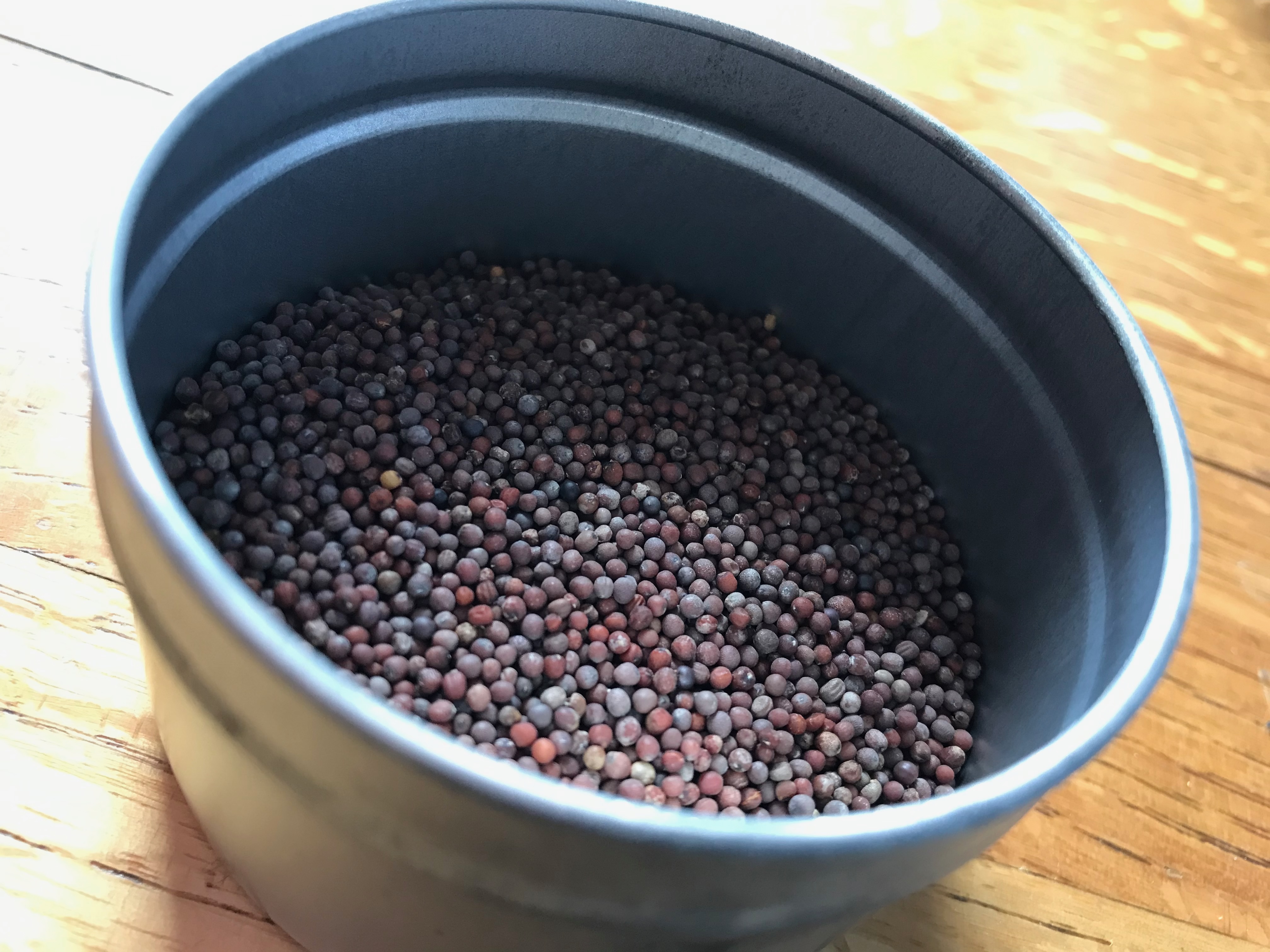
As I gradually grew comfortable discussing pop culture (generally horror), I gradually addressed movies and books without a religious bent.  It could be that I didn’t record everything I read or watched here, and that makes things before 2009 kind of a muddle.  While the muddle really began before 2005—my last year at Nashotah House.  That period was a kind of maelstrom of desperation to find a job, teaching classes, pretending to be an editor, making my way in a world unfamiliar to me and certainly unchosen.  Eventually this blog came to focus on horror movies more than religion.  Now, like my life, it’s a jumble of conflicting impulses trying to make sense of the world as an existentialist with a bit of faith.  I’m still aspiring to that mustard seed.

I’m not sure when it was that I began commenting on most movies I watched.  I’ve used movies as therapy since 2005—for some reason horror made me feel better.  Even now, when I want to remember when I saw a movie I check this blog.  Or if I want to know when I read a book.  My wife pointed Goodreads out to me in 2013, and that became another place to post on books, even if they didn’t qualify for “Sects and Violence.”  But that slushy period between 2005 and 2013 was full of books, I know.  In addition to movies, I read incessantly.  If I want to remember when I read what, however, I’ve only got the last decade really covered.  Goodreads says I’ve read about a thousand books since 2013.  For movies, I have no way of knowing how many I’ve seen.  Or where, for the most part.  Maybe I need to start keeping a proper diary.  Maybe one with a lock and a key.


Finding The Exorcist

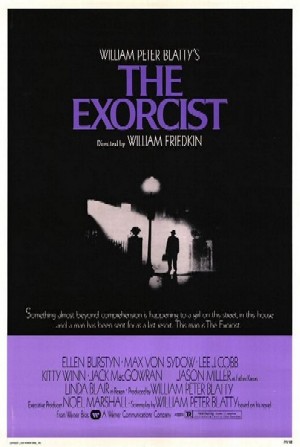
This blog is the closest thing to a diary that I keep anymore.  It’s also the place where I remind myself when I read a book or saw a movie.  I started this blog (actually, my niece did, but I started putting content on) about a decade-and-a-half ago.  Most of the books I’ve read since then (but not all), have been featured here.  It didn’t start out that way with movies.  I watch a lot of films.  The other day I was wondering when I first watched The Exorcist.  I figured that it must’ve been something I’d blogged about, knowing me.  It could be that I watched it before 2009, or it could be that the search function on WordPress doesn’t allow me to find the post, if it exists.  You see, I don’t know what else to search for beyond “The Exorcist,” because I can’t recall what I might’ve written about it.  If I did.

So, in case I haven’t, I do want to say a bit more about that experience.  I was only eleven when the movie was released.  Three movies that I grew up terrified to see were Rosemary’s Baby, The Exorcist, and The Omen.  I finally saw them as an adult.  Since it was the DVD era (preceded by the VHS era, and followed by the Streaming era—all within about three decades) I bought the disc.  In all likelihood this was at FYE, which used to be a thing, just like Blockbuster before it.  Of course by the time I sat down, trembling, to watch it I’d seen many clips, stills, and parodies.  Still, I was afraid.  The movie, some thirty years old, lived up to its reputation.  I was left trembling more than when I started.

Many books have been written about The Exorcist, and although people sometimes laugh at it today, most horror fans I know still speak of it with reverence.  This movie changed horror.  It also changed demons.  Today what we believe about demons derives largely from this movie.  Its explanatory value is that it offers somewhere to turn when nothing else works.  Religion as a last resort.  And, ultimately, religion works where everything else fails.  It is possible, that somewhere in this sprawl of a blog, that I wrote first impressions of seeing it.  It would’ve been 2009, or perhaps I saw it as early as 2006.  I was struggling with my own demons then.  And, as often happens in such cases, precisely when things happened can be a little difficult to determine.


Strangers

Okay, so I like to think that I’m a reasonably intelligent person.  I can drive a car.  I’ve read over two thousand books.  I have been blogging for nearly a decade and a half.  Why can’t I figure out this password thing?  My brother has a blog on WordPress too.  His posts are quite different than mine, but I always like to read them since we think a lot alike.  Anyway, I wanted to leave a comment on a recent post he wrote.  You’d think that’d be easy since this blog is also hosted on WordPress.  (I’m the one who suggested WordPress to him.)  When I went to post the comment I received a dialogue box basically asking “and who might you be?”  When I gave my web credentials it wanted a password, but it wasn’t clear which password it wanted.

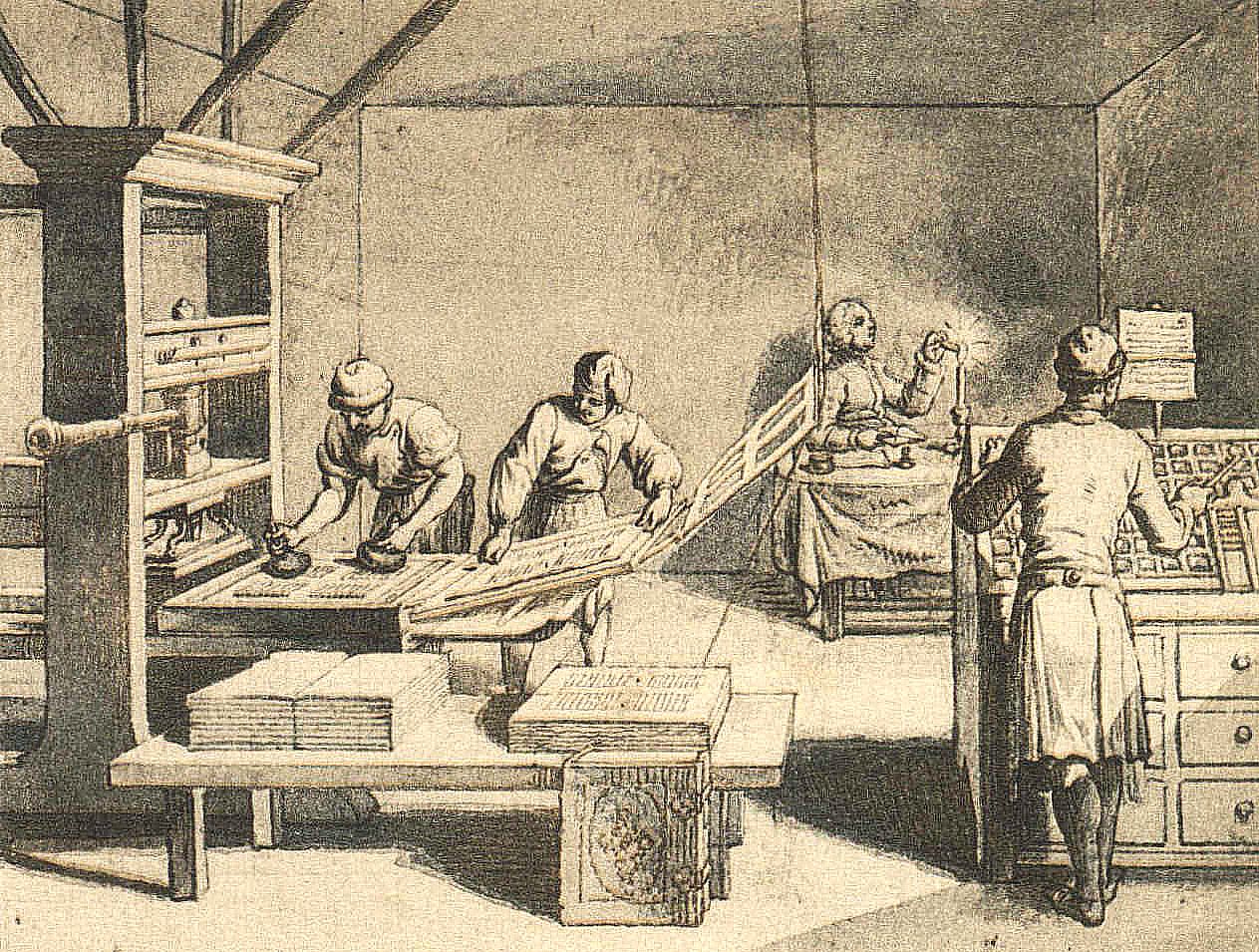
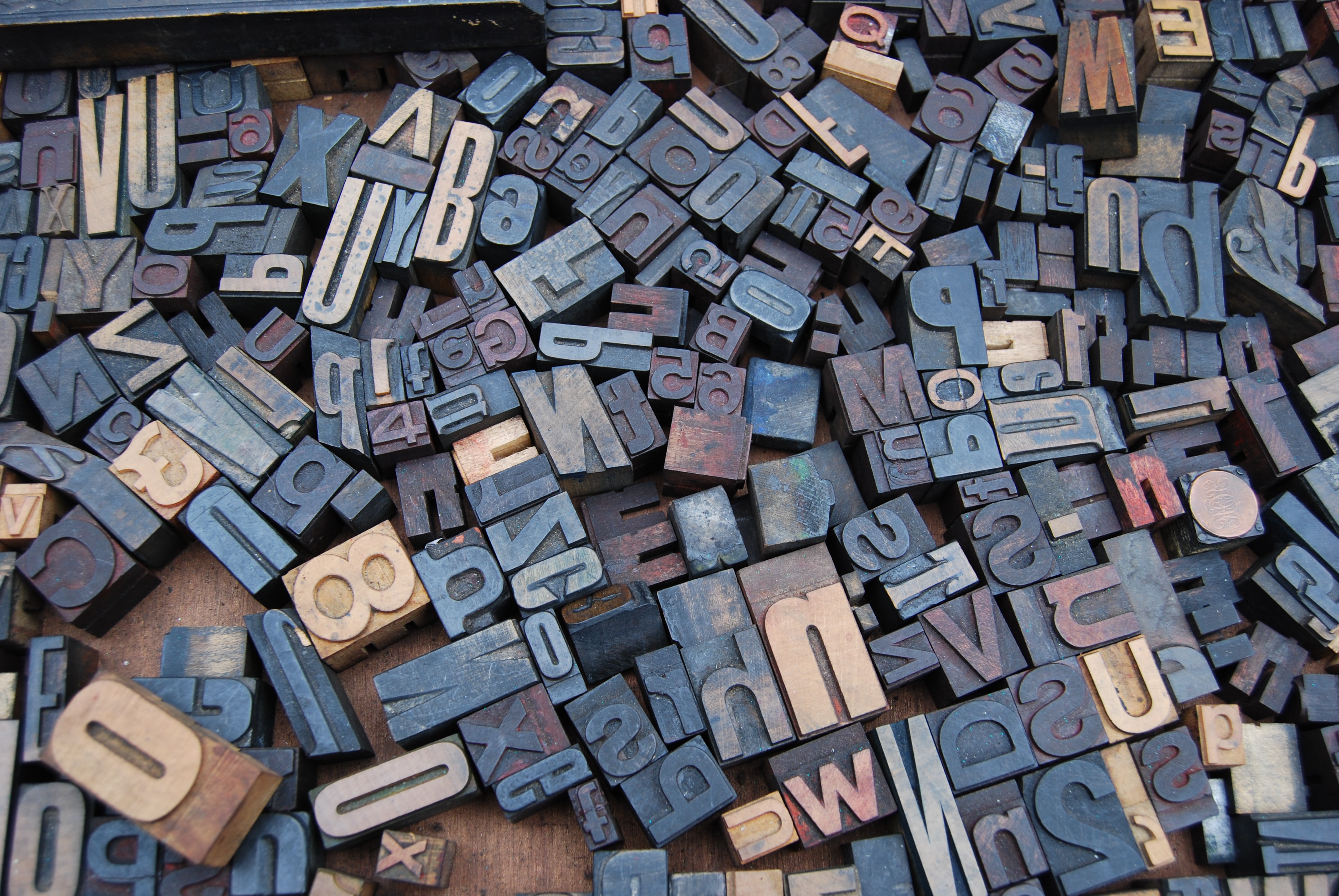
An actual word press; image credit: DANIEL CHODOWIECKI 62 bisher unveröffentlichte Handzeichnungen zu dem Elementarwerk von Johann Bernhard Basedow. Mit einem Vorworte von Max von Boehn. Voigtländer-Tetzner, Frankfurt am Main 1922, public domain via Wikimedia Commons

Like most human beings alive today I have more passwords than atoms in a typical tardigrade.  With a brain over sixty, trying to recollect them all in an instant, well, let’s just say that ain’t happenin’.  As I laboriously lumber through all relevant passwords (I’m pretty sure they don’t want all the unique ones I use at work, in addition to my private accounts), it rejects each and every one.  You see, WordPress is funny.  My own account, now 14 years old—maybe that’s the problem—those teenage years!—doesn’t recognize me at times.  Indeed, on my own blog (and I have a paying account) it sometimes blinks its virtual eyes and says, “and who might you be?”  I try not to take this personally.  I mean, we’ve only known each other for years.  And all I want to do is put a supportive comment on my brother’s blog—we share the same surname, and even the same web host.  What could be so difficult about that?

I’m pretty much logged into my WordPress account constantly.  I post every day.  There’s over 5,300 mini-essays of about 400 words.  That’s over 2 million words.  Is this relationship really so one-sided?  I’m trying hard not to let my aporripsophobia get the best of me here.  Just tell me which password you want!  And, if I can use it to log into my own WordPress account, why won’t it work for the WordPress accounts of family and friends when I want to make a comment?  We’ve been together for so long, do you really not know me any better than this?  Hey, I think I need a private moment with WordPress—you can check out my brother’s blog while you wait…


Intimate Thoughts

Although I haven’t had much time to devote to my fiction writing—I’m finishing yet another nonfiction title—I do have a Twitter account for my pseudonym.  I’ve always found it ironic that that Twitter account, which gets very little attention from me, has gained well over twice as many followers as the account in my real name.  On both accounts I follow back, but few notice the account where I post more often.  Strange.  Lately I’ve noticed that my pseudonym account has been getting attention from what seem to be cyber-prostitutes.  I’m not sure if that’s the proper name, but these users purport to be young women and they direct message you with solicitous intent (at least online).  Needless to say, I don’t respond.  It does make me wonder if that’s why Twitter is now known as X.

Social media has given new license to strangers, of course.  For a while there I accepted any invites I received on Facebook (publishers look at how many “followers” or “friends” you have on social media).  Many of these people I don’t know.  One, in particular, happens to be online quite early in the morning and has tried to video call me a few times on Facebook.  Those who do actually know me are aware that I spend less than five minutes a day on Facebook.  I post my post, check my notifications, and move on to other things.  In other words, anyone who knows me would never try to video call me through Facebook.  There are other ways to reach me.  I do have a blog, you know.  Social media has mediated a level of intimacy that I’m not ready to engage.

What am I doing here?

For all my daily shooting off at the fingers, I’m a pretty private person, really.  I’m shy—who knows? Maybe even on the spectrum—but also social.  Working in publishing I know that those who have the power to promote your book (and price it so mere mortals can afford it) want you to have internet exposure.  I guess that means some people will take it as an invitation to try to get sexy with you, or to call you at what is, in reality, the middle of the night.  I want people to get to know me first.  As much time as I spend writing, it’s a mere fraction of how I spend my days.  Intimacy should be reserved for friends.  At least I believe so.  Those who know me well know my pseudonym and its real-life counterpart.  For when I have time for that sort of thing.


Reading Prompts

Perhaps it’s because maybe a half-dozen times in the past two years I’ve forgotten to click “publish,” or maybe everyone gets this, but WordPress started giving me daily prompts when I open the new post screen.  Everyday blogging questions such as whether you’re where you’d thought you’d be last year at this time, or what’s your favorite holiday food, or talk about your father or a father figure in your life (a loaded suggestion!).  I appreciate the thought, but I do strive for some measure of depth here.  Believe it or not, many of my posts are metaphorical, written about something that’s not the “obvious” subject of the mini-essay.  (Often when people criticize me it’s because I’m posting metaphorically.  Or maybe I just don’t know what I’m talking about.)  In any case, there have been times when a writing prompt might’ve been useful.  I haven’t used any, though.

Writing is a strange avocation.  These days many people make some kind of living as self-published authors.  The internet offers ways to minor fame—in some cases major fame—for anyone who has the time to put into it.  There’s always the question, however, of what to talk about.  This blog began, back in the days when I was fresh out of teaching religious studies, as a place where I could discuss the Bible and culture, or, more broadly, religion and culture.  That in itself limited the appeal.  People are fascinated by religion but really don’t want to read about it.  So it was that initially I had many followers—particularly among the biblical bloggers set—that eventually dropped off when I began writing about secular subjects.  Mostly I tend to focus on books.

There’s an irony to that as well.  As much as the internet helps some of us learn about books, it’s also a place that has diminished them.  Many people focus on social media to the point that there’s little time left to sit down with an actual book.  Interestingly enough, none of the prompts that WordPress now sets for me daily, has asked about what books I’ve been reading.  Perhaps books are the natural enemy of the online world.  If so, I seem to be caught between worlds.  I set aside time each day for reading, offline.  For those of us who write, reading is our food.  It often gives me the prompts I need for writing daily blog posts.  Even the days that I miss aren’t for lack of content—they’re simply forgetfulness because non-reading events crowd the rest of life.  It’s no wonder, then, that I try to engage others by asking, what books have you been reading lately?


The Daily Show

Long ago—over a dozen years now—I decided this blog would receive daily updates.  Some of the more successful blogs out there receive multiple daily updates, but I’m just one guy, and a working stiff at that.  When you do something every day a couple of contradictory things happen: one, you get better at it (if you’re a Gladwellian, it may take almost three decades, but the principle holds), and two, the quality varies.  I’ve long noticed this about daily ventures.  (I’ve also lately begun to realize that even daily shows take time out to refresh.)  I used to stay up to watch David Letterman (that seems impossible to believe in my current time warp).  When he was good he was very good, but when he wasn’t it was painful to watch.  You can’t be “on” every single day.  Emotions are funny that way.

Over the past year or so I’ve taken to occasionally binging on “Good Mythical Morning”—a YouTube daily show starring Rhett and Link.  These North Carolinians are inherently likable.  They’re a couple of guys who, in many ways, refuse to grow up.  They’re smart, and often funny.  And extremely popular.  Their channel has approaching 18 million subscribers.  They have off days, as do we all.  Sometimes I wake up feeling so contrary in the morning that I’m not sure I’m the same person who crawled into that bed only hours before.  Some days I don’t feel like writing a blog post.  On other days I feel like writing several.  What perhaps stands out to regular readers, if only one or two, is that some days you’re off.  So tragically human.  So wonderfully human.

I’ve often wondered if this is just a condition of life.  Pets, for example, have off days too.  I suppose the difference is that those committed to a daily show have put themselves out there so others can see them.  On one of those aptitude tests I took in high school the results suggested I should’ve been an entertainer.  Instead I took a religious and scholarly approach to things.  Maybe because I’m a middle child I always felt that nobody really paid attention to me.  So here I am, a baker’s dozen years out from writing daily on religion, ancient West Asian topics, books, and horror.  And sometimes current events, when I  feel like it.  If you’re taking the daily show route, you need to be aware that, despite the ennui, not every day will be the same.  Even someone as successful as Letterman knew that.


Say It in Poetry

I was listening to some Nick Cave the other day, and, as usual, I was quite taken by his lyrics.  I dusted off my poetry notebook and began to try to forge words into an impossible chain, but without much success.  Yes, I do occasionally write poetry.  I used to write quite a bit more.  There are too many “used tos” in my life, I think.  I grew up with two brothers, and a decade later, three.  (I also have a half-sister, but that’s a long story.)  My brothers have very different lives than mine.  One of them is now posting some of his poetry on a WordPress blog at Poetry Random Ramblings and Rants.  You ought to check it out.  (You might also run into a ramble or rant…)

Photo by Amador Loureiro on Unsplash

One thing I’ve learned from my many editorial board meetings is that successful books are often about the author.  My brother has an interesting life story to tell.  As I’ve noted here before, we grew up in a poverty-level working-class family.  We all found our own ways of coping with the stresses that involves.  Religion was my coping technique that become a strange vocation.  I knew, even as a tween, that whatever job I ended up having it would involve writing.  I learned early on that poetry is difficult to publish, but that never stopped me from writing it.  My brother has always been a much better poet than me, perhaps because of his life.  He’s less inhibited.  An authentic human being.  I don’t want to say too much, since that’s not my place.  Knowing the author, however, I know that he should have readers.

We make our way in the world, and when our parents haven’t really prepared, by example, what a life might be, we’ll you’re left second-guessing everything.  I suspect it drives my wife crazy sometimes.  For me every day is like being in a foreign country, unsure of the language.  Sure, I earned a doctorate but that doesn’t mean I know what I’m doing.  I’ve known medical doctors that were, truth be told, not that smart.  No, life is more of a story we tell about ourselves.  Some of us tell it in poetry, some in song, some in prose.  Some of us tell it nonfiction, and others, well, fictitiously.  A big problem with our world is that we don’t take time to listen to other peoples’ stories.  Their lives.  Those we do listen to (such as television and movie starts, sports players) are often dull.  For my money, there’s more to be learned from poetry, and the life it represents. 


Blog Writing

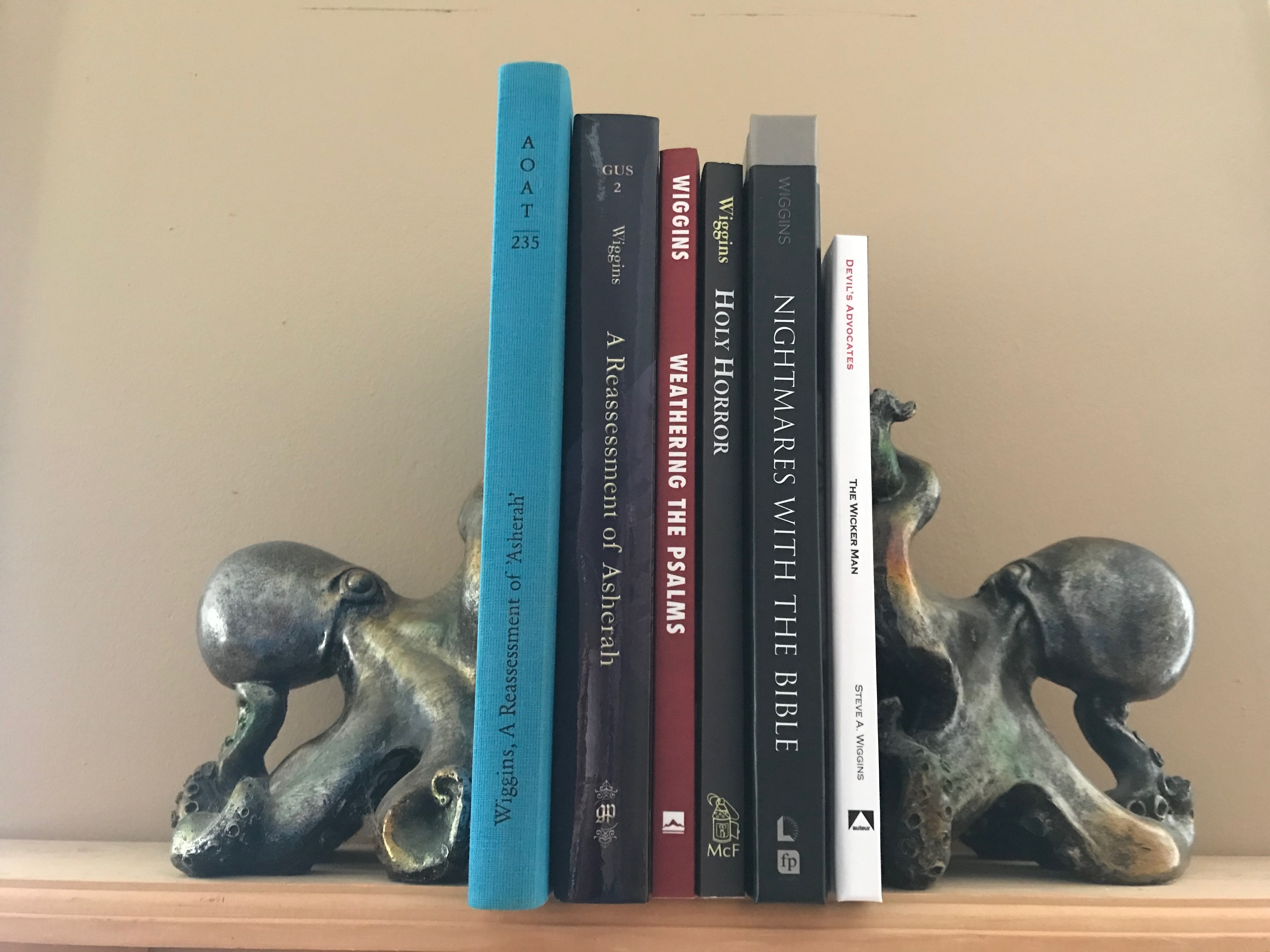
From time to time someone will ask me about my personal writing process.  Those who know that I write at all, primarily, I suspect, think I do mostly blog posts.  I have, however, written five nonfiction books and have completed seven unpublished novels.  Thirty of my short stories, also fiction, have been published.  I also have a few novels and at least four nonfiction books currently underway.  Like other writers, I require quite a lot of alone time.  From at least seminary on, I have carved that out of the early morning hours.  I’ve gone through phases when I slept normal hours like a civilized human being, but when at Nashotah House, where morning chapel was a daily requirement, I began awaking early to write.  When I began commuting into New York City, that writing time got pushed back to 3 a.m., and that is mostly still true today.

It is said that Isaac Asimov had three typewriters in his study, each loaded with a different writing project.  That way he could work on the one he felt like writing when the mood struck.  Yes, we writers use our emotions extensively.  What I work on in the morning depends on which me gets out of bed that day.  Is it the long fiction me?  Is it the nonfiction me?  Is it the short story me?  Is it the academic article me?  Is it the blog post me?  Ah, the blog posts.  They take a lot of time.  And, like most writing, they are driven by my moods.  Sometimes I write about current events, often posted after the fact.  Why?  Because I have other posts that have been waiting to be presented.

There’s a bit of illusion involved in writing.  Apart from the fact that all of my blog posts are written in the early morning, it isn’t evident from the post itself when it was written.  (Unless I refer to something as having happened “yesterday” or “last week.”)  I don’t follow current events closely.  I can get depressed just fine on my own, thank you.  I don’t start out the day with the newspaper.  Writers often live in their own worlds.  Reality intrudes too much, most of the time.  I may never become a bestselling author.  I may never be able to court an agent—believe me, I’ve tried.  I may never have more than a few followers on this blog, but one thing I will do is continue writing.  It wouldn’t surprise me, and in fact I think it would be entirely within character, if I died with my fingers on the keyboard.


Learning to Like

The shout-out is an always appreciated gesture.  Among the guests on The Incarcerated Christian podcast, I’m pretty clearly the one with the smallest following.  That makes me doubly grateful to Robin and Debra for the work they’re doing.  If you want to get a sense of what their initial year involved, please take an unrushed moment or two and listen to their year-end reflection.  Better yet, follow them wherever you follow podcasts.  I’ve been watching some YouTube lately (I know, I know, the world has gone after TikTok instead) and I’ve come to realize that even those channels with millions of views have to remind people every single episode to click like, share, and/or notification.  Nobody knows it’s worth their time if readers/watchers don’t share!

One of the things about writing is that is craves readers.  There’s an almost Hebraic sense in which my writing is intended as a statement, whether or not it’s even read.  Ideas build up until they must be expressed.  You start to get to know other people by their words, written or spoken.  I sincerely wish I had more time to listen to podcasts.  I’m one of those people who can’t write with music or talking going on.  Nor can I work that way.  Those two activities make up the majority of my waking hours (perhaps I’m trying too hard, if there is such a thing).  Even the smallest Who, however, has his “Yop” to express.  In that case, however, he ended up saving the world.  I suspect many people have no idea what this blog’s about.  If you know, please tell me.  (There’s a comment section below.  Don’t forget to click like and share when you’re down there!)

The Incarcerated Christian has had everyone from evangelical pastors to obscure religionists such as yours truly on their podcasts.  People who aren’t afraid of the dark.  There’s an episode about the divine feminine.  There’s another by a blogger who used to follow my blog and comment on it in the early days until his own efforts took off.  And there are the hosts, Debra and Robin, whose stories are intriguing in their own right.  They approached me not knowing my own history with abusive religions—perhaps it comes through in my writing, or at least my choice of subjects?  There’s a strange comfort in knowing that others have had similar experiences.  Religion can be a monster, devouring people and spitting them out, all in the name of sanctity.  Listen to the Incarcerated Christian podcast, and don’t forget to like and share alike.


Picture This

For a writer with limited time, a blog seems like a good idea.  Years ago WordPress emerged as the premier site on which to host such a venture—it was free (but like all things in the tech revolution it would eventually start charging a subscription fee), easy to use, and friendly to your average Luddite.  Now that I’ve been doing this some dozen years you might think that coming up with daily topics is the difficult part.  Well, it is a challenge sometimes, I admit, but the hardest part is coming up with images.  Occasionally I have an image around which to base a post, but the fact is I’ve discovered several blogs because I was searching for an image.  So I started putting an image in each post.  So far, so good.

WordPress has evolved over the years.  It has become more and more commercial.  After so much space is filled on your site (I pay regular fees for both the space and for the domain name) you must upgrade.  The next upgrade available to me is “Business.”  This blog is purely an avocation.  Any writer who doesn’t offer online content these days, at least according to the marketers and publicists I know, will never write a break-through book.  From my own experience, agents won’t even touch you unless you’ve got a far larger following than mine (and I’ve been faithful for a dozen years).  Anyway, I don’t want to pay for a business plan, so I reuse a lot of images.  That is the most time-consuming part of posting on this blog. 

You see, I post each day immediately before work.  To search over twelve years of images is difficult on WordPress.  Many of my images are my own, and my phone names them “img” (which autocorrect wants to make “omg”).  Searching those in WordPress to find a specific image can easily take an hour.  Considering the time these pieces are posted, you get an idea of when I have to start.  Good thing I’m an early riser!  My relationship with technology is an uneasy one.  I appreciate content.  Producing it is an act of pure creativity and it’s important to me to do it every single day.  But work is non-negotiable.  Metrics apply.  Consequences for not meeting them can be significant.  Where is that image I thought would be perfect for the post I wrote?  I should’ve renamed them before using them.  But just this moment, work’s about to start.  Now, what am I going to use to illustrate this post?

Remember the early days?

Voice of Experience

Trust your publisher.  Well, if you have one, that is.  I’m not the only erstwhile academic to have ended up in publishing, but what constantly surprises me is that academics care little about those who give voice to their ideas.  Now this blog is self-publishing.  It contains my ideas, but they are free for the taking, and here’s a bit of useful advice: trust your publisher.  These days with easy online publication and formatting that makes your posts look like a pro (not here, mind you), it’s sometimes difficult to realize that publishers actually provide more than just an imprint.  They offer services to make your book look serious, scholarly, and also to be useful to others.  Those of us who write books are often far too emotionally involved to see this.

I regularly run across academics who tell publishers how the text should look on the page.  I’m not talking about those weird and wonderful sections of ancient texts with <lacunae>… ellipses… [brackets] and whatnot.  No, there are those who want to control kerning, leading, and all sorts of things.  There are those who want practically every single word indexed, although research shows that most researchers access searchable PDFs rather than wasting their time thumbing through pages to find a reference.  And that traditional chestnut, “written for general readers.”  Publishers have access to book sales figures (at least of their own books).  There’s no need to bluff; if your book is only for scholars (does it have words like “reify” or “heuristic” in it?  Be honest now!), publishers know how to handle that.

We’re all nervous when our book gets through the acceptance process.  Peer review always breaks me into a cold sweat.  Believe me, we understand!  Take a soothing sip of tea.  Go for a walk.  Better yet, jog.  Scholars tend to be precise thinkers.  We get that.  When, however, is the last time someone used a map from a Bible for navigation?  Most of those cities don’t even exist any more!  This strange mix of online savvy and adherence to the old ways of print (which I love and of which I shall never let go) clash in ways that cause publishers great stress.  You can find a YouTube video on how to make your own book.  Those of us in the biz can tell at a glance if a book’s self-published or not.  And believe me, we’re rooting for you.  We want your book to succeed.  Why not trust those who know what they’re doing?