Don’t Stop Moving

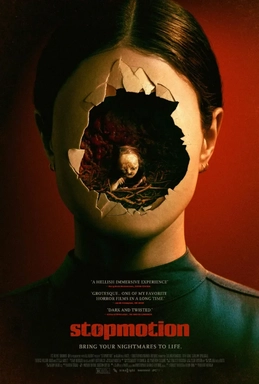
Stopmotion is a strangely affecting horror movie.  Body horror as well as Euro-horror, it follows the dream-like world of Ella, a stop motion animator.  She learned the trade from her mother who, suffering from arthritis, has Ella do the work for her.  After her mother has a stroke, Ella continues working on her final film but in a new location.  Tom, her boyfriend, gets her an apartment in a run-down building where Ella meets a precocious and odd little girl who tells her she should film a different movie and proceeds to tell Ella how it should go.  To her chagrin, Ella has to admit that the little girl’s story is better than her mother’s.  With the girl’s help, Ella animates a monster, the Ash Man, who is pursuing a girl lost in the woods.  Then Ella starts receiving visits from the Ash Man, or at least she believes so.  She ends up in the hospital. Spoilers follow.

Tom, who visits her there, is worried that Ella has let this go too far.  He threatens to delete the film while she’s immobile in the hospital.  Ella’s mother dies and with the little girl’s help, Ella gets back to her apartment to finish the film.  When Tom, and his plagiarizing sister, come to return Ella to the hospital, she kills them both.  She then, with the girl’s help, finishes the film.  The film results in her own death, or at least that’s the way she sees it.  The film features quite a lot of stop motion animation although the movie itself is live action.  It’s a very artful, if gross, film.  The little girl is never seen by anyone else, nor explained, suggesting that she’s a younger Ella following her own creativity.  And paying the price for it.

I can’t claim to understand everything that happens in this movie.  That doesn’t make it bad, but worth pondering.  Those of us who live creative lives experience dry patches, and often, self-doubt.  I know that when I compare my writing to that of others, I suffer in the very comparison.  When Stopmotion first ended, I felt both confused and intrigued.  Euro-horror of recent years, to generalize, emphasizes the art of the craft.  There was a lot of symbolism in this movie, some of which I couldn’t connect to the action.  I suspect repeated viewing might bring some of this to light.  My family has often told me that with my focus and interests, I would’ve been a good stop motion animator.  I certainly have the creating monsters part down pat.  It’s just a matter of deciding which narrative to follow.


In the Water

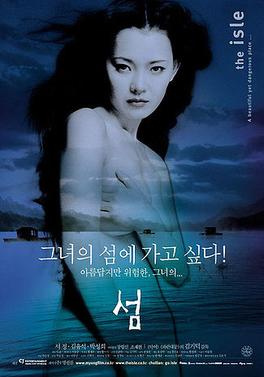
On a list of hard-to-watch horror, I found the South Korean offering The Isle.  I was feeling particularly brave that day, I guess.  I was unfamiliar with Kim Ki-duk’s work, and looking for something that wouldn’t cost me any money to watch.  I found out this was one of those vomit or faint body horrors, but it is otherwise filmed so beautifully and gently that the contrast is downright shocking.  It all takes place at a low budget fishing platform rental business where the proprietor is a mute woman.  She ferries customers to their platforms, delivers food, and female companions, and occasionally takes revenge when customers treat her badly.  One day a fugitive arrives.  She doesn’t immediately know that he’s on the run, but she’s intrigued by him.  She prevents a suicide attempt and the two begin to bond.

Wanting to make sure her customer is satisfied, she starts bringing him a prostitute, but she gets jealous when they start to bond.  When the police come to find potential fugitives, he again tries to kill himself in a particularly gruesome way.  (Probably one on the vomit scenes.)  The proprietor again saves him and hides him from the police.  Apparently drawn to that type, she gets close to him and sees the prostitute as a threat.  She kidnaps the woman and when the prostitute falls in the water, hands and feet tied, she drowns.  The proprietor sinks her body and when the pimp comes looking for her, she drowns him.  The fugitive now realizes that they both have murder in common, but he feels trapped and escapes with her boat until she uses a reverse method of his suicide (another vomit scene) and he rescues her.  The police discover the bodies of their victims and the two take the platform house to a hidden location.  Apparently Kim Ki-duk likes enigmatic endings because the final scene is the proprietor drowned in a partially sunken boat.

I’m not quite sure what to make of this one.  I would agree with the hard-to-watch assessment.  Not only are there gruesome, self-destructive acts, I’m pretty sure that some animals were harmed in the making of the film—particularly fish.  I’m not often in the mood for body horror, but sometimes when I’m trying to save money, I’ll settle.  I very much doubt I’ll ever watch The Isle again.  K-horror is sometimes compelling, though.  This one manages to be emotional, and of art-house quality, but the only monsters are humans and they seem more to be misunderstood than anything else.  And I didn’t vomit or faint.


Not Yet Illegal

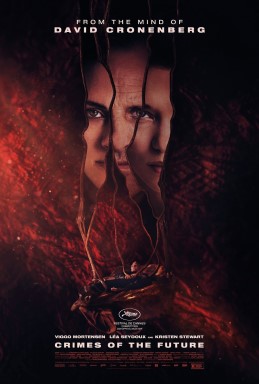
David Cronenberg’s name suggests a certain kind of body horror as unique as it is unsettling.  Crimes of the Future (2022) immediately reminded me of Existenz, which I watched many years ago.  Crimes of the Future is more difficult to understand, however, in part because it is shot dark and quite a lot of the dialogue is indistinct.  I happen to be reading a hard-to-follow book and my overwhelmed brain was hoping for a more straightforward narrative.  In any case, in the eponymous future, human evolution is such that it has to be regulated.  A performance artist couple puts on shows of surgery since he (Tenser) is constantly growing new organs.  They’re harvested as part of the performance.  Humans have evolved out of pain by this point, so surgery is done as art.

Meanwhile, a group has evolved to the point that they can eat plastic and toxic waste.  They demonstrate that physical modifications can be inherited, which puts them on the government’s wanted list.  Tenser and his partner, Caprice, own an automated autopsy table (who doesn’t?) that performs the autopsy while letting others watch.  The radical group wants to use this device to autopsy, as art, the child born with the ability to eat plastic (he’s killed at the beginning of the movie).  Also in the mix are a couple of crooked bureaucrats and a detective who seems sincere, but who has been working with an insider among the criminal group.  Eventually the autopsy occurs but it seems the boy’s insides had been surgically altered.  The leader of the radical group is assassinated and Tenser eats a toxic waste bar and dies.

If you’re saying “How’s that make sense?” you’re not alone.  Body horror isn’t my favorite.  Many of Cronenberg’s favorite themes are present here, but the film lacks a strong narrative.  Or at least one that I could follow.  Art house cinema often requires quite a bit of work from the viewer.  The atmosphere of this film, like Existenz, isn’t really horror, but it breezes into that territory.  Just when the horror—the surgeries—appears the social commentary kicks in.  That’s often true of body horror, a genre Cronenberg is credited with developing.  But I watch for the story as well as the mood.  Some movies are more about the images, I know.  And the future orientation makes some classify the film as science fiction.  It has more of a Blade Runner, dystopian feeling atmosphere, but without replicants.  Crimes of the Future, it seems, may require a better detective than yours truly to solve them.


Car Talk

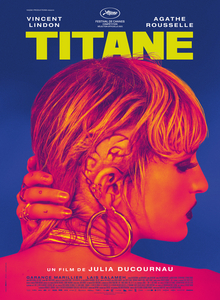
Body horror isn’t my favorite sub-genre, but Titane (French for titanium) had been recommended in several places.  Body horror directed by women takes on a particular cast, especially since pregnancy is, I imagine, kind of scary.  Certainly from a male perspective it can be, so I suspect such major body changes must involve some psychological adjustments for women as well.  The story is strange.  Alexia, after a childhood car accident, has a titanium plate in her skull.  After being released from the hospital, she starts to really love cars.  I mean, really love.  She works as a car model and ends up making love to her showroom car one night.  After that she becomes pregnant.  Emotionally distant from most people, including her parents, she becomes a serial killer.  She’s not a complete sociopath, however, because she realizes this is wrong.

Wanted by the authorities after killing everyone at a house party, she tries to change her identity by cutting her hair, breaking her nose, and wrapping her torso in body tape to pass herself off as a man.  A firefighter chief whose son has been missing for a decade, believes Alexia is his son and he takes her in.  She won’t speak, which he supposes is part of the trauma.  He gives Alexia work among the other firefighters, who are generally sexist and not a little suspicious.  Especially since the chief gives Alexia preferential treatment even though she doesn’t know what she’s doing.  In one scene he tells the firefighters he is God to them and Alexia is his son.  One of the firefighters quips later, that Jesus is white and gay.  (Alexia is pretty and the broken nose only makes her appear androgynous.)

Her painful pregnancy, which involves motor oil, eventually forces her father to acknowledge that she’s not his son, but the lonely man still vows to care for her.  When it’s time to give birth the baby is part titanium (as is Alexia’s distended belly).  She dies in childbirth but her “father” accepts the hybrid baby as his own.  This art-house Euro-horror won several awards.  Exploring issues of both sexism and women’s body changes during pregnancy—particularly an unwanted one—the movie has something to say.  And it’s something that a male writer-director simply couldn’t do.  There are no jump-startles here, and the horror is a slow dread as the viewers’ sympathies tend to be with Alexia.  The first murder we’re shown is when a fan attempts to make love to her (it doesn’t go as far as rape), despite her lack of interest.  She has a motivation and it doesn’t seem evil.  And, of course, there’s a good deal of fantasy at play.  Like most Euro-horror, it leaves you thoughtful.


Double the Trouble

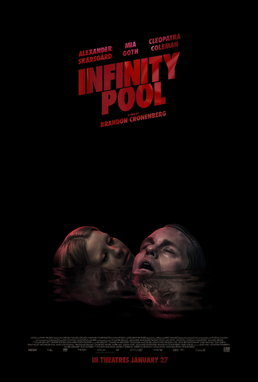
A down-on-his-luck writer (I’m with you so far) vacations on his wealthy wife’s money in a resort in La Tolqa.  La Tolqa is a brutal, very religious, but poor country.  They need tourists.  As the writer, James, discovers, their laws are very strict for a reason.  If a tourist commits a crime they are executed.  However, if they have enough money they can buy a “double,” essentially a clone of themselves, that can be executed for them.  Needless to say, this happens to James.  The name David Cronenberg evokes body horror.  Infinity Pool is the work of his son Brandon Cronenberg and although body horror’s part of it, there’s an even deeper existential fear at work.  Once James’ double dies, his wife insists they leave this horrid place immediately.  James isn’t so sure.

The trouble is that he’s befriended another couple, and the wife, Gabi, has been making no-so-subtle advances on James and he’s intrigued.  This couple sets him up so that he’s likely to break a law, which leads to the killing.  But they’re not finished.  Along with another group of Americans, they travel to La Tolqa every year to commit crimes so they can watch their doubles being killed.  “Murder tourism,” as one reviewer calls it.  They want James to become one of them.  They start putting him into positions where he has to kill his own double.  You can see the existential horror pretty clearly from this vantage point.  Finally realizing that they’ve been mocking him, James tries to escape, but can’t.  As long as the penalty for a crime can be payed by buying a double, they can commit outrageous crimes with impunity.

I have to admit that I envy those who have a family business.  (Mine was alcoholism, so I chose a different career path, such as it is.)  If your father is a well-known, even if often castigated, horror director, you have some guidance on how to get started in the business.  My sense of Infinity Pool is that it’s quite effective, almost at art film at some points.  Like some of his father’s films, it involves both sci-fi elements and horror.  Budapest and Croatia are evocative shooting locations.  The story, while not entirely satisfying, intrigues.  It raises too early the question of whether the double, which has all the memories and thoughts of the original, is really watching the death of the person who actually committed the crime.  Are these copies their own death sentence?  This isn’t resolved, but it’s strongly implied that they’re not.  Still, I’m not inclined to vacation in La Tolqa, which is no place for struggling writers.


Feeling Chilly?

David Cronenberg perhaps defies the tame image we tend to have of Canadians.  I know that’s a parochial thing to say, perhaps reflecting my lifelong admiration of those north of the border.  I even have Canadian family members, from back when it was possible to cross over without a passport.  In any case, David Cronenberg has always been a controversial director.  As the progenitor of “body horror,” his films are often not for the squeamish.  I nevertheless find him one of the more intellectual auteurs, and his movies leave me thoughtful.  One of his early films, Shivers, has long been on my syllabus of “must see movies.”  If you read my pieces regularly you also know that living on an Ed Wood budget, I can’t afford to pay for frequent films and have to wait for a free venue.  Thank you, Tubi, for obliging.

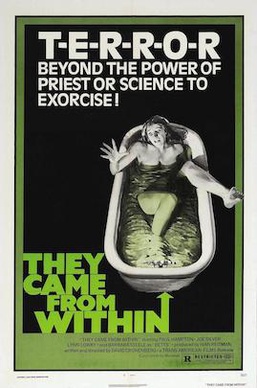
By the way, the poster here shows one of several alternative titles for the movie: “They Came from Within” (aka “The Parasite Murders”).  The film is pretty graphic body horror, but as scholars now focus on embodiment, it seems like this should be explored.  Set in an almost utopian island community, Starliner Towers, the movie opens by touting its perks.  Intercut with that is a graphic murder-suicide taking place within the paradisiacal apartment tower.  A parasite, as one of the alternative titles suggest, has been unleashed by what might be called a mad scientist.  And that parasite has two main effects—prompting orgies and violence.  (Hey, the official title of this blog is Sects and Violence in the Ancient World, after all.)

Religions, Christianity in particular, in the west, are often uncomfortable with the body.  In religious studies approaches to embodiment, it’s stressed that everyone has to reconcile themselves with what it means to be a physical being.  So much so that the mad scientist developed this parasite because he believed people thought too much.  They’d forgotten the mindless reality of bodies.  We’re sometimes uncomfortable being reminded of our bodily existence—at least those who perhaps think too much are—and that comes with both good and bad.  The interesting thing about the film is that it refuses to condemn the results of this experiment gone awry.  Everyone eventually falls victim to it (sorry if that’s a spoiler, but the film was released nearly half-a-century years ago).   Cronenberg is difficult to pin down, but his films, perhaps despite the message, always give me things to think about.


Too Haunted

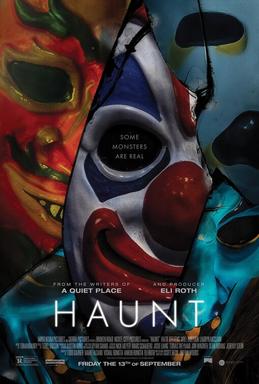
It’s past the season, I know.  But I have no control on when streaming services acquire new titles.  So it was winter by the time I saw Haunt.  Maybe it was the seasonal disconnect, or maybe I’m not all that fond of slashers—whatever the cause, I found it disturbing.  As a horror watcher, I really don’t like being afraid during movies.  And Haunt has those most troubling of characters—the unpredictable kind.  So let’s set this up properly.  Six young people—four women and two men—decide to visit a haunted house attraction on Halloween.  Although they take a random turn on a rural road outside Carbondale, Illinois, they end up at a haunted house attraction, with an illuminated road sign.  I’ll admit it; I don’t like fun houses.  They scare me too much.  So when the creepy clown at the entrance indicates, nonverbally, how they get in (taking no money) and puts their cell phones in a lockbox, I’d have told the others I’d wait in the car.

As we might expect, since this is horror, after a fakey plastic skeleton and some cheap props, it turns our that the terrors are real.  One by one, the young people are killed by a group that practices extreme body modification to make themselves look like real monsters.  For an unexplained reason, they kill everyone who comes to the attraction.  Sadism, one suspects, might be behind this.  In any case, it ends up with a final girl and final boy making it out alive and seeking medical attention.  The haunted house is burned down since Harper, said final girl, and her new boyfriend end up killing most of the killers.  The creepy clown, however, survives to try to hunt Harper down.

The film received pretty high ratings, but it seemed to me there wasn’t much beyond the terrors I normally experience at a fun house.  The body horror verges on torture porn, which is a sub-genre that I simply do not like.  In fact, I only watch it by accident.  My dilemma is that I don’t like to read summaries or watch trailers before seeing a movie.  I prefer to approach it fresh.  I suppose that’s why I keep a list of films that others have recommended, so I know they’re likely good.  I prefer intelligent horror rather than shock horror, although the two can overlap.  Movies that focus on the the pain humans can inflict on each other aren’t the kind I prefer.  Give me a garden-variety monster any day.  Even if it’s a winter weekend, and not Halloween.


Fostering Euro-Horror

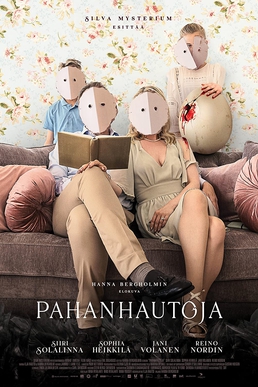
In another example of Euro-Horror, Hatching is a remarkably effective monster movie.  Filmed in Finnish, and set in Finland, it’s a remarkable parable about families and what we reveal to the world.  An affluent family consisting of Mother, Father, Tinja, and her brother Matias, live in a beautiful house in a nice neighborhood and Mother prospers with a blog about the ideal family life.  She videos the family, especially Tinja as she prepares for a gymnastics competition.  Then a crow gets into the house, causing chaos and bringing the true nature of the perfect family to the surface.  When Mother breaks the crow’s neck, reality seeps through the internet myth of perfection.  Tinja, disturbed by what happened to the bird, locates its egg and brings it home to care for it.

Mother, it turns out, has been having an affair.  Father is shown as caring, but ineffectual.  Matias has anger issues.  Meanwhile Mother drills Tinja in gymnastics practice until her daughter’s hands are raw and bleeding.  The egg grows.  Mother confesses to Tinja that she’s in love for the first time and for real.  She begins spending weekends at her lover Tero’s house.  The now huge egg hatches into a Tinja-sized bird-like creature, sparsely feathered.  As Tinja psychologically bonds with the creature, she hides it in the house and it becomes clear that what each feels what the other feels.  Over time the bird begins to become Tinja’s double, doing those things her “perfect daughter” image would never allow her to do.

The story is a parable.  Families uphold facades while the world pays to see perfection that doesn’t really exist.  Tinja isn’t terribly fond of gymnastics, but Mother drives her to compete.  Father knows about Tero, and pretends to be okay with the affair.  Mother spends her love elsewhere while her perfect family crumbles.  The monster in the movie is the revealer of truth.  The truth doesn’t broadcast well on the Internet, which prefers fiction passed off as fact.  Although the story itself could never happen, it is a probing tale that delves into psychology and the price we pay for not being honest about ourselves.  I won’t spoil the ending here, but let’s just say reality seldom works out the way that we hope it will.  Euro-horror has been producing some impressive films the past few years that demonstrate the intellectual side of horror quite well.  This may be offer body horror—without becoming slashers—because they have messages waiting to hatch.