He’s Dead, Jim

So there’s this thing called Spotify.  Like most modern contraptions, I approach it warily.  I’m not sure how it works.  Do the artists get paid?  What’s the catch?  Is it only having to listen to a commercial for Amazon every three or four songs, like the radio?  I don’t have a lot of time to listen to music, but when I do have time I like to discover something new.  Then there’s the oldies.  And I can’t help but feel a deep sense of loss at the death of Jim Steinman.  I discovered Steinman earlier than I realized it when “Total Eclipse of the Heart” came out the year my first romantic relationship ended.  That song can still reduce me to a quivering lump of emotion.  All I knew at the time was that it was a Bonnie Tyler song.
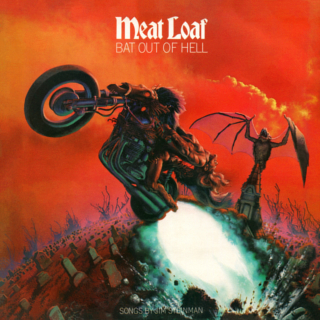
Growing up fundamentalist, even album titles like Bat out of Hell, Meatloaf’s Steinman breakthrough, were enough to scare said toponym right out of me.  I never knowingly listened to any of the songs on that album until after earning my doctorate.  When I did I was hooked.  My research skills had grown by that time to include finding out who the writer of a song was.  I discovered that “Wagnerian rock” really spoke to me.  And the only guy who seemed to know how to write it was Jim Steinman.  Most kids, I suppose, settle into their music tastes much younger, but in my thirties and forties I found Steinman a most compelling artist.  I listened to his older stuff, and his newer stuff.  I found out some surprising things, such as that even Air Supply’s “Making Love out of Nothing at All” was a Steinman song.

I seem to be hopeless at playing musical instruments.  I’ve studied piano and taken guitar lessons, leaving bewildered teachers in my wake.  My wife tried to teach me the recorder.  Despite my failure as a player, music means a lot to me.  I don’t listen to it unless I can pay attention to it.  For me it’s not background noise.  When I learned to identify operatic rock, I soon came to realize that it was the work of a singular genius who was covered by a wide variety of artists.  No one else, it seems, could capture the feeling of being young like Steinman could.  Now he’s gone.  In my noodling around with this thing called Spotify, I wonder if I can discover any more of his songs.  Meanwhile, I’m thankful that I found him when I did.

Life’s Soundtrack

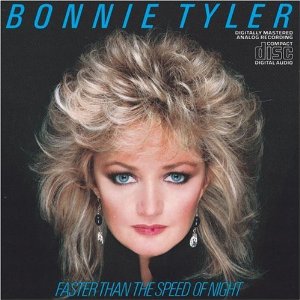
Calvin once said to Hobbes, “I thought my life would seem more interesting with a musical score and a laugh track.” In many ways, our lives do have soundtracks. From my youngest days dramatic music has moved me and Jim Steinman always seemed to know just which buttons to push and strings to pull to bring it off. Growing up in humble circumstances, however, I missed the whole video craze that accompanied MTV, back when MTV still showed music. Friends would tell me about the great videos I was missing, and I let my imagination run wild. Recently, however, a friend pointed out the video of Bonnie Tyler singing the Steinman hit, “Total Eclipse of the Heart” on YouTube. This particular video brings together so much of my adult life that it seems like Steinman spent a few years inside my head. Well, maybe not that much. The song came out just as my first love was breaking up with me, back in college. I attended Grove City College, a campus that, despite its pristine Christian image, can be very gothic at night. The first chords of that song are always like a stake through my heart. Few experiences in life are as dramatic as unrequited love. Just queue up that song and I’m a college junior again.

The video, however, is set in an old-style boy’s boarding school. The setting is not far off from the antiquated campus of Nashotah House seminary, gothic both by day and by night. The imagery of the video employs English trappings of cassocks and surplices and candles along with clandestine romps in the night. Seminaries, in my experience, leave many secrets in their shadows. My heartbreak as an undergraduate cannot compare with some of the drama I witnessed both as a student and a professor in seminary. The pious are often among the most passionate of people, but they must learn to be actors before their congregations. Such inherent conflict is fertile ground for intense drama. The video plays this out with the headmistress (Tyler) fantasizing about her young male charges in a highly ritualized, yet anarchic setting. Too close to the truth.

The sacred and the profane lie close together and may be teased apart only with difficulty. The experience of buying an LP when I was a teenager was an investment for not just the sound, but also the album art, the aroma of the vinyl and ink when the plastic wrap first came off, the feel of the heavy paper sleeve housing the disc. It could transport me to another place. Today the iPod reduces the sounds down to background noise, not a soundtrack. The drama we create for our lives is efficient and convenient, but in the end, plastic. Perhaps it is Calvin’s laugh track. No matter. Even if it is on YouTube, with its electronic sound, that video will take me back decades in time, and will be one of the repeated songs on the soundtrack of my life.