Rocks and Philosophs

Porphyry is, apart from being a cool word, a kind of purplish stone that was prized for statue-making in antiquity.  It is also the name a Syrian philosopher gave himself in the third century of the Common Era.  Now, if you read widely about antiquity, as some of us have done, you’ll encounter the name Porphyry from time to time, but those of us who focused on older materials don’t pay him much mind.  I was reading about Porphyry recently, however, and did a little poking around to discover that he’d written a book called, in translation, Against the Christians.  Some historians speculate that Porphyry may have once been a Christian himself, but whether or not that’s true, he developed an antipathy to the sect.  I was curious about what his beef may have been only to discover that this book is lost.

Now lost works in antiquity are the rule rather than the exception.  Literacy may not have been widespread, but those who could write did write, and often prolifically.  Human history was very well documented.  But tonnes of it went missing.  Wars have been part of that history and wars are notorious for destroying written records.  Also, much writing was on perishable materials that, well, perished.  That wasn’t the case with Against the Christians, however.  Porphyry’s work was purposefully destroyed.  By this point Christianity had taken over the Roman Empire.  Rather than accepting the challenge of a philosopher, officials censored and destroyed his work.  Ironically, all that survives are quotes from books of theologians who were trying to refute him.

This made me reflect on the book bans that are currently all the rage among some “Christian” politicians.  Such rearguard actions belie the confidence that imperial religions showcase.  A religion that’s afraid others might see the holes raises many questions, does it not?  It seems to come down to the idea that nothing has changed in two millennia, even though Jesus didn’t have a cellphone—not even one of those old flip-open kind—and much of what we know of nature was still many centuries in the future.  The fact is that we only try to silence those who disagree when we fear them.  Book bans pretend that they can hold the hands of the clock still and that all will remain as it was decades ago.  Learning, however, is a genie let out of the bottle.  Back in Porphyry’s day powerful bishops and emperors ordered his book banned and destroyed.  And we are all the poorer for it.

Fueling Fires

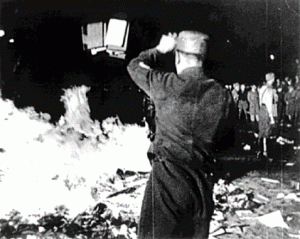
Paying attention to world affairs can take all your time.  In fact, for those who study foreign affairs, it practically does.  I’ve been struggling with the fact that you can’t be lazy in a democracy.  I know that’s true—we must constantly be vigilant of governments turning evil (with a wink)—and yet we each have our own lives to look after.  Trying to balance this teeter-totter, I noticed a Washington Post story lately about library officials in China burning books.  Said books challenge government ideology and are being destroyed.  We’ve seen this before.  Nazis burned books, and Republicans would certainly like to.  Even further back in history Medieval thinking led to the destruction of what would now likely be invaluable tomes.  There is biblical precedent, of course.  Read Acts 19 if you need a refresher.

Book burners now do their deed for its symbolic value.  We live in an age of Kindles and Nooks and books online.  Not as many are printed as there used to be, but the smell of burning plastic doesn’t convey the same pathos.  Besides, you can just whip out your synced phone and continue  reading.  Those of us who’ve committed our lives to reading find this symbolic gesture heinous.  Yes, there are books that offend us.  I’ve read more than one that I wish I hadn’t.  I have, however, no inkling to burn them.  Books represent our attempts to increase knowledge.  Fiction or non matters not.  Those who write have something to say, and surveys reveal that many adults really would like to write a book.  As a symbol, there’s nothing like it.  I suspect that’s why burning them makes such an impact.

The western world is struggling to understand China.  One of the largest investors in both Africa and South America, China is building foreign relations just as the Trump administration is jettisoning them.  Many well-informed Americans don’t realize just how long and how well China has been making connections through financial investment.  Sounds like a very capitalist thing to do.  That librarians should burn books seems an odd form of theater in such a scenario.  Governments that can’t take criticism are autocracies.  I know few donkeys that would state any one of their party is really a saint.  That’s GOP territory.  At least we haven’t started book burnings on the White House lawn.  As we turn our gaze to the east, or, depending on your perspective, to the west, we do have to wonder just how long it will be before we do.