
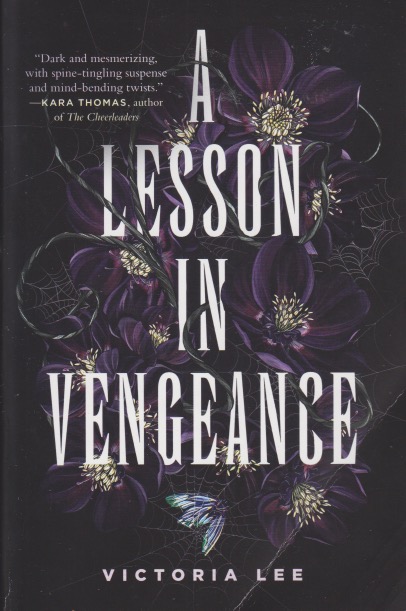
A Lesson in Vengeance, by Victoria Lee, is a novel with some twists that I’ll try to conceal. It is a kind of young adult horror-themed dark academia novel. I really enjoyed it although there are a few improbable events. That’s the way of fiction with an unreliable narrator. Felicity Morrow, a girl from a wealthy Boston family, is enrolled at Dalloway School. Dalloway is a girl’s prep school in upstate New York. Felicity had to take some time off, during which she was institutionalized, after the death of her best friend, and lover, Alex. Now that she’s back at school she feels the ghost of her friend coming back for vengeance. She lives in Godwin House, which only has space for five. It’s also part of the story of the Dalloway five, girls accused as witches when the school was founded, who all died there.
A new girl is starting at Dalloway this year. Ellis Haley has already written a published novel and is working on a second. She lives in Alex’s old room. In spite of their rocky start, Ellis and Felicity become friends. Then more than friends. Meanwhile, they’re both working on their senior projects but Ellis wants to form a fictional coven and replay the way the Dalloway five died, for her novel. Things grow tense as Felicity begins to remember more and more about what happened to Alex. Then a murder takes place. I won’t say more about the plot. The last several chapters are ones where putting down the book is a real struggle. You want to know who did it. And since Felicity is the narrator, you gather that she must survive. But this isn’t without danger.
The horror elements involve ghosts and witches. Since Felicity is revealed to be an unreliable narrator it’s unclear whether the ghosts are real or not. Most of the events are revealed to have had naturalistic answers, but one remains as either a real ghostly visitation or a delusion on the part of Felicity. I read this book as part of my ongoing fascination with dark academia, and I’m glad I did. It’s quite a well-told story. Enough information is held back and revealed in moments of insight as the story unfolds that I was kept guessing until very near the end. And the final realization only hits at the very end. This is a good entry into dark academia for anyone wondering where to start, at least in my opinion.

 Steve A. Wiggins