Cloistered

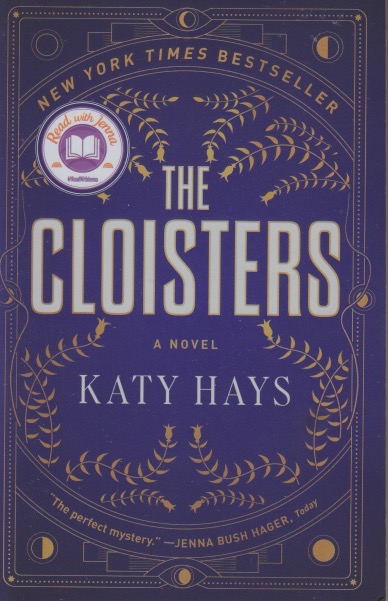
Free will.  I’ll go on the record as a proponent.  Any kind of determinism gives me the willies.  At times, however, it does feel as if we’re merely pawns.  Katy Hays deals with the concept of fate, and the occult world of tarot, in The Cloisters.  The writing is quite compelling and the story moves along at a good pace.  It follows Ann, a graduate from eastern Washington who wants to get away from the town where her father was killed.  She accepts the offer of a summer program at the Met in New York City, but because of a mix-up ends up at the Cloisters instead.  I’ve never actually been to the Cloisters, but this novel makes me want to go.  At this museum of Medieval and Renaissance art, Ann works with Rachel, another assistant, Leo, a gardener, and the curator, Patrick.

Rachel has been at the Cloisters for some time and Patrick, her boss, has become enamored of tarot decks and their history.  He’s been seeking perhaps the oldest complete deck known and has come to believe that perhaps the cards do have the ability to tell the future.  Ann befriends Rachel.  The two begin to make discoveries, particularly Ann, but Rachel, who is independently wealthy, manipulates her, taking advantage of the fact that Ann never wants to return home.  Then Patrick is poisoned.  I won’t reveal whodunnit here, but the last half of the book has several twists that make you reassess whatever conclusions you may have drawn.  It’s a fascinating story, well told.

This novel is another example of dark academia.  Much of it takes place in the library of the Cloisters and Patrick holds a Ph.D. while Rachel is a graduate student.  Ann is about to enter a doctoral program.  All of them have some fairly dark secrets in their lives.  And all of them are driven.  The story has elements of social commentary as well, particularly concerning how life in New York City will drive people to extremes when the competition makes this necessary to survive.  Although three of the four commit crimes, they are all likable people.  Three of them are academics as well.  All four are quite intelligent.  I was drawn into this tale from the start and even as the darkness was revealed couldn’t bring myself to dislike any of the characters.  Some novels have antiheroes that you just can’t feel for.  The Cloisters moves in the other direction, and it does make you wonder just how much choice you actually have and how much is left to fate.


Contours of Dark Academia

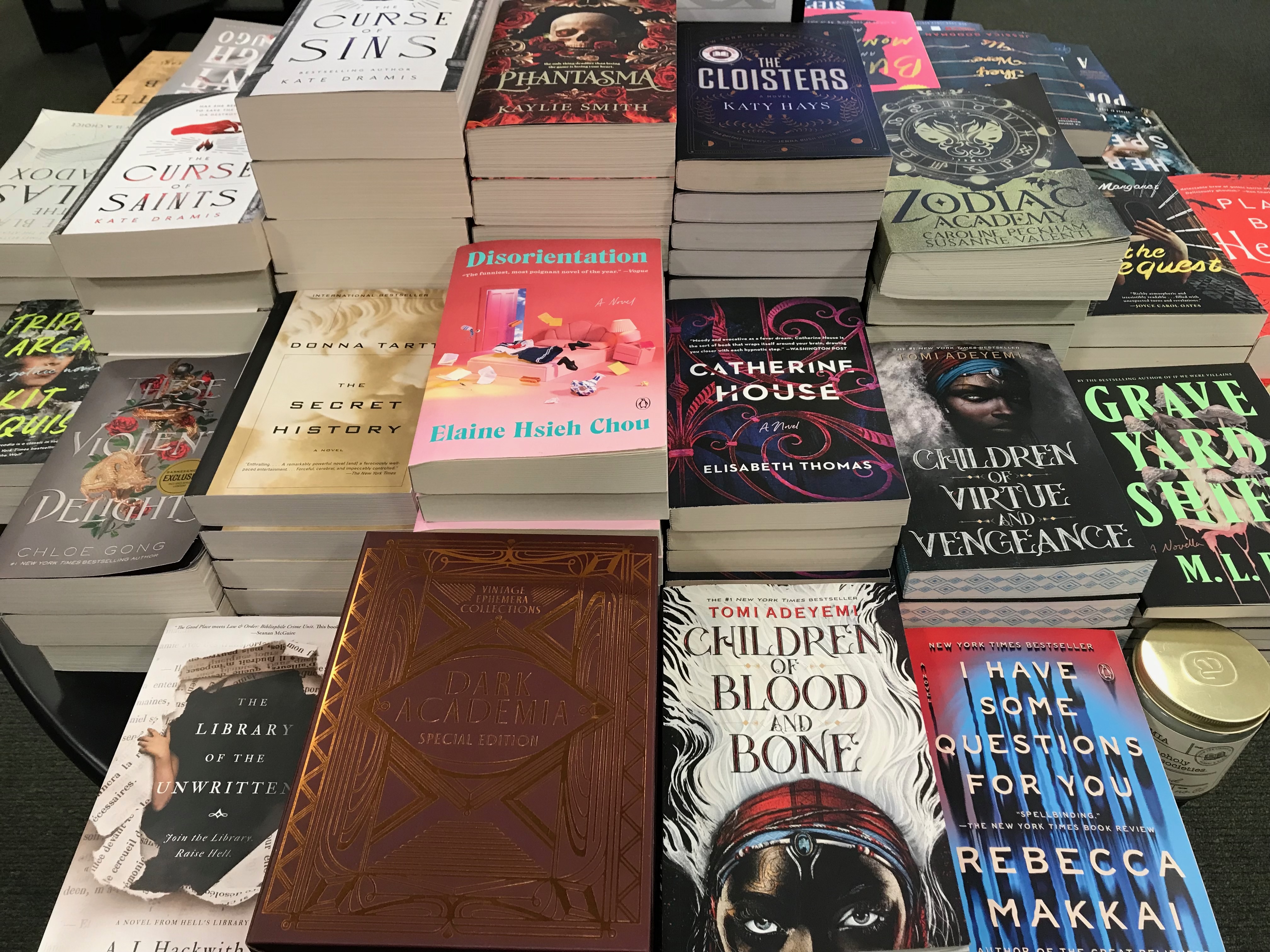
As I attempt to trace the contours of dark academia, I’m learning that much of my reading has been classified that way by others.  My main engine for discovering this is Goodreads, making me think I should shelve my own books more.  Also, I recently visited a local Barnes and Noble where one of the front tables was dedicated to dark academia.  Looking over the titles gave me fiction reading ideas for months.  In any case, apart from classical dark academia, where the setting is an institution of higher, or specialized learning, the category for many includes books about books.  This would pull in titles such as Carlos Ruiz Zafón’s The Shadow of the Wind, which I read before my current conscious interest in the genre.  I think I was looking for gothic books back then.  I include, on my personal list, books about students with dark experiences, such as Familiar Spirit by Lisa Tuttle.

The books about books category does shed some insight.  I love Italo Calvino’s If on a Winter’s Night a Traveller, but it’s not really dark enough to be, well, dark academia.  I understand the critique that dark academia tells stories of privilege, but that dissipates somewhat when including books about books.  Higher education is, and remains, a domain of privilege, but it is possible for those raised poor (such as yours truly) to break in.  I enjoyed higher education throughout the eighties and into the aughties.  After that it began to get far too political and business-oriented.  (Not that I wouldn’t go back if I had half a chance.  Or even a quarter.)  My point is, dark academia can deal with those who lack privilege, but I also believe there’s no point in denying privilege does exist.  And opens doors.

Dark academia is new enough that its parameters are permeable.  To me the real draw is that a fair bit of sculduggery really does exist in higher education.  The reading public seems eager for it.  Thinking of all the odd, somewhat tenebrous things that occurred in the course of my couple of decades in academia, the genre rings true to me as well.  As I think back over the books I’ve read, I think maybe I should build a shelf especially for dark academia.  I’m trying to read in it more intentionally now, but I’ve been unintentionally exploring it for decades.  When you add books about books, Umberto Eco’s The Name of the Rose joins the crowd, and I read that one all the way back in seminary.  I tried to be part of academia, but there’s a darkness about an unrequited love, and so it just makes sense to me.


Worse Seed

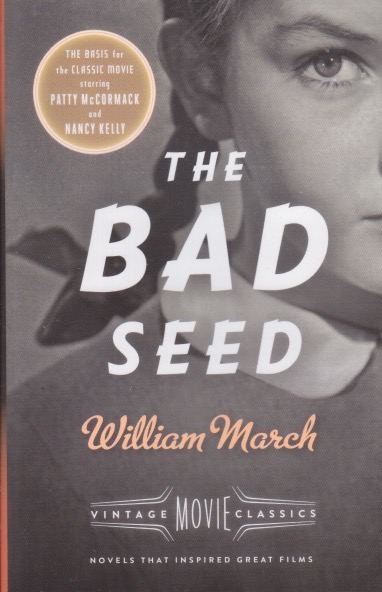
Not too long ago I watched The Bad Seed.  In the 1950s it probably wasn’t considered horror, but it is quite a scary movie.  I’d classify it as horror—not all fifties horror was guys in rubbery suits.  When reading about the movie afterwards, I learned the novel had a darker ending (the movie was pretty dark as it was).  So I decided to read the book by William March.  The movie’s fairly faithful, up to the ending.  As usual, the novel adds more detail and reveals some things rather differently.  For example, Christine Penmark, the mother of Rhoda, can’t ask her father if she’s adopted.  She “learns” this through inference.  Indeed, the book leaves you wondering if she’s actually mentally unstable.  The proof that she’s the daughter of a serial killer is strong but not definitive.  And her father is already dead when the story opens.

The school outing, where Rhoda claims her second victim, is where the movie opens.  Rhoda is expelled from the school because the women who run it can’t abide Rhoda’s dishonesty.  The character of Leroy is very well portrayed in the movie, but he too seems to have some kind of mental illness.  Monica Breedlove is accurately presented as a busybody, but she too spends a lot of time analyzing people, including herself.  Rhoda is, of course, a literal sociopath.  It’s fair to say the novel is an extended exploration of mental illness of various sorts.  I remember from growing up in the sixties that many conditions that are now regularly diagnosed simply weren’t recognized.  Kids were blamed for bad behaviors that were, in all likelihood, caused by being somewhere on the spectrum.

Much water has passed under the bridge since the fifties.  This book was a bestseller then, but I only learned about it last year.  Indeed, it’s been adapted to film three times and was a Broadway play before all that.  There was a sequel released a couple years back.  Rhoda Penmark is herself a trope of the narcissist who lacks empathy.  Hmm, where else do we see that?  It’s still analyzed as primarily a “nature verses nurture” novel, but I suspect there’s something more going on.  We’ve moved beyond Freud and this novel probes what goes on in the minds of those who spend too much time alone, as well as who happen to be the mothers of pathological child murderers.  And the ending is different, but the movie’s is equally as bleak.  The Bad Seed a good book for this particular January.


Getting By

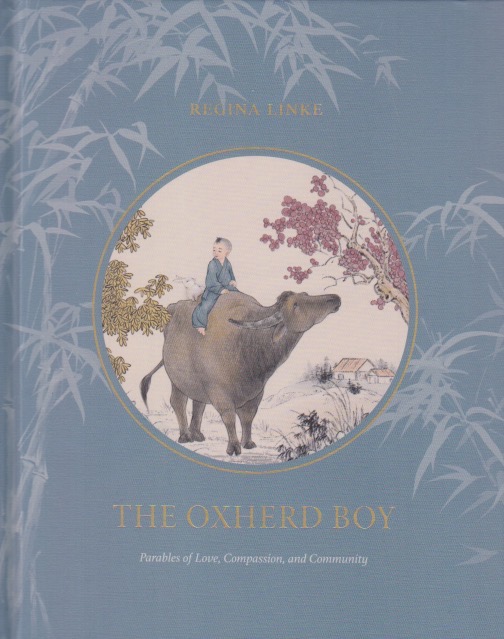
There are some books, such as Trina Paulus’s Hope for the Flowers, or Charlie Mackesy’s The Boy,  the Mole, the Fox and the Horse, that are inherently hopeful and that you like to have around.  Especially in the coming four years full of hate-filled rhetoric.  My wife asked for Regina Linke’s The Oxherd Boy: Parables of Love, Compassion, and Community, for Christmas.  Of course, I read it too.  It is yet another to add to this hopeful shelf.  The thing about these three books is that you could easily read them all in an unrushed afternoon.  All three are profoundly hopeful outlooks on life.  I would recommend having them at hand.  The Oxherd Boy is a combination of beautiful artwork with bits of wisdom drawn from Taoism, Buddhism, and Confucianism that can keep you centered in difficult times.

There’s no real storyline here, but rather reflections.  “Eastern wisdom” is kind of a tired trope, but the “religions” of that part of the world can infuse a bit of sanity into many of the facades western religions throw up.  I’m not anti-Christian; I fear our society is.  It has taken one of these facades and claimed the name “Christian” so that it can get its hate on and feel righteous doing so.  There are seldom positive benefits when politics finds religion.  If any.  The Oxherd Boy reminds us to look for the good in simple things.  A life with friends and one in which love is the primary outlook.  I believe Christianity began that way, but it became politicized in under four centuries and politics tend to engender hatred.  A truly Christian state, through and through, has never, ever existed.  And it’s not coming here.

We know hate mongering will take the norm.  In fact, while out driving recently I noticed an increase in rude and angry behavior on the part of not a few drivers.  There was a noticeable uptick in such behavior shortly after Trump’s first election.  In a nation of people that imitate what they see on the media, I suggest staying inside and reading a book.  I would recommend The Oxherd Boy among them.  As long as you’re stocking up, don’t forget Hope for the Flowers and The Boy, the Mole, the Fox and the Horse as well.  Books don’t need to be written by academics to try to make the world a better place.  In fact, sometimes I wonder about the choices I’ve made.  So I’ll pull down the books that give me hope, and reflect.


Reading Unwritten

There’s a style of writing—I’m not sure what it’s called—where an author keeps revealing new, and necessary information on nearly every page.  The effect on me, as a reader, is almost as if the book is backwards; too much wasn’t revealed up front and that kept me from understanding the story as it unfolded.  I confess that the fault is mine.  I’ve always appreciated a narrative that begins with much of what you need to know and then reveals unexpected things along the way.  This unwieldy preamble is to say that I had trouble getting into the otherwise delightful fantasy The Library of the UnwrittenA. J. Hackwith is a solid writer, but since this is fantasy there’s some introduction to the unfamiliar world that readers like yours truly needs.  At least a bit more than is on offer here at first.

This is a fun book with a fun premise.  Books in Hell’s library are unwritten and restless.  If not watched, their characters come to life and the book goes missing.  The idea of the unfinished also applies to paintings and other creative endeavors.  At first I thought this was going to be like Jasper Fforde’s Tuesday Next novels (several of which are discussed on this blog; you’ll have to use the search function) but the character from a book quickly gets swallowed up in a larger story involving demons with backstories slowly revealed, as well as a librarian and a muse, also with baggage that we only see once the train has left the station.  About halfway through, the story really starts to move and becomes quite enjoyable.  I guess I need more orientation than some readers.

The novel unfolds into a potential battle between Heaven and Hell, but those aren’t the only realms in play.  There’s Earth, of course, as well as Valhalla, and some nameless realms where the gods have died out.  And it focuses on a library.  It’s this final aspect, I suspect, that leads many people to categorize this novel as an example of Dark Academia.  Indeed, that’s where I discovered the book, on a display table with that label.  Although written with a light hand, and often somewhat funny, there is a deeper meaning here, a narrative about the importance of books that faces the reality that some would rather destroy them than read them.  I’m sure there are some religious folk that would see this book as promoting satanism and darkness, but instead it emphasizes loyalty and goodness.  I’ll be pondering it a while.


Measuring Books

You know how some email servers stock your inbox with ads?  I almost never pay attention to them.  Then one for Books by the Foot showed up.  I had to click.  The basic idea is simple enough: you want to look smart so you fill your shelves with books by a company that sells them by the linear foot.  You can get color coordination, rainbows, old books, you name it.  Now this isn’t a free ad.  In fact, this is a rather sad state of affairs.  I’m sure their antique books have been vetted for any real treasures, but the fact that people want to buy books just for display evokes, well, melancholy.  I’m pleased that books retain their cachet as symbols of pride, but these are not books for reading.  I’m left with mixed feelings.  The website states that they have over 5 million books on hand.

At least they’re not selling ebooks.  I love books.  They are a wonderful symbol and I suspect they are among the most noble things that humans achieve.  I grew enamored of books as I entered my tweens.  I was terribly shy by that point.  We had moved to a new, and rough small town where I really didn’t know anybody.  Life, which hadn’t been exactly a picnic to that point, seemed to be getting scarier.  So I read.  And I never really stopped.  Ironically, during my professorial days I had less time to read entire books.  Those who’ve dabbled in higher education know that at even the hint of organizational skill you get bumped into administration, whether you want to or not.  And administration is busy work.  Yes, even professors have it too.  In any case, when I got bumped back down to being a mere adjunct, I started reading a lot again.

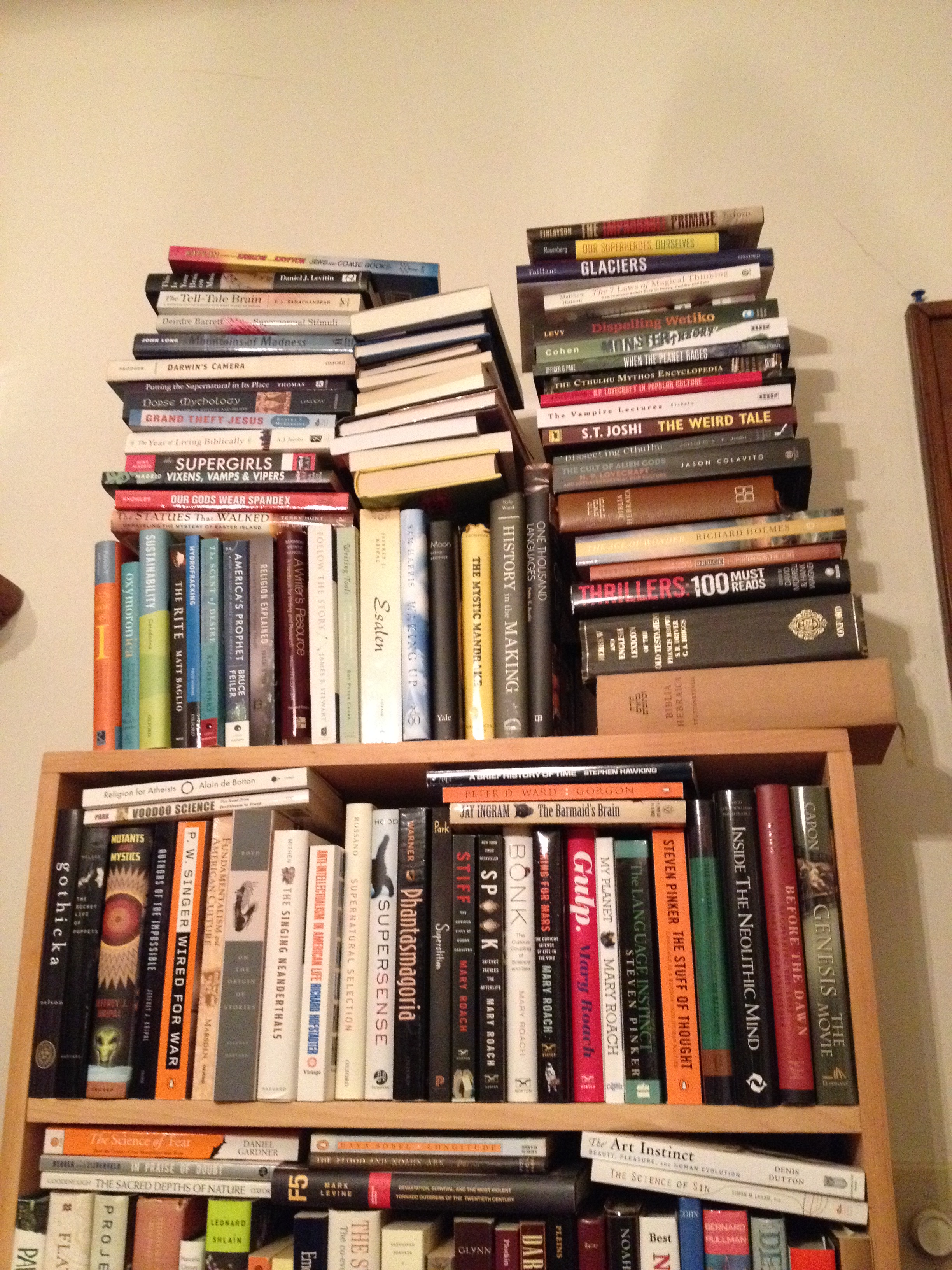
One time one of my bosses asked me how many books I had.  This was early in the pandemic when we were seeing inside each other’s houses for the first time, via Zoom.  My office is one of my main book repositories.  (Along with the attic and the living room.)  I answered truthfully that I’ve never counted.  I started using Goodreads in 2013 to keep track of the books I read.  In those early days I didn’t put everything in there (who hasn’t read a book they’re embarrassed to admit to once in a while?), but when I started the reading challenges in 2016 I did.  Mine has been a life defined by books.  Starting with the Good Book, and including many quite the opposite, I have earned books by the foot.  But I’m not selling.  Symbols have value beyond cash, at least in my mind.


Perhaps More?

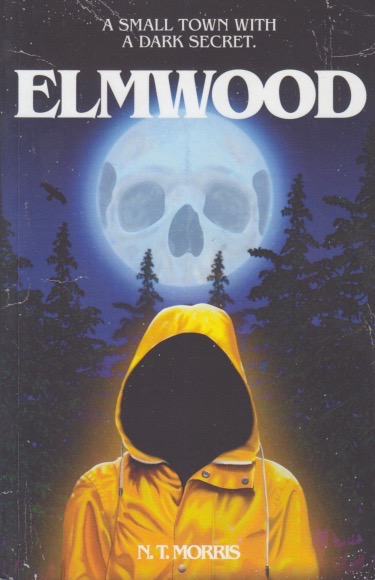
Publishers use the term “deep backlist” to refer to titles that they published long ago.  That’s always the phrase that comes to mind when I browse my “to read” list.  That list was started, in its current online repository, a decade-and-a-half ago.  When I delve into the “deep backlist” of items I placed on the list years ago I sometimes can’t remember where I learned about them.  Such was the case with N. T. Morris’ debut novel, Elmwood.  Someone recommended it years ago and I finally came into possession of it.  A moody tale about a town haunted by a cult, it is a nice effort as a self-published horror novel.  If you read a lot of fiction you start to notice some of the signs with self-published work (and there are many good reasons to go that route).  Morris offers a well-designed and aesthetically pleasing book.  The story does end with some loose threads, however.  There may be spoilers below.

Aidan Crain finds the victim of what appears to be a serial killer.  His difficulty coping with it leads his wife Laura to suggest that they get away from it all in the little town of Elmwood.  They rent out a house she found online, but it turns out to be haunted.  The people of Elmwood aren’t terribly friendly to strangers, but since the goal is to get away from city life, the young couple doesn’t much mind.  Except the ghosts in the house are accompanied by a dark presence in the woods that keeps calling to Aidan.  One of the tricky bits for me was determining what were dream scenes and how they related to waking scenes.  This is often part of speculative fiction, but a solid editor would lead you in the right direction in such situations.

The story tries to fit a lot in, leading me to think—rather uncharacteristically—that it needs to be longer.  The house was owned by a serial killer who’s part of the cult that killed the victim Aidan found many miles away.  The cult has been culling both locals and visitors for years and the police department appears to be complicit.  As do some local business owners.  The darkness in the woods, which is defined more or less as evil itself, seems to control the cult and it wants Aidan to join.  Some of the loose threads at the end suggest that Morris’ next novel will be a sequel to this one.  I can’t recall how I learned about Elmwood, but I’m glad to have finally read it.  It’s a good shot at becoming a horror writer from my personal deep backlist.


Echoes

Among the first books I read that might be considered Dark Academia was P. D. James’ Death in Holy Orders.  That was so long ago that I don’t remember when, although the inscription tells me it was purchased in 2002.  There’s no mystery as to why.  There was buzz at Nashotah House when the novel came out.  It was about a murder at a conservative Anglican seminary with few students.  It seemed very much like Nashotah House to some there, so I read it.  Now, I’m not a fan of murder-mysteries.  I’ve read nothing else P. D. James wrote.  I had no idea who Adam Dalgliesh was.  The book was a New York Times bestseller.  Reviews were mixed, and among fans of Dark Academia it is scarcely noticed.  Still, Dark Academia is still in its toddlerhood.  Its boundaries aren’t clear and it overlaps with other genres, as most modern genres do.  There may be spoilers below.

In a very complex plot (mystery writers like to show off in that way) a rich seminarian at St. Anselm’s, dies by suicide that was strange but not really suspicious.  His wealthy stepfather receives an anonymous letter suggesting foul play and super-sleuth Adam Dalgliesh of Scotland Yard is brought in. After the suicide, an old housekeeper dies of an apparent heart attack.  But then an Archdeacon is murdered in the chapel (here was the frisson at Nashotah House).  Since there were visitors on the isolated campus at the time, and the Archdeacon was not liked by most people there, it becomes a whodunit with conflicting motives, one of which is to see the seminary closed.  It owns artifacts worth millions, and, it seems, someone stands to inherit.  Dalgliesh and his team pick through all the clues and, of course, figure out the guilty party.

Even at the end the motivation seems odd.  There is a kind of Dead Poets Society letter of confession about preserving the arts.  The murderer is a professor of Greek.  These elements definitely cast the book into the realm of Dark Academia.  Still, it’s primarily a detective novel, and I suspect that’s why many fans of Dark Academia haven’t yet come upon it.  I do recall, upon first reading it, that it felt real enough.  I was living in a setting not unlike that of the novel and small seminaries do have big secrets.  This time through I was less impressed.  Super-sleuths are just too smart, which means their writers have to be exceptionally clever.  The setting suggests something wrong in the educational world, however, and that is true enough.


Another Level

Jack Finney is probably best remembered as the person who came up with the idea for The Invasion of the Body Snatchers.  His book, The Body Snatchers, was the inspiration behind the two movies based on it, as well as various knockoffs.  The Third Level is a collection of short stories he wrote.  I’ve been trying to introduce more short stories into my literary diet, and this one was recommended by Stephen King in Danse Macabre.  Specifically, he mentioned it as being more like what The Twilight Zone should’ve been than much of what Rod Serling wrote.  Now, I’m an unapologetic Rod Serling fan.  This is based on memories from childhood when I watched the show and, let’s be honest here, wished he could be my father.  I already had a taste for the unusual and sometimes macabre, and so I was curious what King thought might do Serling better.

The Third Level was labeled as science fiction, but sci-fi and horror share more than a boundary or two and at least four of the stories have nothing sciency about them.  As a collection it’s good in the same sense as a mature reading of Ray Bradbury is good.  I would’ve liked this—probably loved it—as a kid.  I was reading, however, for The Twilight Zone.  There are some good twist endings here, but not all the stories have them.  A couple of them are pretty straightforward whimsical romances.  Many of them feel very much like they were written in the forties and fifties.  A couple of the stories, late in the collection, I really liked.  They were a bit more Zonish than some of the others.

One of the problems in writing a brief post on a collection—and no collection is uniformly great—is that it’s difficult to give a sense of the whole.  So instead I’ll just focus for a minute on the last story, “Contents of the Dead Man’s Pockets.”  This one shows the power of Finney’s descriptive writing and it caused physical reactions I seldom get when reading.  It involves a man climbing out on an eleventh-story ledge to reclaim an important bit of paper that blew out the window.  More than once I almost had to put the book down.  Fear of falling is deeply embedded in the human psyche and Finney is able to probe it for more pages than I was comfortable reading.  Well done, sir.  Overall, the collection is good to have read.  It won’t change my mind about the Zone, however.  It reached me a little too late to do that.


Won’t Tell

This one is pretty darn close to too tense to read before bed.  I don’t remember how I found out about Ivar Leon Menger’s What Mother Won’t Tell Me.  That’s usually a pretty good sign that I found it in a bookstore.  Those are still places to linger while trying to find something a bit different.  This one is a page turner, but also one that I’m not quite sure how to classify.  It may be horror but the “monsters” are all humans.  I almost don’t want to describe the plot because it is so exquisitely suspenseful.  When I’m reading to get sleepy, I often find myself trying to grasp pieces of a story that are floating away like dandelion fluff, unable to put them back together.  Then I know it’s time to close my eyes and re-read a paragraph or two tomorrow.  That never happened with this one.

I think I can say this much without giving it away: Juno lives on an isolated island in a lake with her parents and younger brother.  The parents warn them of the murderous strangers who are seeking them—the father was a states’ witness against a powerful criminal family—so the children must never be seen on the island.  If anyone happens to come, they must hide and remain quiet until they leave.  They have to practice drills in case this ever happens.  It gets pretty creepy, from nearly the first page.  I would also advise against reading the back cover copy, since it will give some of it away.  I tend not to read the copy until after I read a book—you just never know what they might let slip.

This is a story about perseverance and discovery.  Discovery that is full of tension.  It’s a reminder of how precarious childhood is.  There are plenty of twists in the story and chapters generally end with information that creates a tension that the next chapter will only partially resolve.  The end result is a story that pulls you along and is pretty chilling.  I’m not sure if I’d call this horror or not.  If there’s a good case for a thriller being a separate genre, this could be useful as evidence.  Even if it’s not horror, it is likely to appeal to many who read in that genre.  There’s nothing speculative about it.  Perhaps that’s why the story scares in the way that it does—this could happen.  What happens?  Like mother, I won’t tell you either.


Expectations

Our minds are our most powerful tools.  Some of us wonder what reality is, and David Robson has written a very important book that the title explains: The Expectation Effect: How Your Mindset Can Change Your World.  Now, before your woo-woo meter goes off, Robson is a science writer and everything in his book is backed by evidence.  The basic idea is this: what we expect to happen often becomes our reality due to the “expectation effect.”  The brain, as Robson describes it, is a prediction machine.  And what it expects often takes place.  In other words, belief matters.  Probably the most famous example of this is the placebo.  We all know that patients treated with placebos often recover just as well as patients given the active ingredient.  That pill the doctor gives will heal them, and so it does.  The brain expects it, and it happens.  Belief.

This book also explores the nocebo response.  This is where you expect something bad, and it happens.  The most extreme examples of this, well documented, are when people are convinced an imaginary threat will kill them and they die of it.  In fact, the book opens with consideration of such an occurrence where a cultural expectation led to otherwise unexplainable deaths among healthy Hmong populations fearing a night demon.  Hysteria grew and so did the deaths.  Robson also explores how hysteria leads to expectations that our brains carry out.  He shows how training our expectations can help good self-fulfilling prophecies take place.  Athletes, for example, can seem to do the impossible.  Why?  Partially training, yes.  But also because of their mindsets.  Their expectations.  Their beliefs.

The implications of this are very broad.  Everything from our health, to how we handle stress, to how food benefits our bodies, to how we age as we expect to.  Robson is quick to point out that this isn’t a book to solve all our problems, but it is a book that demonstrates our minds do make things real.  Or at least they can.  It is filled with fascinating examples, backed with science, showing that even how a doctor or nurse introduces a shot “you’ll feel a bit of a sting” versus “you won’t feel a thing” can make a difference to how our body perceives it.  And our brains can make our worries, or our hopeful expectations, real.  Personally, I believe that there may be even more to this than Robson explores.  But then again, I enjoy a bit of mystery.  I believe in belief.  Regardless, this is a life-changing book and I hope, for your own sake, that you’ll read it.


Shadow Half

Sometimes you just take a chance on a book you haven’t heard of.  You see, I keep a very active “to read” list.  The problem is that many books on it are a bit on the heavy side and it takes me a long time to get through lengthy books.  Every once in a while I go to a bookstore to browse for a book that’s short and speculative.  It seems that when I was growing up it wasn’t difficult to find fiction under 300 pages.  In any case, that’s how I found Sunny Moraine’s Your Shadow Half Remains.  It was in the “horror” section of a local bookstore.  (Even “horror” sections are now difficult to locate.)  It looked like it wouldn’t take me a month to read.  It was a good call.  It’s what I like in a scary story.

Not too gory and written with literary finesse, Your Shadow Half Remains is a pandemic story.  Well, not literally, but sort of literally.  It was published just this year and the story revolves around a pandemic in which people are infected by looking into each other’s eyes.  Nobody knows for sure how this happens, but people who are infected begin to act violently toward those around them before killing themselves.  Naturally, therefore, survivors begin to isolate themselves.  So Riley moves to a lake cabin where her grandparents got infected and died, but since there’s nobody else around the contagion can’t spread.  She lays in supplies and awaits, well, that’s just it—awaits what?  Her plan is interrupted, however, when she learns that she has a neighbor.  Maybe two.

One neighbor she starts to get to know, but they can’t look directly at one another and can’t really know each other’s motives.  Herein hangs the tale.  People are social creatures and the pandemic (in real life) caused much of its damage in the form of isolating ourselves from one another.  Other people, instead of being companions, were threats.  Especially in the early days when it wasn’t clear how the virus was spreading.  The safest thing was to stay home and avoid others.  It’s that aspect that Moraine really captures here.  A woman set to try to wait this thing out alone, but then, another person complicates things.  And how can you tell insanity from infection apart from insanity brought on by isolation?  Both seem to lead to the same results.  I took a chance on this unknown story, and it was a chance well taken.


Showing Gratitude

Stealing is something that we all, except some capitalists, know is wrong.  I think quite a lot about the land that was stolen to make America possible and I know that simply giving it back isn’t an option.  Nevertheless, I do believe that we should listen, and listen attentively to those who’ve been here longer than Europeans.  Robin Wall Kimmerer’s Braiding Sweetgrass is an important reflection of this dilemma.  Kimmerer is Potawatomi and she’s also a professor of Environmental Biology.  The book is a series of essays that focus mostly on plants and what we can learn from them.  It also brings in indigenous teaching, contrasting the outlook of gratitude against that of greed.  By turns sad, funny, and profound, Braiding Sweetgrass contains a message that is vital to counter climate change.  To correct our attitude before it’s too late.

There’s so much in this book that it’s difficult to know what to touch on in this brief notice.  Throughout, Kimmerer notes that the First Nations viewed life as a gift.  The earth is constantly giving and the native way was to be thankful and to accept the responsibility of being given a gift.  Seeing how the European attitude was “take until there’s no more to take,” she points out that taking what you need and leaving for others is a way out of our current dilemma.  She does this, most strikingly, by the story of the windigo.  The windigo has become popular among monster fans as a consuming beast, but Kimmerer shows how the story has a profound point.  If all you do is consume you become a monster.  You stop a windigo by showing gratitude.

Perhaps the most striking thing, to me, was how Kimmerer describes her own experience becoming a scientist.  How standard academics refused to believe they had anything to learn from Native American outlooks, especially when borne by a woman.  How she was told she couldn’t be a scientist, not with that outlook.  And how she learned the European way but didn’t give up her native understanding.  How she brings two worlds together and does so with a sense of urgency and hope.  Things have gone too far simply to turn back the calendar and say that our ancestors had it all wrong, but it’s not too late to learn from those who lived for millennia on this land and were untainted by ideas of private ownership.  Those who knew how to live sustainably with nature.  Those who knew, and still know, how to defeat monsters.


Fear of Spiders

To anticipate, “mygale” is French for “tarantula.”  I learned about Mygale, also published under its English translation, or else Serpent’s Tail, from a Goodreads review.  It’s increasingly difficult to find good, short books.  I knew little about it other than it is a “thriller” by Thierry Jonquet.  The book contains one of the most cleverly drawn plots I’ve encountered in some time.  I also believe it could slip into the horror genre.  I’m reluctant to say much because the pieces are revealed so intricately that to summarize would be to ruin the effect.  I will say that if you’ve seen The Skin I Live in you know the basic idea already.

I will opine that this story demonstrates that a book need not be excessively long to be a good novel.  Some of us appreciate the economy of language that illustrates Pascal’s famous quote, “I have only made this letter longer because I have not had the time to make it shorter.”  My first relatively descent novel was about 230,000 words, or, in other words, well over 400 pages.  The publishers I half-heartedly queried said it was too long.  When writing short stories I quickly learned that many journals only take them if they’re under 3,000 words, some only under 2,000.  As a result, I began writing short.  That’s not exactly true.  I write the story as I want to tell it, then I cut it down.  Again and again.  Short seems to be the fashion in the internet age.  Ironically, the books on my too read shelf all seem to be quite long.  That’s why I decided to give Mygale a try.

I’m glad I did.  The story may not be for the most squeamish, but it’s certainly not blood and gore.  It’s a little confusing at first, but it comes to make sense.  And the ending is somewhat satisfying.  It’s not happy by any means, but it’s well told.  Some classify it as science fiction, but there’s nothing too impossible about it.  It’s set in France around the 1980s.  No space ships or ray guns to be seen.  Genres can be tricky in the face of creativity, but the final act, if you will, reveals this to have been horror all along.  Well, I hope I’ve been able to give a sense of this book without giving any spoilers.  Talking around a subject comes with years of classroom experience, I guess.  I will say the spider isn’t literal.


Clergy Problems

I believe Revival is the most recently written Stephen King novel I’ve read.  It was pretty good—it certainly scores high on the religion and horror scale, although it takes quite a while to get to the horror part.  Part of the problem for me is that I liked Charles Daniel Jacobs.  I tended to relate more to him than to Jamie Morton (the narrator/protagonist).  Perhaps this was because, like Jacobs, I studied to be a Methodist minister.  And like him, came to have a rather different view of what is really going on in the world.  He’s clearly King’s villain, however.  Or “fifth business” as he’s termed in the novel.  The secret lightning he seeks turns out to be a kind of MacGuffin.  I was curious to know more about it.  The novel, as is typical, has several subplots but the main one is how Jamie and Charlie face what’s after death in a tragic climax.

Charlie starts out as a Methodist preacher.  When his wife and son are tragically killed, he becomes a huckster who actually has tapped into an electrical power that can heal people.  It often, however, leaves bad aftereffects.  Jamie, who knew him as a kid, is cured by him from a heroin addiction.  Their paths continue to cross over the next fifty years or so—this is a longitudinal story—as Jamie comes more and more to distrust his childhood hero.  Charlie can use electricity to perform wonders and it make him rich.  He wants more, however.  He wants to see beyond death to assure himself that his wife and son are in a better place.  It seems to me that that motivation isn’t a bad one.  The only way he seems a villain is that he doesn’t really care for other people.

The story is well told but it doesn’t have the same “classic” feel as some of King’s earlier novels.  He well understands, however, that horror and religion belong together.  I haven’t read all of his novels—not by a long shot—but clergy aren’t rare and when they’re present they’re implicated in the horrors, or in this case, responsible for them.  These are important insights, as others have also noticed.  Revival is one of those books that requires some reflection.  It certainly feels like something written by a man facing the limitations of the aging process.  And not necessarily at peace with it.  Ministers sometimes do go bad—they’re only human—but they can also lead to real change.  I, for one, am interested to hear what King has to say about it.