Used, Again

It may be impolitic to admit it, but I have positive associations with Amazon.  This goes back to before they started using smily boxes.  Before Amazon, getting books often involved mail orders and checks and several weeks before delivery.  Now Bookshop.org does a similar service, and with more of a conscience, but Amazon showed everybody how.  I do have a complaint, however, with the internet giant.  They allow used book sellers to be the top place when ordering a book, since they sometimes have a lower-than-retail price.  I used to sell used books on Amazon, back when I had no full-time job.  I took great care to list books according to the accepted standards of book conditions.  I know I’ve written about this before, but two recent used book orders simply didn’t measure up.  So, herewith, a tutorial:

“Like new” means in mint condition.  You should not be able to tell the book was read.  Look for soft rather than sharp edges on the pages, slight curling of the cover (especially paperbacks) from repeated opening.  Hey sellers, if you have any of this, the proper category is either “fine” or “very good”—not “like new.”  I’m not really a collector (in that way), but if I order a book “like new” I expect that I won’t be able to tell it’s ever been read.  Normally I opt for “very good.”  This brings it down to a less expensive bracket and it implies things are in pretty good shape.  If your book has extensive writing or highlighting in it, it is not “very good,” but “good.”  If it does have minor markings you are required to list them.  I recently bought a “very good” book in which practically the whole first chapter was highlighted.  This isn’t easily missed, and it’s certainly not “very good.”

I get it, classifying books takes some discrimination.  The categories are there, however, to protect the buyer.  People do all sorts of weird stuff to their books.  The used book seller, on Amazon, is morally obligated to tell us about what’s going on.  And Amazon, please make clear when a book is “new” or not!  I recently bought a book that was listed as new but it had clearly been read at least once.  Be honest, people.  Book folk, in general, are good folk.  Reading is so important for a civil society.  Books are collectible items.  If you’re thinking of going into the biz, please remember that I’ve found books for a buck at library book sales in better condition than many “very good” books I found used online.  Just be honest—you’ll still sell the book, even if for a few pennies less.

Philanthropy

I’m sure it’s happened to you.  You’ve driven two or three places, often in different towns, then you simply give up, go home, and order it on Amazon.  I try to support local businesses whenever I can, but if you’re looking for something specific, Amazon can generally find it.  (And despite the advertising hype, eBay does not have literally everything.)  This happens often enough that I’d set up my favorite charity, the Crohn’s and Colitis Foundation, as my Amazon Smile charity.  At least I could feel good knowing that my support of the internet giant was being shared to help find a cure for a major, often unspoken, disease.  The latest stats I’d seen said Amazon had donated, I believe, somewhere around $45,000 to the Foundation.  I felt good.

Then I received a notice that Amazon is retiring the Amazon Smile program.  The notice informed me that they’re focusing on other philanthropic causes.  I have to wonder what they are.  Will they help those suffering from terrible diseases?  I think of the Vlogbrothers (Hank and John Green).  They are internet personalities as well as successful authors and content creators, and they hold telethon-like fundraisers donating all of the proceeds to charity.  They do this once a year and additionally they’ve started several small businesses, again, with all proceeds going to charity.  Like that great Unitarian actor, Paul Newman.  If you have enough money, why not give the excess away?  Both John and Hank have families.  I’m sure they’re fiscally savvy enough to make sure their kids won’t have to struggle.  And yet they give millions away.

Philanthropy makes me smile.  It is the best that humans have to offer.  Those who’ve managed to break through realize that there’s an ethical obligation to give back.  What with political Christianity we’ve generally outlived morals, it seems.  They no longer have the hold on culture that the social contract seemed to dictate generations ago.  So it’s up to those with tons of lucre at their disposal to demonstrate largesse.   It nevertheless makes me happy when I hear of it.  I don’t understand finance and I don’t have a head for numbers.  Instead, I try to support those who believe in giving back.  For books that’s often Bookshop.org.  But time is limited, and weekends are too precious for spending driving hither and thither for something that’s only a click or two away from my restless fingers.  I just hope Amazon’s supporting some worthy charity.  Human need is too great not to. If they are it may make me smile.


Next Year’s Reading

One of my year-end rituals, apart from looking back at the past year’s books, is to look ahead for the next year’s reading.  This is such a pleasant exercise because Christmas often comes with gift cards from Bookshop.org or Amazon.  Until this year I’ve used the Modern Mrs. Darcy’s reading challenge to push me into some areas I might not read, but that challenge has now been discontinued.  I participated (this is strictly self-monitored, of course) in six of the seven years that challenge ran, starting in 2016.  Part of each late December was spent in visiting book stores, planning new reading projects, and thinking about the year ahead.  Of course, you can’t predict anything with too much accuracy, but I start the year with a stack of books and a head full of literary dreams.

Also in 2016 I began doing the Goodreads book challenge.  This is merely numerical—you pledge a certain number of books to read in the year.  According to my Goodreads stats (there are some books I don’t publicly admit reading, of course), I’ve read 517 books in the past six years.  Numbers were higher in the commuting days, of course, but I try to read more than a book a week and that practice gets me through some difficult times.  It always looks sunny when planning ahead for a year’s reading, but you never know where the other parts of life will actually take you.  Anyway, this year I’m planning my reading without Mrs. Darcy, mostly culled from my Amazon wishlist, which is unwieldy and constantly growing.  I try to buy the books from Bookshop, however, as it benefits independent bookstores.

This year I may set a slightly lower Goodreads goal.  The main reason for this is that books seem to keep on getting longer.  Novels grow to multiple hundreds of pages but time doesn’t increase in proportion to that number, unless it’s an inverse proportion.  Even with a lower goal I won’t plan on slowing my reading down.  In my commuting days it was fairly easy to read a hundred books per year.  I still tend to get over sixty without those hours on the bus, and hopefully all that reading is doing something useful to the world as a whole.  I write to give back for all the good I’ve been given.  If this in any small measure offsets the headlines that meet us daily, it will have been time well spent.


Bookshop

I still remember when I first heard of Amazon.  It was getting on in my years at Nashotah House and one of my students, a former university faculty member that I’d know prior to his decision to attend seminary, mentioned that’s where he ordered books.  I used the internet with caution in those days and I still ordered books by mail directly from publishers.  My library grew slowly back then, in part because faculty pay wasn’t exactly competitive.  Amazon quickly grew to the point that it became a household word, and, like Google, became an internet giant.  Publishers have felt the pressure from Amazon’s bargaining power and, arguably, its market dominance led to the downfall of Borders.  Despite my love of independent bookshops, I do miss Borders still.

I don’t have a similar, singular memory about Bookshop.org.  It may very well be because I found out about it online and studies have shown that online learning is less effective than the old fashioned way.  We put up with it because it’s convenient and we can cram more stuff in that way.  It’s all about getting more.  In any case, I do recall that I was impressed with what Bookshop was doing.  At a recent seminar I learned it was even better than I’d previously heard.  The organization supports independent bookstores so that when things become more normal again they’ll still be there.  The book industry is a rather strange one, and it operates a little differently than many others.  Places like Bookshop really do help when one vendor becomes too dominant.

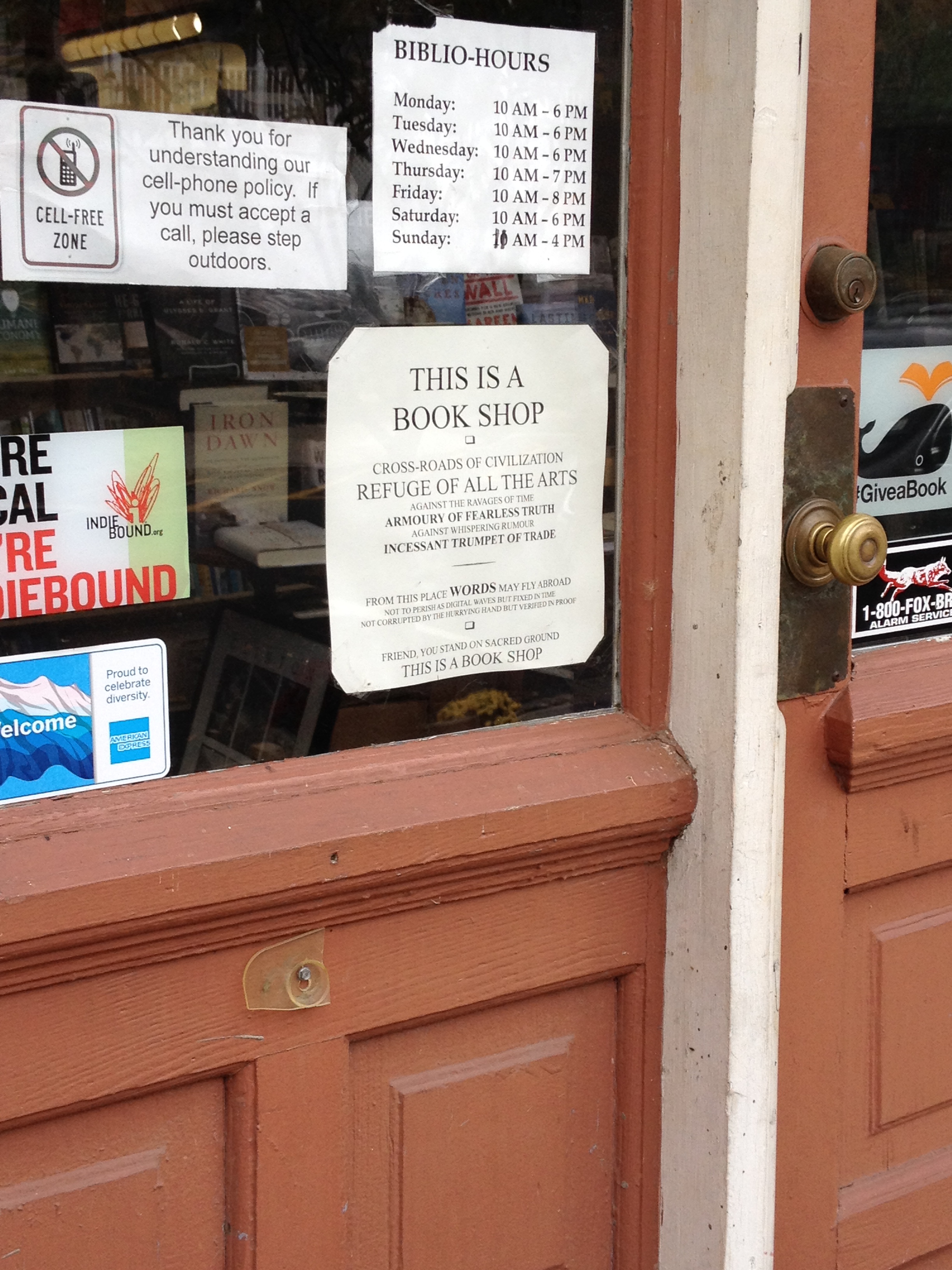
Reading widely is a form of education, and the key, it seems to me, is to get books people find interesting to them.  I stopped by a local independent on a recent Saturday to find it quite full.  The weather was good, of course, and lots of people were out and about.  Still, nothing is quite as encouraging as finding a bookstore doing good business.  When that happens it’s clear society is improving itself.  I’m trying to make a habit of stopping by Bookshop before the default of ordering on Amazon.  Amazon clearly has the logistics of delivery down to a science, but the world is a less rich place for not having physical bookstores in it.  Making one’s name synonymous with the product on offer is a sign of success, at least on the business side.  Balance, however, is important too.  And that’s where the Bookshop story has to fit.


Open a Book

With all the talk of premature “reopening” one development does seem to bring cheery news.  Germany and Italy, it is reported, are considering experimenting with opening bookstores.  Bookstores, at least in the United States, tend not to be crowded except around the winter holidays.  More importantly, they are places to go to find printed knowledge—not the internet knowledge that shifts by the second.  This cheers me because it shows that people still trust books.  With all the talk of going digital, which is okay, we sometimes forget that the human experience of reading has, for the last several centuries, been book based.  I’m as guilty as the next guy for looking trivial stuff up on the internet.  I always feel uncertain, however, if I don’t check it against a book.

Nielsen, the people who used to bring you television ratings, also track books at point of sales.  One of their findings is that books have remained solid sellers throughout the pandemic.  Granted, a lot of them are children’s books—it’s one way to entertain the stay-at-home kids—but several categories have fared well.  Books on staying in shape, and survival, and how to do things we used to know how to do (planting a garden, or making bread) have boomed.  I suspect people have felt some comfort in reading.  Books are reassuring.  They’re a sign of normalcy.  Having said all that, I’m not sure I’m ready to go back into a physical bookstore just yet.  Infection rates have slowed down around here, but they’re still high.  And other people who miss bookstores as much as I do might form a crowd.

Bookshop.org has arisen to give back to independent bookstores.  Yes, the prices aren’t what you’ll find on Amazon, and yes, you’ll pay for shipping, but they support your local indies.  This doesn’t seem to be a bad idea during a crisis.  One of the more charming aspects of the Lehigh Valley is the number of bookstores in the area.  I am looking forward to an “all clear” when we can emerge like post-apocalyptic survivors and stand blinking in the sun.  In my vision of that day, there will be birds singing and trees leafed out.  The air will be clean.  We’ll stare at our neighbors, assured that if we accidentally brush against them, or stand too close in line, we won’t do so at the risk of exposure.  I’ll stand there for some time acclimating to the new reality.  And then I’ll head for a bookstore.