Using Brains

I’m old enough to know better.  Here’s a thought.  I recently saw a headline that suggested human brains filter out things like ESP because brains evolved to help us survive.  No matter what you believe about ESP, the idea got me to thinking.  We often act as if our brains are able to determine the Truth (that capital is intentional).  At the same time we don’t understand what consciousness is.  We know that other animals have brains and that the evolution of said organ is to help individuals survive to reproduce.  Some animal species end their existence at that point, but others linger on to wonder.  And I’m wondering if our brains are filters.  Stick with me here: we know that there are stimuli that we can’t perceive that other brains can.  For example, it seems that migrating birds can perceive magnetic fields.  Even if they can’t there are magnetic fields that we perceive only through their effects on objects.  Our brains have no direct access.
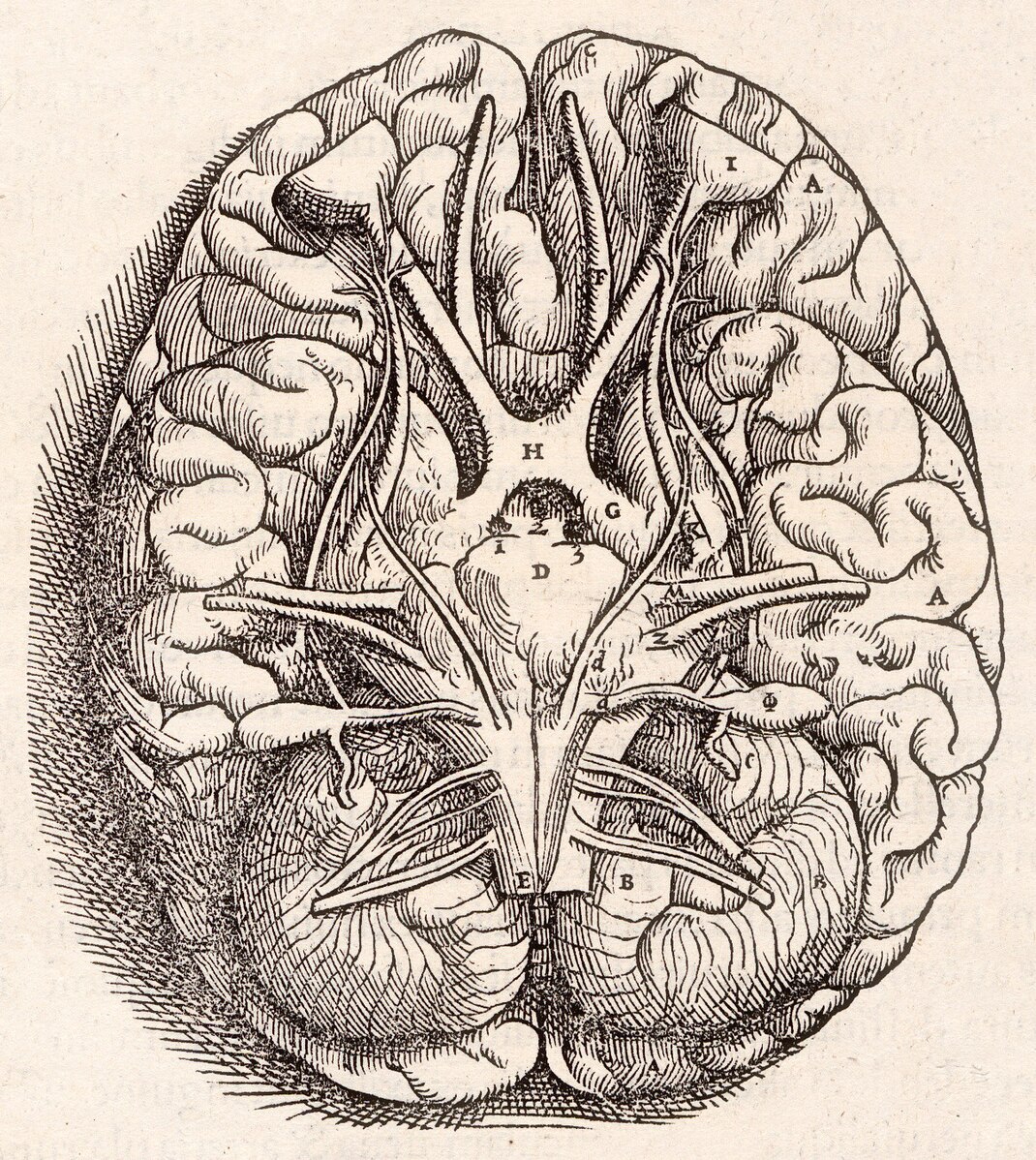
Image credit: Andreas Vesalius‘ Fabrica, showing the Base Of The Brain, by user Ancheta Wis

Here’s where it gets spooky.  If our brains filter out things that may hamper us in survival, what if they overzealously teach us not to perceive things that actually exist?  We’re somewhat limited by our “five” senses, no doubt.  We get along okay.  But what of those people who see things that others don’t?  We tend to medicate them or lock them away, but what if their brains have learned how to shut off part of the filter?  Having written a book about demons, naturally they come to mind as a test case.  Or, if you prefer, ghosts.  We tell our children these things aren’t real.  Trust the filter.  Get on with life in “the real world,” right, Cypher?

I didn’t have time to read the article, but I’d experienced a perspective shift.  If our brains are all about gathering information (and in part they clearly are), that’s one thing.  If they are actively filtering things out, well, that’s quite another.  We laud the imagination of children until they become “old enough to know better.”  Do we teach them to shut out what they can actually see, or sense, in order to accept the inevitable, material, adult world?  This idea has startling implications.  As we plunge ahead inventing AI to do our thinking for us, perhaps we’ve left something even more fundamental behind.  Have we lost interest in the Truth?  We may not be able to access it directly, but I wonder if we’re taught to give up without even trying.


Mediating Reality

The brain is one troubling organ. The gateway to both our thinking and our physical experience—as well as our survival—it tends to explain things in terms of narrative. Human consciousness likes a good story. Experiment after experiment has shown that if the brain doesn’t know why you do something it will make up an answer. Consciousness is far from foolproof. Those who rely too heavily on rationalism don’t like to think about such things. Logically, if your brain can fool you then you can’t believe everything evidence seems to verify. Think about that. If you dare.

Psychology has sometimes received a bad rap among the sciences for not having empirical evidence to back up some of its assertions. “Freudian” is now used as much as a slur as it is a sign of the sudden insight that strange things constantly go on inside our heads. BBC Future recently ran a story by Melissa Hogenboom titled, “The woman whose tumour made her religion deadly.” The account regards a woman who came to the hospital with serious self-inflicted wounds. Although hackneyed, the voices in her head told her to do this to herself. Brain scans indicated a tumor at the point in her brain where auditory information and religious belief come together. Paging Dr. Jaynes! Now, I know this is over-simplified. I’ve read enough neurology to know that brain functions can switch from one part of the brain to another and that mapping this kilo-and-a-half universe is one of the the most vexing of scientific enterprises. Still, in this case, the implications were clear: the woman’s self-destructive behavior was connected, in her brain, to religious commands.

Many educated people in this post-Christian world rely staunchly on reason. I don’t disagree that reason is essential. I do wonder, however, what happens when such thinking is forced to confront the fact of the irrational brain. Ever since setting our clocks forward I’ve been awaking in the midst of dreams. My usual sleep cycle hasn’t yet adjusted. I know some pretty strange stuff is going on in my brain when rationality’s taking a snooze. The other day I awoke convinced I was in my boyhood home. Rationality tells me it was razed years ago. Yet this brain with doctoral-level education was convinced it was in another state at another time. And this isn’t the result of a tumor, but normal sleeping brain functioning. It does make one wonder if putting too much faith into rationality isn’t a form of minor neurosis. To find out you have to ask a troubling organ and hope for a rational answer.