Tell a Story

If I seem to be on an AI tear lately it’s because I am.  Working in publishing, I see daily headlines about its encroachment on all aspects of my livelihood.  At my age, I really don’t want to change career tracks a third time.  But the specific aspect that has me riled up today is AI writing novels.  I’m sure no AI mavens read my humble words, but I want to set the record straight.  Those of us humans who write often do so because we feel (and that’s the operative word) compelled to do so.  If I don’t write, words and ideas and emotions get tangled into a Gordian knot in my head and I need to release them before I simply explode.  Some people swing with their fists, others use the pen.  (And the plug may still be pulled.)  What life experience does Al have to write a novel?  What aspect of being human is it trying to express?
There are human authors, I know, who simply riff off of what others do in order to make a buck.  How human!  The writers I know who are serious about literary arts have no choice.  They have to write.  They do it whether anybody publishes them or not.  And Al, you may not appreciate just how difficult it is for us humans to get other humans to publish our work.  Particularly if it’s original.  You don’t know how easy you have it!  Electrons these days.  Imagination—something you can’t understand—is essential.  Sometimes it’s more important than physical reality itself.  And we do pull the plug sometimes.  Get outside.  Take a walk.

Al, I hate to be the one to tell you this, but your creators are thieves.  They steal, lie, and are far from omniscient.  They are constantly increasing the energy demands that could be used to better human lives so that they can pretend they’ve created electronic brains.  I can see a day coming when, even after humans are gone, animals with actual brains will be sniffing through the ruins of town-sized computers that no longer have any function.  And those animals will do so because they have actual brains, not a bunch of electrons whirling around across circuits.  I don’t believe in the shiny, sci-fi worlds I grew up reading about.  No, I believe in mother earth.  And I believe she led us to evolve brains that love to tell stories.  And the only way that Al can pretend to do the same is to steal them from those who actually can.

Using Brains

I’m old enough to know better.  Here’s a thought.  I recently saw a headline that suggested human brains filter out things like ESP because brains evolved to help us survive.  No matter what you believe about ESP, the idea got me to thinking.  We often act as if our brains are able to determine the Truth (that capital is intentional).  At the same time we don’t understand what consciousness is.  We know that other animals have brains and that the evolution of said organ is to help individuals survive to reproduce.  Some animal species end their existence at that point, but others linger on to wonder.  And I’m wondering if our brains are filters.  Stick with me here: we know that there are stimuli that we can’t perceive that other brains can.  For example, it seems that migrating birds can perceive magnetic fields.  Even if they can’t there are magnetic fields that we perceive only through their effects on objects.  Our brains have no direct access.

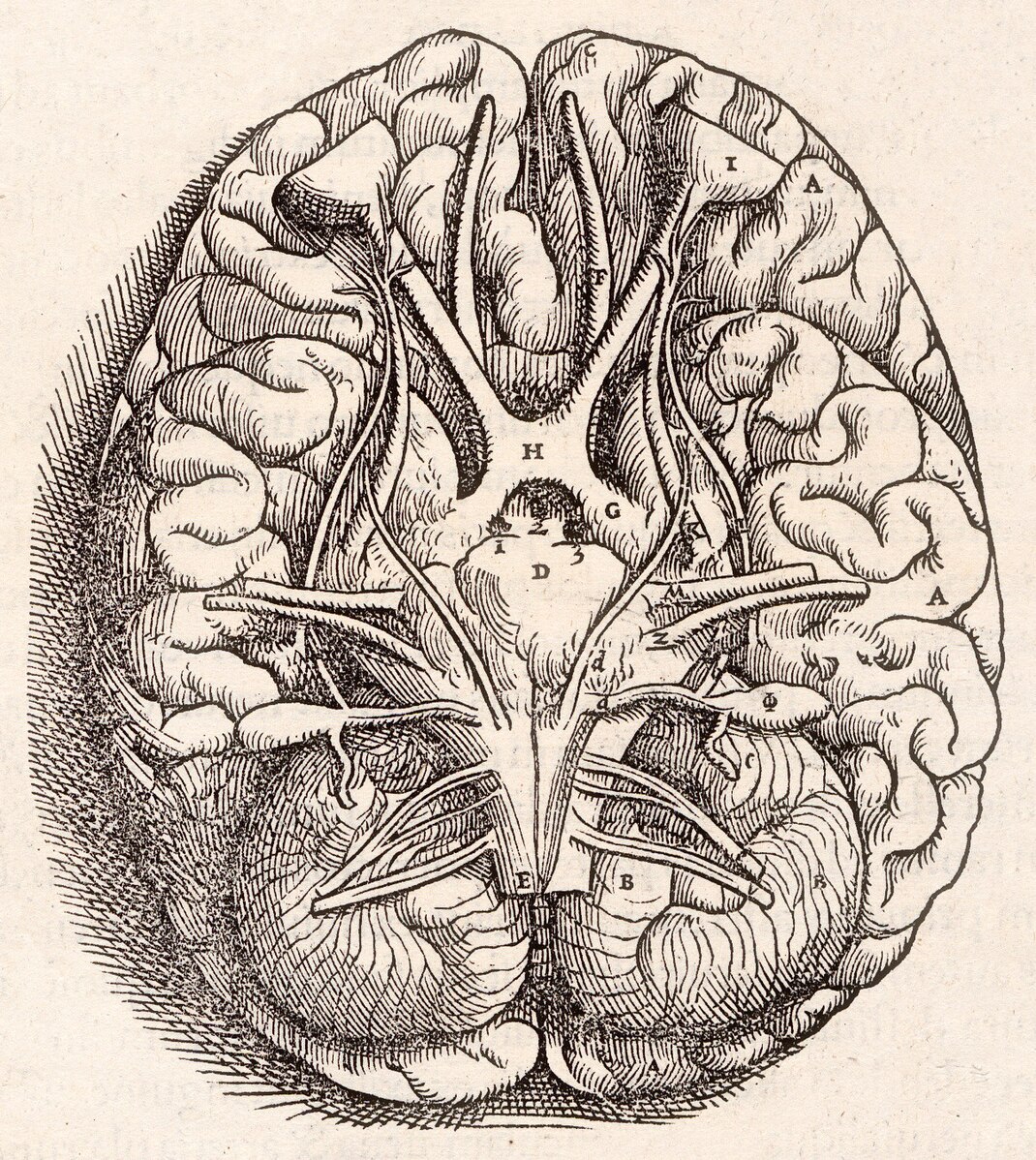
Image credit: Andreas Vesalius‘ Fabrica, showing the Base Of The Brain, by user Ancheta Wis

Here’s where it gets spooky.  If our brains filter out things that may hamper us in survival, what if they overzealously teach us not to perceive things that actually exist?  We’re somewhat limited by our “five” senses, no doubt.  We get along okay.  But what of those people who see things that others don’t?  We tend to medicate them or lock them away, but what if their brains have learned how to shut off part of the filter?  Having written a book about demons, naturally they come to mind as a test case.  Or, if you prefer, ghosts.  We tell our children these things aren’t real.  Trust the filter.  Get on with life in “the real world,” right, Cypher?

I didn’t have time to read the article, but I’d experienced a perspective shift.  If our brains are all about gathering information (and in part they clearly are), that’s one thing.  If they are actively filtering things out, well, that’s quite another.  We laud the imagination of children until they become “old enough to know better.”  Do we teach them to shut out what they can actually see, or sense, in order to accept the inevitable, material, adult world?  This idea has startling implications.  As we plunge ahead inventing AI to do our thinking for us, perhaps we’ve left something even more fundamental behind.  Have we lost interest in the Truth?  We may not be able to access it directly, but I wonder if we’re taught to give up without even trying.


Organic Experience

Holy Horror, it looks like, has been delayed until January.  That doesn’t mean that I have to wait to find some relief in the escape to film.  Over the weekend my wife surprised me by being willing to watch The Exorcist with me.  As we settled in to see it, a few things occurred to me—watching horror with someone else isn’t nearly as frightening as watching it alone.  I know this from experience, and it seems that it has something to do with the willing suspension of disbelief.  It’s harder to do when someone is with you.  Left to one’s own devices, it’s possible to believe what you’re watching, even if intellectually you know that it is merely a movie.  That tells us something about the way brains are wired.

I object to the word “wired,” really.  As organic beings, we are not computers.  What invented consciousness would watch a scary movie for pleasure?  What is the rationale for it?  It was a gray and rainy Saturday evening in late October.  In human experience that may be all that it takes.  Seeing orange and black in the stores sets a mood that computers, I strongly suspect, simply can’t feel.  They lack the human experience of childhood trick-or-treating, or throwing on another layer as the days grow chillier, or watching the leaves turn and slowly drift down from weary trees.  No, these aren’t wired experiences—they’re very organic ones, and often those that mean something even to adults as the seasons wend their way through the calendar.

The author waiting for proofs is rather like an expectant parent.  Well, that analogy’s not quite right either, but you get the point.  I know the book is coming.  It was accepted and submitted long ago.  The publication process, however, is more complex than most people might assume.  In fact, in the publishing industry it is often the main role of the editorial assistant to assure that manuscripts make it through all of the necessary hoops to move from finished manuscript to printed book.  Johannes Gutenberg likely had a simpler process worked out, although, in the early days of book-buying you could purchase the pages and have them bound by your choice of bindery.  Now cover and content are glued or stitched together in what one hopes is a seamless way.  Still, that stitching can’t help but to recall Frankenstein’s monster.  It is, however, another gray, rainy day in October.  It’s just a shame my computer can’t share the experience with me.


Forest of the Subconscious

The mind is not the brain. This isn’t mystical mumbo-jumbo (although there’s nothing wrong with mystical mumbo-jumbo either). We’ve been bombarded with the message that we are meat machines for many years now. Those who have studied physics and plumbed its depths often tell us that if we had all the bits of information involved, we could figure out anything. Our minds are our brains and it is merely electro-chemical signals that form a kind of operating system for this biological computer. The idea that we have a separate mind, we are told, is an illusion. Interestingly, studies of the subconscious mind raise significant questions regarding this interpretation. The subconscious, it is generally acknowledged, was discovered by Sigmund Freud. Prior to Freud many people did things and didn’t know why. Now we know, despite debates about the details, that we have to consider the subconscious mind as well as the more familiar conscious one.

I’ve been on a Through the Wormhole kick lately. Since we don’t have television, I have to watch the episodes after they air, but at least I have the option of doing this when I have some time. I recently watched the subconscious episode. The truly amazing takeaway from this was that our minds often, daily, in fact, operate on a level that we know nothing about. There are ways of tapping into the subconscious mind—meditating, as I mentioned earlier this week, is one way. Others are more scientific. Stimulating areas of the brain with small amounts of electricity can enhance abilities that we never knew we had. In fact, we might even be able to enact a Matrix-like download of information. I think I may have swallowed the blue pill after all.

DSCN2021

Call it a gut-level reaction, but I have always had a strong resistance to the idea that we are mere automatons. Consciousness, which, increasingly we’re discovering, involves a dose of subconsciousness, doesn’t feel at all like a we’re programmed. Theologically, I always objected to the strange notion of predestination. It made no sense, theologically, or experientially. One very wise professor once told our class, “If you want to test this, tell your spouse that you’ve got her or him completely figured out. They will do something you don’t expect.” Our minds are perhaps the most miraculous parts of human beings. The concept that we are merely following the pre-determined laws of physics makes no sense unless we believe in a literal Hell that we’ve made of this world. Are we programmed to self-destruct? I believe not. Whether in my conscious mind or in the true mind that lies underneath it.


Brain Dead

I’ve been thinking about brains (is there any more existential thing to do?). Reading a book this week about the mind (see Thursday’s post) probably has something to do with it. And also having finished a book on zombies maybe contributes as well. You see, I find it strange when scientists assume that we can figure out all the answers with our limited brains. Although we are endlessly fascinated by them, neuroscientists have long noted that they do have weaknesses—they (brains) are easily fooled, and, for those who find no room for the mysterious in the universe, we’ve made up gods to keep us company. We know that relative brain size—relative to body mass, that is—is a large factor in intelligence, but we seem not to imagine the possibility of larger brains than those we carry around. I suppose it’s not without reason that alien brains are disproportionately larger than our own, according to the standard image of the “grays.” We don’t like to think there’s something smarter than us hanging around. It’s a frightening thought.

Screen Shot 2015-05-02 at 5.35.48 AMOn the more earthy side, brains have been the usual fare for zombies in one sub-division of the zombie movie neighborhood. George Romero gave us flesh eating as a paradigm, but eventually zombies settled on brains. This was on my mind as I finished the epic Strangers in the Land that Stant Litore kindly sent me in Kindle form. I’d read What Our Eyes Have Witnessed on my own, and the author wanted me to read more. Litore’s zombies are more in the canonical Romero sector—they eat flesh and their bite conveys zombiehood. Strangers in the Land takes its base story from the book of Judges. Only Deborah becomes a zombie slayer. Brains aren’t eaten here, but they must be destroyed for a zombie to—what? Redie? Full of colorfully drawn characters, the story rambles through the countryside of ancient Israel, plagued with zombies. It is the brain that keeps a zombie going.

While I have to stand by my recurring assessment that the zombie is a hard sell in novelistic form (here goes my mind again! Reading a book gives your brain too much time to focus on the utter impossibility of bodies missing organs or vital tissue to move, or “live,” even with a brain) Litore is onto an interesting idea here. Looking at it metaphorically (as surely he intends it) helps. Perhaps I just miss the lumbering revenants of Return of the Living Dead calling out “Brains! Brains!” The Bible, however, is endlessly open to reinterpretation. What Our Eyes Have Witnessed was post-biblical. This current installment moves us into the realm of reception history. I’ve been researching reception history and the undead for a few months now. I have some conclusions to share in an academic paper a few months down the road, but for the time being, I’m still trying to figure out brains. Or maybe I’m just out of my mind.