
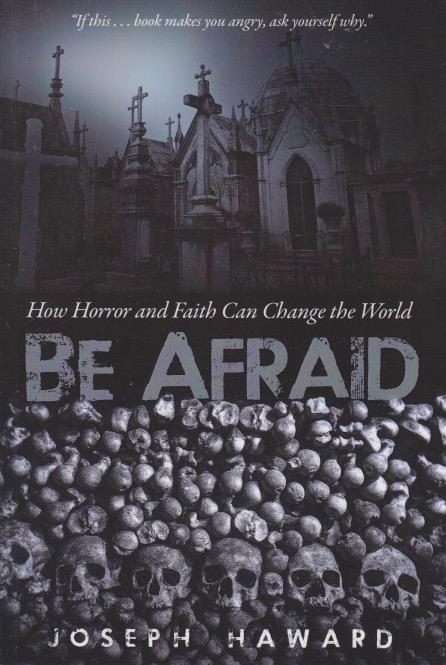
It’s something many of us do. Trying to explain why, while religious, spiritual, and moral, we find horror fascinating. I read Brandon Grafius’ Lurking under the Surface, and when I learned about Joseph Haward’s Be Afraid: How Horror and Faith Can Change the World, I figured I’d better read it too. Haward is a British Baptist minister who seems to support progressive causes. He also enjoys horror. He even finds it prophetic. I have to admit that when I read the foreword by John E. Colwell I was afraid that this would be one of those books. You know, the kind that only half-likes horror because their religion tells them so. Colwell is no horror fan, and his foreword doesn’t set the tone for what follows. Haward finds horror homiletical.
When I was young I used to see movies and analyze them theologically with my friends. This was in college and seminary, mostly. We’d discuss the implications of movies—sometimes horror—and how they fit into our Christian worldview. This book is like that. It’s Haward’s reading of various horror films, some television, and some novels, integrating them into his theological outlook. The book is more about theology than it is about specific horror films, although it does mention quite a few. The discussion is sometimes hard to follow because the paragraphs are so incredibly long and the style is very theological. I got the feeling that Haward would be an interesting person to have a conversation with. His book didn’t really do it for me, however. Some things are simply better in person. (I do know Brandon Grafius, and enjoy our talks.)
I’m not into horror for the violence. Haward tends to point to that element, but I’m generally looking for the mood. And avoidance. Also when I was young I learned the truism, “He who lives to run away, lives to run another day.” I like to think that I’m brave, but violence really bothers me. My family finds me a contradiction; I won’t watch movies that are based on “true events” unless they’re speculative. I don’t need reminding that people can be horrible to each other. I know that from scanning the headlines and from watching the election results. No, I use horror to help me cope. And it works best when I know there’s something supernatural going on. I’ve grown out of theologizing about movies. I took plenty of theology courses in college and seminary, but they seemed a bit too abstract to be helpful. Then I’d go out with my friends and watch a horror movie on the weekend so we could talk about it. There’s a bit of that nostalgia here.
 Steve A. Wiggins