Contextual Criticism

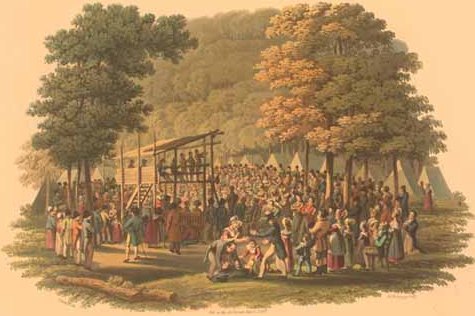
As I was reading Brian Pavlac’s Witch Hunts in the Western World, I learned about klikushi, or “shriekers.” These were Russian “witches” who appear as early as the seventeenth century and who are characterized by screaming, “wailing, barking, and writhing during worship services” (184). In that day this was taken to be a sign of witchcraft and women were arrested and tried for it. Fast forward a century or two. In the wilds of Kentucky what is generally called the Second Great Awakening was taking place. Manifestations of the Holy Spirit were, well, wailing, barking, and writhing, significantly, during worship services. These “signs” triggered the beginning of the Pentecostal movement, today one of the largest sects of Christianity. If the exact same behavior had taken place in a different context, the coverts would’ve been convicts.

It is safe to say that psychological explanations may be found for the bizarre activities of people living under a great deal of stress. No supernatural agency is required for glossolalia, spontaneous dancing, or canine vocalizations. If you look closely you’ll probably find any combination of the three in secular contexts during an average stroll through Manhattan. In a haunted country full of tales of the devil, they will be attributed to witchcraft. In a tent-meeting revival under the influence of an emphatic preacher, they will be called signs of the spirit.

Religions like to teach that they are universal, but in fact they are highly contextualized. What I used to tell my students about words applies also to acts—the meaning depends on the context. Whether somebody getting up off their ass is vulgar or merely a statement of fact depends on where the person is sitting. Religions are often rose-colored glasses, casting events in the shades we prefer to see. They are ways of interpreting the world around us and speculating on what, if anything, is outside our apparently closed system. There’s a lesson here to be learned by all. One person’s Monday may be another’s Thursday, but there’s no need for anyone to be crucified if they do it differently. Wouldn’t the world be a better place if we only believed that?
It's all a matter of perspective.

Strixology

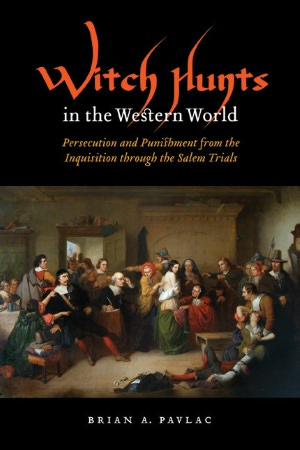
One of the fascinations of parenthood is learning to see things through the eyes of a young person again. When my daughter was fascinated with dinosaurs, I found myself learning such tongue-twisters as micropachycephalosaurus (I spelled that without looking it up just now) and struthiomimus just to remain conversant with her. (That, and I never really grew up.) When she took a childhood interest in insects, I found myself picking up bugs that would have sent me running just a few short years before, in my bare hands, to take them home to show her. All of this is by way of introducing my current continuing interest in witch trials. My wife (and consequently our daughter) is a direct descendent of the Towne family that included three innocent women accused as witches in the 1690s—Rebecca Nurse, Mary Easty, and Sarah Cloyce. When my daughter found out, the next long weekend from school we drove to Salem. I’ve been reading about witches ever since. I recently finished Brian A. Pavlac’s excellent Witch Hunts in the Western World. Well, as excellent as any book about such a gruesome topic can be. In the course of reading it, an unexpected connection dawned on me.

Many of those accused of witchcraft in the early modern period in Europe were accused of killing babies. The vast majority of them were women, often midwives. Those so accused had their bodies stripped and examined in public venues, generally only to have confessions tortured out of them later, under the eyes of male magistrates. The church had given credence to the superstition that witches actually existed and were in league with the Devil. Suddenly as I read, I heard the echo of a familiar refrain that comes from modern witch hunters. Those who, like the magistrates of old, are men; men telling women what they may or may not do with their bodies. Who draw their self-righteousness from their religion and who claim that birth control is of the Devil. Who accuse women of killing babies. Texas begins to sound like the rebirth of the Holy Roman Empire. In all of Europe that was where the most women were slaughtered, in thousands, by men who burned with the zealotry of a religion that had lost touch with reality.

Time spent on history is never wasted. At times we seem to have come so far, but then I look back over my shoulder and see the suchomimus of unbridled male fantasy closing fast. We have worked hard to bring equality to all people, but at the start of yet another millennium, we are still measuring the worth of humans by the gonads they carry. Based on outdated views from a book that was once meant to be inspirational. Sadly, the legacy often left by religion is only a residue of superstition. The reasoning behind the witch hunts of yesteryear and those of today is the same—the desire to control the behavior of others. It is the cocktail of religion and politics that inebriates those who crave power. What was true then remains true today. In the words of Pavlac, “A history of the Middle Ages shows the intensifying entanglement of magical thinking with political power, which produced the European witch hunts.” Substitute “Modern Day” for “Middle Ages” and “Planned Parenthood” for “European” and see if you can’t find a pattern.