Monster Bride

I’ve been taken with Ed Wood lately.  It’s quite possible, lost somewhere in my memory banks, that I saw one of his movies as a kid.  If I did it would’ve been Bride of the Monster.  Just in case I hadn’t, I decided to watch it again.  As I’ve noted about Wood before, I admire someone who persists in the face of constant criticism.  Someone who refuses to back down, even if they end up alcoholic and dying too young, in poverty.  Now he’s coming to his deserved recognition.  Even if his movies weren’t intentionally bad, when I laugh out loud I’m not laughing at Ed Wood.  No, it’s the absurdity of fame and the price it both expects and exacts.  Wood paid that price and now that it’s too late he’s grown a considerable fan base.  Or maybe it’s never too late.
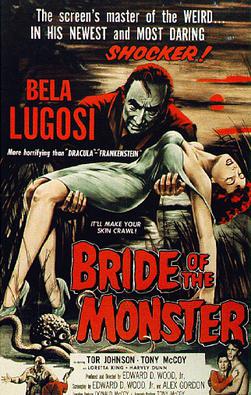
Bride of the Monster brings Bela Lugosi back to the screen as a mad scientist.  Rejected and mocked (I’m sure some of this was personal), he locates an isolated swamp house from which he plans his revenge on the world.  He’s somehow managed to build a nuclear reactor in his hidden lab and he intends to make a race of giants to conquer the earth.  Naturally enough, he starts with an octopus.  As the story unfolds, we learn that he was also responsible for the Loch Ness Monster.  He’s employed a human (but somehow bullet-proof) henchman, Lobo, to help him in his quest.  When a nosy reporter and her police detective boyfriend get involved, well, you might imagine the results.

The stories behind Ed Wood films, it seems, are as entertaining as the movies themselves.  This one, for example, has as its protagonist an acting unknown (Lugosi was the name draw).  Tony McCoy was the son of the owner of a meat-packing plant.  He received the lead role as part of his father’s stipulations for funding the movie.  Another stipulation was that it had to end with an atomic explosion (which it does).  Wood would go to any length to see his movies made, even agreeing to casting choices and plot points made by those who had no other connections to the film.  That’s part of the charm of Ed Wood’s movies—they were made to order.  And they demonstrate that deepest of human desires—to tell a story.  If I didn’t see this as a kid, I would’ve loved it if I had. 


Life Lessons

Most of us know a bad movie when we see it.  Some of us walk away.  The rest of us linger and wonder.  Some weeks ago now I watched Ed Wood’s Plan 9 from Outer Space.  “So bad that it’s good” is the mantra often chanted about it.  I lingered because of Ed Wood.  While it’s somewhat fictionalized, Tim Burton’s Ed Wood is itself an odd movie.  It performed poorly for a Burton film starring Johnny Depp.  Critically, however, it was praised and it eventually became a cult film about a cult film.  Or films.  Mainly, I suspect, because Ed Wood is such an interesting figure.  He was a man who wanted to make movies—knew he was meant to make movies—but never got the backing he needed to make them.  He did it anyhow.

Ed Wood starts with Glen or Glenda.  Written and directed by Wood, who also starred in it, this movie was about cross-dressing.  In real life Wood’s mother used to dress him up as a girl and although he was heterosexual, Wood became a transvestite.  This was, of course, in the days when such a thing was scandalous.  Making all of this surreal, and poignant, Wood had befriended an unemployable Bela Lugosi—known to be a drug addict—and had him star as God in the movie.  The next film Ed Wood focuses on is Bride of the Monster.  Again starring Lugosi, this one has a giant octopus in it and heads toward horror territory.  The film about a filmmaker ends with his notorious Plan 9 from Outer Space, the last film in which Lugosi appears and which was financed by a Baptist church.

Ed Wood ends before Wood becomes a poverty-stricken alcoholic and dies in his fifties.  There is a poignancy both to the stories of Wood and Lugosi that also applies to many people in life.  People who know, without a doubt, what they should be doing with their time on earth but who are kept from it by those, who like Lugosi’s God, pull the strings.  We all have limited time and as we grow older we realize that spending it doing a job that’s a drudgery is really a kind of crime.  Would Ed Wood have become a famous director if he’d been backed by the money to produce the movies he wanted to?  We have no way of knowing.  What we do have, however, is a tribute by a talented film maker to a fallen colleague, and that, it seems is the best part of human nature.