Pretty as a Prayerbook

Stolidity.  Canons all across this deck are known for it.  Visions of unchanging texts, however, tend to be false perceptions.  Even the canon of the Bible differs, depending on who you talk to.  So it is to be applauded, I suspect, that the Episcopal Church is planning to revise the Book of Common Prayer.  The last revision was 1979, and before that, 1928.  This schedule should be telling you something—the BCP, or simply “Prayerbook” as it’s commonly called, was never a changeless canon.  We mere mortals rely on experts to change the words by which the Almighty is approached, and although Episcopalians are thin on the ground in this country, world-wide they’re a formidable sect.  They’re united mainly by their commitment to the BCP.  And with good reason.

The days of the British Empire are long gone, but when it ruled the waves (and even before) this island state contributed a number of religious elements to the world.  The Prayerbook was born out of struggles with Rome for secular power disguised as sacred.  We try to live with a fiction of separation, but churches and states have always had mutual influence—just consider the way secular Trump has changed Christianity and you’ll see.  The BCP was to define English Christianity and in doing so became a Scripture in its own right (or rite).  Phrases from the Book of Common Prayer pepper the English language so as to rival the Good Book itself.  When church attendance was an expectation, you couldn’t help but internalize it.

A certain seminary, nameless here forevermore, will not be pleased with such change.  When I taught there many still clung to the 1928, claiming the church had erred (a strange position for someone in a voluntary organization and who vows to support its decisions) by adding “inclusive language” in the ’79.  This, they averred, was a man’s religion.  And they meant biological males.  Stolid.  Or perhaps stale.  Like the fiction of unchanging canons, the myth of the rational male hierarchy exists only to be exploded.  The two longest reigning British monarchs have been queens, after all.  World wars tend to be the legacy of male rulers.  So, although a tiny seminary in the woods of Wisconsin will likely rage, the BCP could use a bit of a makeover.  The world has changed substantially since the 1970s.  Mainline churches have been steadily shrinking and redefinition with a declining financial base makes good sense.  “This is another day, O Lord. I know not what it will bring forth, but make me ready, Lord, for whatever it may be.”  Even if it be changing canons.


Theoretically Speaking

lit-theory-vsiI’ve been brushing up on my literary theory. All writing tends to get classified as fact or fiction, and we don’t stop to think, generally, about what “literature” is. Those of us who write fiction and non know that a well-placed hyperbole might throw us from one camp into the other. Such is the power of rhetoric. So it was that I found myself reading Jonathan Culler’s Literary Theory: A Very Short Introduction. Witty and insightful, Culler acknowledges the elephant in the room for many of us—theory, in a literary context, is often impenetrable. I’ve often wondered what one had to do to be considered a theorist, and this little book actually addresses that. Nobody has time to read all the theorists, though, and come up with their own creative things to say. Chose your poison.

The Bible, of course, is literature. That’s one reason I was reading Culler. I found one of his assertions immediately applicable: people in nineteenth-century England saw literature as a unifying principle. The British Empire encompassed the world, and to make diverse peoples a part of it, literature might be used, they thought, to do the trick. Culler suggests that it might have been a substitute for religion, which, he notes, was no longer holding society together. This gave me pause. Religion—at least official religion—began as social glue. The earliest recorded religions were state sponsored and served to cast the monarch in the role of the special appointee of the gods. There’s no arguing with that, right? Elaborate, expensive temples were erected. Financed by tax-payers’ dollars. This worked fine since priests declared the rule of the king as sanctioned by the gods. Nations warring against each other were thought of as rival gods fighting.

When science began to take the universe literally, religion lost its stickiness. How do you hold a society together when the gods no longer exist? You see, scientists didn’t think out the whole picture in advance. Scientists, like most academics, work in silos (that’s a metaphor). The discovery of a scientific truth can dissolve a social epoxy quite efficiently. Recognizing the slippage in the British Empire, theorists (I suppose that’s who noted such things) considered literature the great uniting force of a diverse people. We’re kind of facing that same dilemma today as literature is becoming, for many, as irrelevant as religion was a century-and-a-half ago. At the same time, people don’t understand science well enough to assess it for themselves. What are we supposed to do? Is there a theorist in the house?


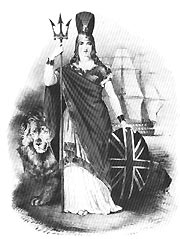
Rule Britannia

Being back in Britain serves as a constant reminder of how conspicuous consumption has come to be a hallmark of American culture. When my wife and I moved to Britain back in the 1980s we soon became acclimated to the shift in scales to a size that seemed much more within our grasp. Yes, civilized people could live without undue excess and still be quite happy. Living in the States swiftly eroded the confidence that less is enough. Those who do not climb die. Back in Britain, there is evidence that the unabashed capitalism is spreading like a poison through this nation as well. Too readily the draw of gain and personal comfort outstrip our concern for other people. On a whole, however, the ideals of a society where all have health care and the elderly are not simply forgotten still remains intact.

Perhaps it is the benefit of having once been an empire that spanned the globe, or perhaps it is a hangover from having borne the burden of monarchy and a stratified society where noblesse oblige ensures that those below are not left behind. Not that such a system is without its faults. A century ago Titanic was setting forth from these ports and sank with the humble classes going first. Such tragedies show that even where noble ideas hold sway, the inexorable draw of evolutionary development will favor those who assert themselves. The monkey on top when the ship sinks gets to draw the last breath.

Back in my Nashotah House days I used to have recurring nightmares of sinking ships. In our attempts to extend mastery over the largest environment on our planet, the one in which we cannot survive, we face an uncomfortable reality. Even if those whose names still register a nod of recognition are those who had amassed the most wealth, they are equally as deceased when the hull strikes the Atlantic floor. Is it such a difficult matter to make sure that everyone has enough before allowing those enamored of wealth to accumulate superfluous amounts of it? When the ship sinks, those with the wealth to buy themselves extra minutes may have time to think. And if those thoughts are honest, they will realize that the cost has been too great all long.