Avoiding Ritual

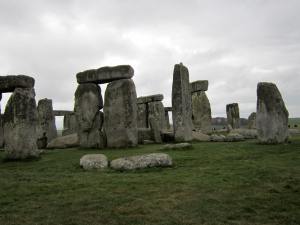
IMG_0100

While on my current British kick—not really intentional, but sometimes life gives you limes—I thought I’d mention another piece sent to me by a friend. This one falls under BBC Earth, and it’s about “Why Ancient Brits threw out their most valuable possessions.” You can find the story by Amanda Ruggeri at the link. The basics are pretty simple: some people with a metal detector discovered what turned out to be a Bronze Age “hoard” in Lincolnshire. You have to understand that, in a way that makes me totally jealous, the United Kingdom has tonnes of ancient artefacts still undiscovered. While my wife and I lived there it wasn’t unusual to read about such finds in the newspaper. (Newspapers still existed then.) People had been smelting in the British Isles for a long time. The Phoenicians actually popped round the pub to get their tin—which can be one of the main ingredients for Bronze. What the article somewhat embarrassingly addresses is the nature of the hoard.

Hoards are where a large number of (usually metal) objects are discovered, after having been deliberately buried. These are not uncommon, what with Phoenicians, Romans, Angles, Saxons, Franks, Vikings, and others invading all the time. The issue that embarrasses is the “r word.” Ritual. While we don’t know the reason, the fact that people deliberately deep-sixed their valuables, routinely, suggests a ritual. As the article makes clear, professionals try to avoid the r word. Ironically, such deliberate burials, often with items purposefully broken, is also known from the ancient Levant, often predating the hoards of the prehistoric UK. Intentionally broken items—often of clay, and not infrequently depicting perhaps deities—were buried in biblical times. We don’t know why, but scholars suggest they could’ve been offerings. After all, breaking something potentially useful is an act of faith.

I’m not suggesting a direct connection here. I took a sound scholarly thrashing some years ago for suggesting a tale I heard on the streets of late twentieth-century Scotland had its origins in ancient Sumer (grad students are prone to such thinking). Still, it might not hurt anthropologists to cast a wider eye now and again. People had similar rit— well, let’s just say strange habits, in a land far away. Just cross the Channel and make a left. When it starts getting arid head south. The ancient world may have had more of an “internet” than we think. While that pathway may not always be marked by material remains, we now know ideas travel fast. Even something such as putting a daily post on a blog might become a ri—, strange habit.

Darwinian Dawkins

Richard Dawkins seems like he’s probably a nice guy in person. You can tell quite a bit about somebody from their writing, and even when Dawkins is being abrasive in script, you can almost see a gleam in his eye. When I read The God Delusion, for example, I found myself nodding in agreement quite a bit. Not that I agree with everything he wrote; as an academic I can’t, in principle, agree with everything anyone writes. Nevertheless, Dawkins expresses himself with passion and clarity, if with a bit over overstatement. I was interested to read the interview with him in the 10 Questions section of this week’s Time magazine. When one is building a case, it is easy to pile on rhetoric, and pretty soon the force of an argument takes on its own life and sometimes a few casualties are left bleeding in the wake. Still, it is a good exercise to sharpen the mind.

Wikipedia Commons, photo credit: Mike Cornwell

Wikipedia Commons, photo credit: Mike Cornwell

The last of Time’s 10 questions deals with how Dawkins can be certain there is no God. Dawkins, in a conciliatory move, declares that there is much of which we can never be certain. Noting that future science will discover realities that we simply don’t foresee, he suggests, “it’s extremely unlikely that it would happen to home in on an idea from a Bronze Age tribe in the desert.” I found this final sentiment a touch off-kilter. We have plenty of scientific developments that have come out of the “Bronze Age tribes,” but God is not one of them. “Desert tribes” gave us metal smelting, bovine and caprid domestication, and, perhaps most importantly of all, writing. God, however, comes from a much earlier evolutionary strata. In fact, by the time that the Sumerians appeared, multiple gods were already in their train.

In fact, evolutionary scientists seem to indicate that our brains have contrived some need for God/gods. That God isn’t a semitic desert mirage, however, is attested by people all over the world developing the idea independently. Not only did the Israelites and their forebears have deities, so did the Vedic cultures that we now call Hinduism. So did the Native Americans, indigenous African religions, and those who developed in isolation on Australia. Gods evolved everywhere. It doesn’t take a scientist to figure out that this means that we have some need of them. I like what Richard Dawkins writes. I enjoy his candor and passion. We do, however, have to credit the desert tribes with much of the thinking that leads to science, but the gods, they are far more ancient than that.


Eine Kleine Neanderthal-Musik

I suffer a limited form of amusia. No, it’s not a fear of amusement, but rather lack of musical ability. I appreciate music very deeply, but I simply can’t make it. I’ve tried lessons and teachers end up turning away in exasperation. The embarrassing part about all this is that music is an integral part of religion – almost all forms of religion have their musical repertoire, and musicologists have demonstrated that the early human impulse to make music has a religious basis. I can only sit in the audience.

That's me on the left

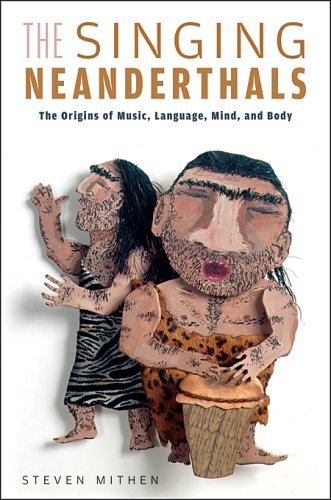
I’m finally getting around to reading Steven Mithen’s The Singing Neanderthals: The Origins of Music, Language, Mind, and Body. A few years back I gave an academic paper suggesting that musical development could be an analog to religious development on a neurological level in the Bronze Age. Since I’m not a neuroscientist I have to rely on others to do the experimental side of the equation. Mithen serves this function nicely. When I read about music and the brain, which I do frequently, I am surprised that more scholars of religion haven’t picked up on this connection. Since music is frequently “background noise” today, many people casually assume that it is insubstantial, a whim. I look at it (listen to it) from a different angle. I seldom listen to background music – if music is playing, I pay attention to it, and something in my unprofessional brain says Mithen is often right on target.

Of course, religion and music is not the main thrust of The Singing Neanderthals, but rather the idea that music was formative for human cognition. Perhaps music even developed before speech. For me this is an important piece of a much larger puzzle: whence did religion arise? Like all inquiries that delve too deeply into the past, the answer is lost among ambiguous artifacts and ancient dust. And yet, those who know more about this than I do seem to be pointing in the direction that both religion and music have their origins in the pre-Homo sapiens stage of our evolution. I’m not surprised. I only wish I could play along.