
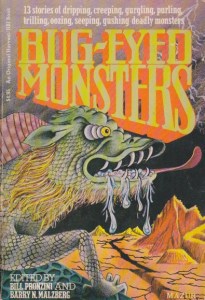
 Science fiction and horror are close kin. Once relegated to the cheap rack of “genre fiction,” both have now developed considerable literary sophistication, perhaps in the wake of their ability to bring in money. I used to attend used book sales. Two of the big ones in central Jersey were the Bryn Mawr sale, held just outside Princeton, and the even larger Hunterdon County Friends of the Library sale. Both were springtime events and highlights on my calendar. I always had a list with me when I went, but there were also so many books I’d never heard of and that looked fascinating. One such book was the science fiction anthology, Bug-Eyed Monsters, edited by Bill Pronzini and Barry N. Malzberg. The garish cover was half the appeal, and, well, monsters go without saying.
Although I’ve mostly moved to the horror end of the spectrum, there were some good stories here. Bug-eyed monsters were a staple of 1950’s sci-fi, gracing the covers of pulps, often menacing women with their tentacles. Some of the tales here share that kind of wide-eyed wonder at the sheer power of imagination, while others are much more subtle. Monsters, of course, lurk between genres, bursting into consciousness when something unexpected is discovered. They also have strains of religious awe associated with them. That’s obvious in a couple of the stories as well. Since I’m trying to read through my own books while stores are closed, I decided to spend some time with my monsters. The problem with story collections, however, is you can’t discuss them all in the short format to which I limit myself here. Besides, some of them I didn’t like.
Monsters deserve to be treated with respect. In the “golden age” of sci-fi they were often played for titillation. Most of the monsters in this collection are from outer space. Some are homegrown, generally in the scarier tales. We are afraid of those who are different. Monsters, as more than one of these stories indicate, can be more humane than humans often are. It’s no surprise that they tend to represent the foreigner, the person whose culture and appearance are different than our own. Titillation apart, these narratives often ask us to stop and consider what might happen if we really did listen. Would we not improve ourselves if we could learn from those we fear? In these days of government-approved xenophobia, perhaps we should dust off our copies of the old genre fiction. Even in those days we were encouraged to be open minded like our monsters.

 Steve A. Wiggins