Avenge This

Recently rewatching The Avengers I noticed a subtext that had escaped me the first couple of times I saw it. When Loki explains to his victims why he is spreading his chaos, he uses a concept that many of us have been spoon-fed since 9/11—that freedom is not free. When he is asked from what he is setting humans free he replies, “Freedom.” He further explains that people really don’t want freedom, but they want to be led. This sounded so much like Bush administration rhetoric that I was put on alert for the remainder of the movie. Indeed, in the climatic scene much of Midtown is attacked, and who launches the nuclear device at Manhattan? The shadowy government figures who wish to remain anonymous. “Freedom is not free,” they seem to say, “support your government without question.” The scene of police and firefighters herding frightened citizens out of harm’s way looked an awful lot like footage from near ground zero.

Comic books, I have often reflected, are already story-boarded and some make excellent movies. Some are funny and some are serious. As a child I had only a handful of comics, but they were like movies for kids with modest means. Like an adult going back to the old Warner Brothers cartoons, you see many things that escaped you as a child. Comics may not be high literature, but comic book movies, at their best, are not far from it. The X-Men movies likewise introduce themes that rivet adult attention: prejudice, discrimination, the ambivalence of evil. The stories are didactic as well as entertaining. In the case of The Avengers, the characters, while overblown, all have their own agendas but government has only one: compliance.

Sometimes I read about the early days of the American experiment and wonder what went wrong. Yes, there are certainly times and issues that demand strong centralized government for survival, but when did those who castigate such strong control decide that they should take over? Who gains here? It certainly doesn’t seem to be the average citizen. Looking over the landscape after the last laissez-faire government, the only one who ended up hands-off were the very wealthy. Left with no social responsibility, they reign, resisting any taxation so that the burden of the increase trickles down to those who, in the words of Loki, really don’t want freedom. That’s perhaps the only thing we have in common here; no matter how long ago our ancestors arrived, they were searching for freedom. Or so they believed. Like a comic book, it has become mere fantasy for most, while Richie Rich happily continues on his gilded, but vapid way.

Mårten_Eskil_Winge_-_Tor's_Fight_with_the_Giants_-_Google_Art_Project


Important Days

A few years back, during that nightmare called the Bush Administration, a petition was going around to try to prevent the United States from going to war in Iraq. A phone petition was put in place to encourage those against the war to telephone the White House and peacefully make their convictions known. I decided to call in. Since I worked at Nashotah House, I had forgotten that Martin Luther King Day was a national holiday (the seminary did not commemorate it). I telephoned the White House from my office only to receive a recorded message stating that the offices were closed because it was “President’s Day”! I hung up astonished. Our own government did not know what day it was (in retrospect, not such a surprise —).

A couple of years later while I was working on my book of holidays for children, I recalled the incident. It still strikes me as very odd, given the importance of today’s commemoration. I am including below my brief write-up for Martin Luther King Day from my still unpublished book:

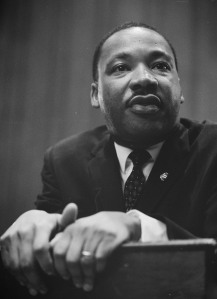
One of the few national holidays in the United States to honor an individual is Martin Luther King Day. There are only three individual based holidays – Washington’s Birthday and Columbus Day are the other two. Martin Luther King Day is observed on the third Monday of January, and it had a hard time making it through the government process of becoming an official holiday. It seems like old prejudices die hard, since the bill proposing this holiday was introduced in 1968 but was not signed into law until 1983!

Martin Luther King Day is the only national holiday commemorating an African American individual. While school kids are probably just grateful for a day off so soon after the Christmas holidays, this holiday stands out as important for many reasons. Perhaps the main reason is that the United States were united around the idea of freedom, a basic right for all in this country.

Martin Luther King Jr. was born on January 15, 1929. His story of a courageous, non-violent challenge to unfair practices in the United States is an inspiration to all who care about justice. King was a Baptist minister and a main leader of the Civil Rights movement. He was awarded the Nobel Peace Prize in 1964 for his example of peaceful protest; King was the youngest person to have ever been awarded this honor. He was assassinated on April 4, 1968. Even so, this holiday was not officially observed in all 50 states until 2000.

The federal government (pay attention!), that is, the government over the whole country, has the right to set holidays. Anyone who works for the federal (national) government gets the day off. Individual states, however, can decide if they will observe the date as a holiday or not. That is why some state workers get a holiday off while those in another state do not.

The United States stands for equal rights for all citizens. King stands as a symbol for that belief and his life shows that sometimes it takes everything you’ve got to make sure that the right thing is done.

Another factoid about this holiday is that it shows just how different holidays can be from one another. Some are fun while others make us think.


The Hardest Job

Being a religionist is the world’s hardest job. That’s because you are trying to peddle something that everyone gets for free – their own religious opinion. No other professional field has such universal competition. From the time our parents mutter their first bedtime prayers to us, we begin to become masters of religion. With an entrenchment deeper than any wisdom tooth, we know, on a sub-atomic level, that we are right. We consult lawyers about the law and physicians about aches and pains, but on the level of religion, we already know we are right. We seek houses of worship that agree with our way of looking at things, and if the minister strays too far from our views, we go shopping again. Never try to make a career out of studying religion – it is a dead-end street.

I bristle whenever someone calls me a “theologian.” I am not. I have spent my life studying religion, sometimes participating in it, sometimes sitting back and watching it, but always analyzing it. Theologians deal with abstract concepts that can never be verified or falsified. The unquantifiable is their realm, and their rarefied debates seldom touch those of us of less exalted mental energy. And they are also never wrong. Those of us in religious studies watch how people’s religious outlooks impinge on the real world. Put your tin cup on the sidewalk in front of you. Everyone knows the answers already.

For some 25 years I have been specializing in religious studies, and I still assert that it is the most important, yet neglected academic field in the humanities. Twice I have been released from a living in the field by religious folk with less theological acumen than Cal Meacham. (If you don’t recognize the reference please educate yourself!) Not even eight years of a brutal Bush administration could convince university folk that the study of religion should be given priority. The most powerful nation on earth run by a recycled fundamentalist, and we don’t care to understand, thank you. Everyone is an expert. As we watch religious leaders of “foreign” nations posture with their weapons and rhetoric, we can sit back and be assured that even if they start a nuclear war, we were right about religion all along.

Better burn than learn

Better burn than learn