
They’re one of those things, my daughter explained, that people do that make them so likable. She was talking about building cairns. Cairns are piles of stones, but not exactly the kind a farmer might make at the edge of a rocky field. Cairns are intentionally built. And they have been for millennia. The thing is, while people could choose to knock them over, instead most people add to them. When we’re out hiking we add rocks to cairns, and we’ve started our own from time to time. I first became conscious of them in Scotland. While out with some friends we spied a carefully stacked pile of rocks—I think it was at some remote location on the northern Scottish coast—and they told of of the tradition of adding to them.
While recounting this, I also recall seeing a pile of rocks—it wasn’t called a cairn at the time—at Walden Pond. Some friends from seminary and I went to visit Thoreau’s famous site and although his cabin hadn’t survived, other pilgrims had started a rock pile. It was, if I correctly recall, conical because the stones weren’t flat. Most cairns involve the flat kinds of rocks that break off of bedding planes. They are fairly easily stackable and they quite often tumble due to the forces of nature. I recall building or adding to cairns in Ithaca, near Ithaca Falls. Such cairns would be fortunate to survive the harsh winter and torrents of the spring thaw. And yet still we build them.
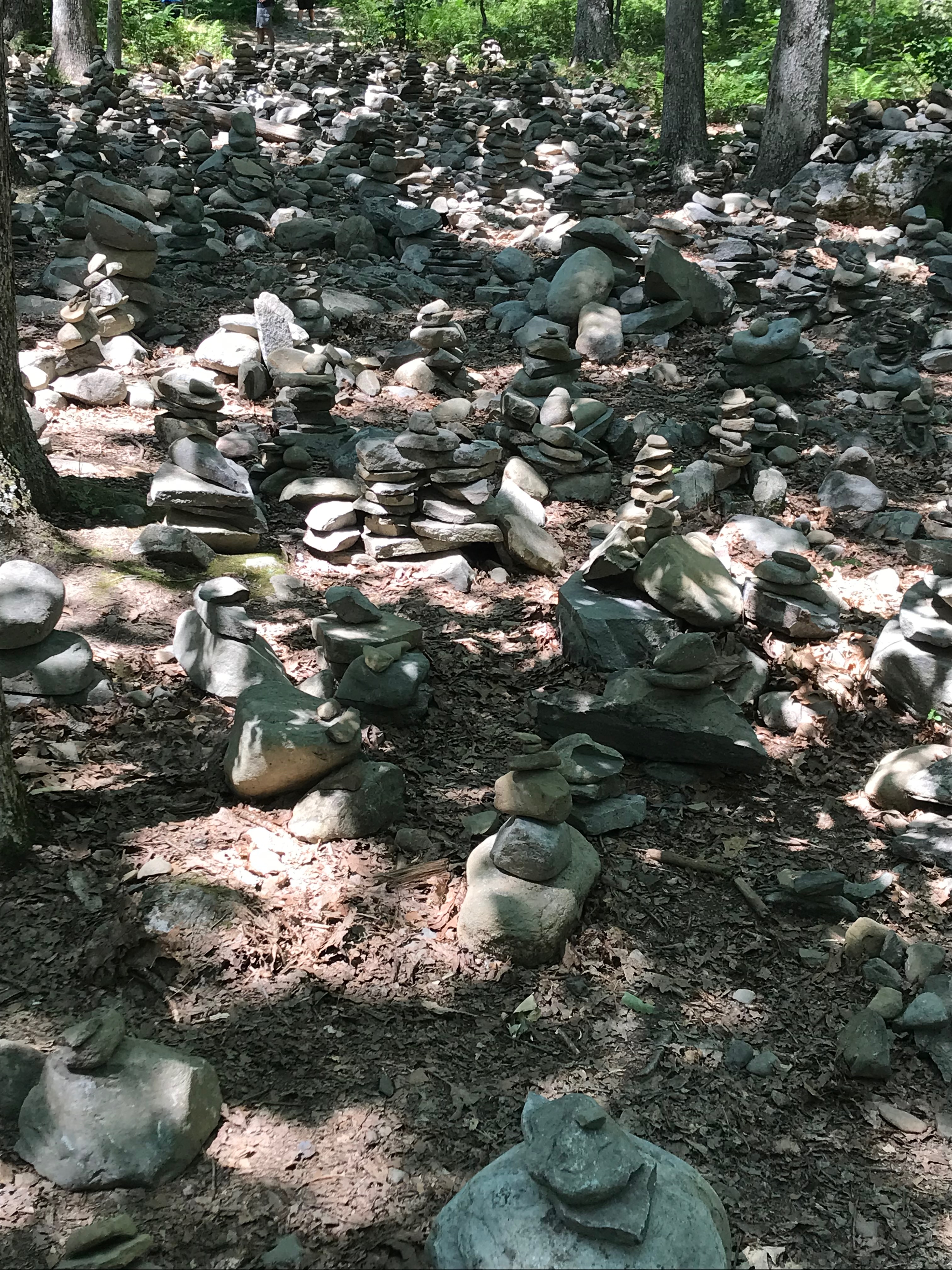
While on the red trail at Bushkill Falls, where picking and taking items is forbidden, we found cairns. There were isolated stacks along the river, dotted here and there. Then, at about the halfway point we came across a field of cairns. Alongside the trail, cairn builders had obviously seen the beauty of repeated patterns. Other hikers were snapping pictures there as well. It was clear that this was a joint venture that had spanned years of cooperating with strangers. Nobody asks your race or gender or orientation when you add to a cairn. In fact, those who start them are unknown and leave them for other strangers to carry on the work. This is frequently the case with human ventures, but when they involve money we become very specific about who might be considered a proper owner. Stones are common, and although useful are generally not valuable. Make them into a stack and they become a symbol. And that symbol can be a guidepost for future travelers, left in the spirit of cooperation of those we don’t know.

 Steve A. Wiggins