Words for Play

IMG_2849

Maybe you’ve seen it too.  Corporate-style psychobabble.  Memos land on your desk, whether real or virtual, jostling with neologisms, indicating the trendy new directions the business is going.  Apparently a legal requirement is that old vocabulary is vorboten in such information-bytes.  You can’t call a spade a spade—it might confuse somebody.  Do you mean a playing card spade, or something to dig with?  And do people even use spades anymore?  Why not call them loam-moving facilitators?  Isn’t that really what they are?  If you can get through a memorandum without a dictionary (slang or otherwise) you’re much more fluent in my native language than me. Or I.  I often wonder how much this has to do with an inherent inferiority complex.  A cog in this corporate machine has to prove it’s usefulness.  If nobody can understand what you’re doing, it seems, your job is secure.  I imagine think tanks as being like big aquaria, but with fewer viable ideas than captive fish.  I once read a memo that had to give each and every stage of a process a chic new name.  I felt like I needed to update my wardrobe and get a fashionable haircut just to read the thing.

Perhaps it’s just that a simply guy like yours truly prefers things explained clearly.  I can imagine a meeting taking place where nobody really understands what’s going on but they all have to nod their heads in approval for fear of feeling stupid.  New phrases, of course, have their place.  We needed a portmanteau for “telephone” back in the day, since there had been nothing like it before.  Most of my memos, by contrast, have been about plain old things that have been around for centuries.  Or millennia.  And if an old word is used, such as “idea,” it has to be in quotes.  Business must find a way of ensuring stakeholders that it’s on top of the latest developments.  Who uses a fax any more?  Most people consider email outmoded.  The period itself, I’ve read, is about to go extinct.  Still we have time to make up corporate-speak.

I work in the publishing industry, which is notoriously slow.  Unhurried attention to detail is a sign of quality.  If you want a book to be good, you need to take your time at every stage of the process.  Sure, a book can be churned out mere days after an important event, but if you read it you’ll see the corners that have been cut.  We even received an issue of Time once that had the “e” accidentally chopped off by a hasty cutting machine.  You want quality, you need to take your tim.  Adopting the newest coinage in the busyness business hardly seems a way for minting success.  Utilizing quality ideas isn’t the same as the fabrication of nonce words.  Of course, attention to detail takes away from time that could be spent making more money.  Churning out new verbiage creates the illusion of being ahead of the game.  If you need a dictionary to understand what your company is doing, perhaps it’s a good thing to work in publishing, even if you have to look words up online.


Riding a Cycle

Spare-ribs and sauerkraut. My step-father always insisted on these for the turning of a new year. The old year was to end on something sour while the new was to begin with something sweet. So his reasoning went. It is this Janus-faced aspect of the new year optimism that we anticipate with such high hopes every twelve months, only to come back to another gray December. Time, since antiquity, was considered something cyclical. Today we think of time as linear—a line stretching from there to here, nobody really knowing where it might end. New Year’s Day reminds us of that obscure hope that things might indeed get better.

Since I’ve been cast into the role of someone dependent on business for a living, I’ve become keenly aware that, although the fiscal year doesn’t end for another three months, and the school year doesn’t begin for about six more after that, we open each year on the hope for better profit than the previous one. In a way that I’ve always felt earned economics its sobriquet of the dismal science, constant increase in a world of limited resources is sure to disappoint. What is really sought, it appears, is more for me, which means less for you. Born an idealist, I find the whole concept baffling. If I have too much to use, shouldn’t I share it with those who don’t have enough? Those who read about the behavior of apes would recognize this basic altruism as deeply embedded in the primate genome. Unless, of course, that primate is a human being.

Janus.xcf

I wish that a New Year celebration could be more universal than just fiscal success. It is always my hope as a new year begins that by the end of it we will all be in a place we would prefer to be. Those of us who live under the law of greed and personal gain have long felt the frowning aspect of Janus’s face. As the year turns over in the month named for this deity of thresholds, we hope that a smile might beam down upon us, and that a new year might truly be new. Knowing this is an election year, however, has come to cause increasing anxiety. Those who can command public attention are those with the deepest coffers. Those most unworthy to lead. We do, however, love our entertainment. The Force has awakened, and what might we anticipate for 2016? For me, no animal has ribs to spare, but the symbol has become increasingly apt. Let’s hope the Force is good and will awaken peace.


Forward Planning

Smallmindedness bothers me.  Now don’t get me wrong, I don’t claim any great intelligence for myself.  I’m just an average guy who thinks too much.  No, the smallmindedness that I despise comes in capitalist colors.  More specifically, it comes in the form of business-speak.  This is a language in which I make no claims of fluency, but in which I am forced to converse from time to time.  I believe there is a secret coven of businessmen hidden in a dark board room determined to make themselves sound intellectual by cobbling together polysyllables.  Business is, at the heart of it, really simple.  I want your money; how little can I give you for it?  They call economics the dismal science for a reason.  In any case, the other day I was confronted with the phrase “forward planning.”  It was like one of those moments when you walk into the wrong room and you’re disoriented for just a second or two because what you see is not what you expected through that door.  Forward planning.  What other kind of planning is there?  Backward planning?  Victims of time have no choice in the matter.
 
I’m bemused by the ubiquity of “best practices.”  No, thank you.  I prefer to use worst practices.  Of course we all want to do things the best way possible.  Putting insipid neologisms in the way is not how one achieves it.  What’s wrong with just saying what you mean?  Oh, I forgot—the guys in the shadowy boardroom.  There’s nothing like lingo to substitute for depth.
 
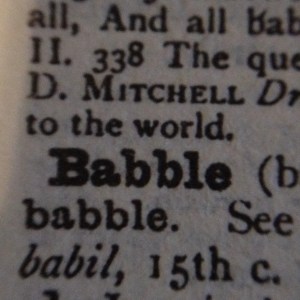
At a campus book sale a few weeks ago, I found a copy of the Compact Oxford Dictionary.  Fully aware that any word can be instantly searched online, I hefted the two, heavy volumes and for six dollars walked out with over a million words.  People on campus looked at me funny.  Someone even asked why in the world would I buy a dictionary?  There are plenty of answers I could give.  I could say that I like the feel of something solid in my hands when I practice scholarship.  I could say that it impresses people when you show them how small the type is.  I could say that I have some leaves I’d like to flatten effectively.  The truth, I suspect, you’ve already divined.  I bought these books because no matter how much you look, you won’t find “forward planning” listed anywhere as a legitimate concept.

IMG_2618


Hallowed Be Thy Income

IMG_1924

Some time ago, I was invited to attend a “best practices” session where the language was businessese. As I suffered through statements about how everything can be quantified as numbers and how emotions should be left at the door but creativity should flourish, I began to wonder when I’d become so cynical. I mean, the presenter really believed this–it was clear from his eyes. He’d been so indoctrinated that he really believed selflessness was letting somebody else have their way when they’re your supervisor. Then it hit me. It was so obvious that I felt silly for not seeing it sooner. Corporate culture is a religion. The business world has its own specialized vocabulary, belief system, deity (Mammon), prophets, and ethics code. Those who believe it pass their teachings on to the next generation with the zeal of converts. It gives their lives meaning and purpose. It even has its own origin myth, going back to Adam Smith. All the elements are there.

A point that I come back to repeatedly on this blog is that a solid definition of religion does not exist. I once had a boss who told me there was no such thing as “religious studies.” Too many universities also believe that. When we see terror all around committed in the name of religion and our response is to decide the business curriculum is far more worth saving, I believe we’ve just decided on our religious preferences. Reward and punishment. The price of non-conformity is high. Ironically, our motivational speaker indicated that we shouldn’t be just like everyone else. Only, just don’t be too different.

I couldn’t help but to think back to an episode of Ruby Wax. While living in the UK some friends had a television license and we watched an episode or two. Ruby Wax is an ex-patriot comedian. On one episode she followed a vacuum cleaner salesman for an upscale vacuum manufacturer. Her path took her to a motivational convention which was—there’s no other way to describe this—an emotional religious ceremony. Although their god (Mammon) may not suck, his prophet (the vacuum) most surely did. At the time I saw the episode I thought it was simply entertainment, something at which to laugh. I’ve been to enough business seminars now to find that I’m a heretic in this faith. I may not know much, but I do know selflessness when I see it. And it is a trait that takes a lifetime to master and those who have belong to a different line of work altogether.


Lords a’Leaping

As I’m writing a not insubstantial check for the rent, as I do every 25th, I am participating in a Christmas ritual. Having grown up with trees, presents, cookies, and a general warm glow about the holiday where you got things for free and didn’t have to do any work (home or otherwise), it is hard to believe that this kind of Christmas is a modern invention. Some years ago I wrote an unpublished book about the holidays. In researching it, I learned that Christmas was only gradually accepted as a day of celebration. For many it was too popish, and for others it was too frivolous. It was the day when tenants paid their rent to their landlords—and here is the tradition in which I’m participating—for landlords who don’t make money from their tenants are no lords at all. Indeed, this commercial transaction gives the lie to the common lament that Christmas has become commercial. It has been commercial for a very long time.

Some suggest that Charles Dickens—who wrote not just A Christmas Carol, but several stories about Christmas—is largely responsible for our sentimental image of the holiday. Individual traditions of the day go back to Medieval or earlier times, but the conglomeration of events that occur around December 25 come from many sources. Human beings, entrepreneurial by nature, recognize the economy of bringing various disruptions to the flow of money onto a single day. Indeed, the day after Christmas is often a day to rival the holiday itself, with people returning items and purchasing more. Soon enough Epiphany will ring in austerity. In watching for economic recovery, Christmas is a mere indicator of financial health. There need be nothing more to it.

A capital Christmas

A capital Christmas

As I was sitting in my windowless cubicle this week, receiving little email from academics (who are the main business partners for publishers) already out on a semester break, my thoughts turned toward the deeper meaning of the holiday. Business is business. Meetings with recurring set dates popped up for Christmas reminding me of events that, one senses, are only reluctantly cancelled. The true entrepreneur can’t wait to get back to the office. I’m busy looking deeper. The trappings may be modern, but the idea of celebrating in the darkest time of year is very ancient. We are hoping for something better. We are looking for a new start. Christian or not, anyone looking over the sprawl that we’ve made of everyday life can appreciate the symbol of a baby on the day the rent is due.