
It’s like a horror movie. You’re about to enter a place where the dead were laid to rest. You’re out in the remote Orkney Islands, and nobody knows you’re here. This cairn, although it has a modern entryway, is prehistoric, and to get to the burial chamber you have to descend the stone stairs into total darkness. There’s no towns anywhere nearby. The guidebook advices bringing a trustworthy flashlight. At the bottom of the stairs, as the daylight from the door fades, you face a tunnel lined with stone. You have to stoop to walk through it until you come to the burial chamber itself. Completely isolated from the rest of the world. It makes you stop and think.
While I was a student at Edinburgh, my wife and I made two trips to the Orkney Islands to explore the antiquities. The expense of getting to the islands north of the mainland is the most prohibitive part of such a journey. Once on the islands you find things relatively inexpensive, and safe. As the local at the car hire asked us, “It’s an island—where would a criminal go?” Nobody locked their doors. But the tombs. Orkney, being relatively unpopulated, hosts more available antiquities per square mile than just about anywhere else in Europe. Tramping through barren grasslands where you might encounter a few sheep, you can hike to a burial chamber that was built thousands of years ago and, after archaeologists tidied it up, has been left for you to explore on your own.
My wife sent me a link to Historic Environment Scotland’s Sketchfab page. Using photogrammetry, the site offers three-dimensional, manipulable images of the various cairns and soutterrains you can find on Orkney. You don’t need to crawl through the damp chambers on your hands and knees, or even bring a flashlight. The technology brings back memories, but I do wonder if something hasn’t been lost here. There was a reckless sense of discovery being a young couple in an isolated, underground chamber where no one, not even my doctoral advisor, knew where we were. No smartphones, this was off-the-grid living. Not once did we encounter anyone else in these Neolithic chambers. Gray skies and windswept cliffs. Puffins cowering in the lee of a North Sea gale. None of this can be experienced on this armchair odyssey, but it can certainly be recalled. And after exploring the exotic underground chambers, I know I have to make my way to a similarly windowless cubicle above the ground and have the audacity to state that this is the world of the living.
 The specific form of penny offerings seems to go back to Benjamin Franklin’s burial, at least in America. A few years back while in Philadelphia, I saw for myself that people still leave pennies on Franklin’s grave in Christ Church Cemetery.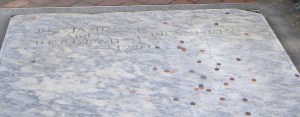
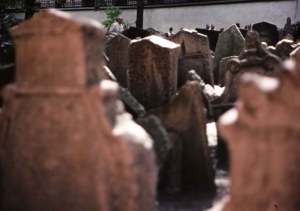 I recalled having seen stones on tombs outside Jerusalem some years back, and I even had a student bring me a stone from Israel to keep as long as I promised to put it on her grave after she died. This practice in its recent form is associated with Judaism, but again, it has ancient roots. The building of cairns, or piles of stones, is often associated with the Celts or the pre-Celtic inhabitants of the British Isles. On our many wandering through the highlands and islands we saw several Neolithic examples in Scotland, particularly in the Orkney Islands. The practice of putting stones atop the dead also goes back to ancient times. One plausible suggestion is that it was intended to keep the dead in their graves. A more prosaic conclusion is that digging deep holes takes more work than hauling over a pile of rocks.
 Steve A. Wiggins