Eastern Canon

It’s complicated.  The Bible, that is.  Tracing its origins as a book can easily occupy a lifetime, but the issue that keeps coming up with Scripture is how, definitively, to close the canon.  If we should.  My research on demons lately has led me once again to the books of Jubilees and 1 Enoch.  The latter has long been popular with the paranormal crowd because it has some weird stuff in it.  Thing is, as I mentioned back in November, these two books are part of the biblical canon of the Ethiopian Orthodox Tewahedo Church.  And the Eritrean Orthodox Tewahedo Church.  That makes these two books by definition “biblical.”  You won’t find them in nearly any printed Bible in the western world, although you can locate them in collections of the Apocrypha and Pseudepigrapha.

This privileging of the western canon has implications.  How do we know what really belongs in the Bible?  Judaism never officially closed its canon, but by consensus the same books contained in the Protestant Hebrew Bible (aka Old Testament) are those recognized.  Early Christian writers had different Bibles.  It took almost four centuries for them to agree  generally on what should be included.  In Europe, that is.  Not all branches of the church were represented in the Council of Rome.  Instead of waiting for the consensus of all—there was an urgency to stomping out heresy—the decision was made.  For some.  Meanwhile other Christian groups continued to use certain books that “the official” closing of the canon left out in the rain.  Or the desert.  Whichever.

The question of just what’s in the Bible goes a bit deeper than that.  The Tewahedo Churches of eastern Africa also recognize the books of 1 and 2 Maccabees.  “So?” did I hear you say, “Catholics recognize them too—what’s the big deal?”  These books, however, in the Ethiopian and Eritrean canons are not the same as western 1 and 2 Maccabees.  The books of the Mäqabeyan contain different content while maintaining the same basic name.  This means that we’re gonna need a bigger canon.  What’s more, these books have been pretty much ignored by biblical scholars.  One of the reasons, no doubt, is that they are written in Geez, a language not on the menu of too many seminaries.  Simply to dismiss them, however, is to ignore the belief system of over 50 million Christians.  It seems that the version of the Good Book tucked under the arm of many an evangelist is the condensed version.  Putting together a canon, it appears, is more complicated than it looks.
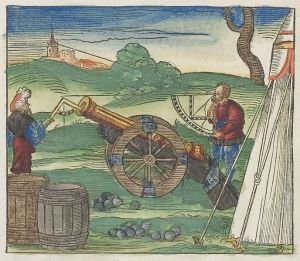
Not that kind of cannon! (Photo credit: Walther Hermann Ryff, via Wikimedia Commons)
Let the Memory

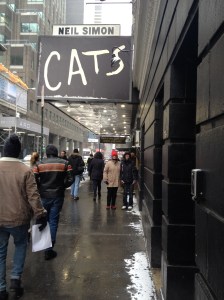
One of the rare and long-anticipated treats of being near New York City is the prospect of a live show. For practical reasons we don’t go to shows very often—years separate the occurrences—but once in a great while we manage to afford such a boon. Yesterday we attended the penultimate performance of the Cats revival on Broadway. The experience was transcendent. I’ve seen the movie version a number of times, and over the years I’ve caught a few live performances here and there. For whatever reason, this musical speaks to me. Although it doesn’t really have much of a plot—it’s more a series of vignettes—it is about redemption and being comfortable in one’s own skin. T. S. Eliot was a poet who knew spirituality intimately. Andrew Lloyd Webber, no one needs me to say, writes stirring music.

Cats, unlike many shows I’ve seen, requires athleticism as well as vocal ability. The performers are in nearly constant motion as they play out their roles, often with acrobatic flourishes. Most of the parts are for the young, while those dwelling on the experience of older characters—Gus, Grizabella, and Old Deuteronomy—tend to be recollections of youth as a commodity that slips away leaving as residue the wisdom that comes with age. It’s quite biblical in that respect. Even the old can appreciate back flips and double cartwheels and the grace of ballet. For this particular production the lighting stood out as an integral part of the story. Illumination, I might add, is a powerful metaphor.

In our family discussions afterwards, comparison with other versions dominated. Although my wife and I saw a community theater production long ago (placing us, I reluctantly suppose, in the ranks of the older characters), our main introduction was through the filmed adaptation. Again, like the Bible, we tend to think of canonical versions. This is how it should go. Because of both its running time and its demands on the players, not all vignettes are included in each production. The character who narrates the story may change. Choreography is adjusted. Each show, as is the case with live theater, is a little different. Standing in the snow on a cold, New York City December afternoon awaiting the opening of the doors, we wondered what would be changed. The original Broadway run had ended while we lived in the Midwest, so this was both our first exposure but also our fourth rendition over the decades. None, it turns out, could be called canonical. That, however, took nothing away from the inspiration of the event unfolding before our very eyes.


Go Down, Moses

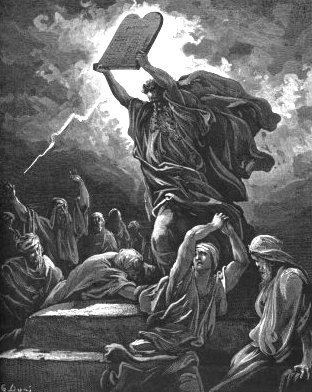
For a time, I tried to write down family tradition. My family was somewhat unusual in that regard. Family saying came generally from my maternal grandparents—my father wasn’t around for my childhood years—and since my grandparents died when I was relatively young, I didn’t hear much of their wisdom firsthand. Still, my mother told me various things her parents used to say and I tried to keep a record. Kind of like I wanted to be an anthropologist for raw folk sayings among the, non-elites. One thing my grandmother used to say, so I was told, was “Where was Moses when the lights went out?” I was always intrigued by this since I supposed it had something to do with Moses the miracle-worker. I guess I imagined Moses waving his rod and the lights coming back on. That single question is all I ever heard of this particular family treasure. I forgot about it until recently, though the miracle of the world-wide web, I learned that the query comes from a song.

Moses gets down

Moses gets down

The song, it turns out, exists in multiple versions. The Library of Congress has a recording dating to 1901 available on the web. According to this version, written by Harry von Tilzer, Moses was not “the” Moses, but a preacher condemning gambling. Also, “lights” is rendered in the singular. So much for the canonicity of family tradition. Duke University library has an undated, but clearly old, version of another song by the same title. This one does reference the biblical Moses, also the name of the song’s narrator. A child afraid in bed at night falls in love with and marries his nurse girl who used to ask him the question “Where was Moses when the light went out?” as he was falling asleep.

Yet another version, dating from 1965, has the question “Where was Moses when the lights (plural) went out?” followed by the answer, “He’s in the dark.” With all of this instant information from the internet, I’m still not certain what was being conveyed by my grandmother with this cryptic question. My mother said she used to say it when someone walked into the room too late to help with something, a kind of sarcastic “Where were you when I needed you?” What is clear is that the song was about as old as my grandmother and she found it somehow appropriate in an unconventional situation. I have to wonder how much of sacred tradition, including the Bible, might have come from misunderstood original instruction. We will, of course, never know. I don’t know what the original lyrics were, but I have learned that even family wisdom has a backstory, like any Scripture, for those who look hard enough.